Pa6–Pa8 - Inverse hyperbolic functions and integrals
Inverse hyperbolic functions undo sinh, cosh and tanh, with a branch restriction where two inputs give the same output. You establish their domains and ranges in Pa6, derive and use their logarithmic forms in Pa7, and recognise the radical integrals in Pa8. Careful sign choices will keep every logarithm and square root real.
Domains, ranges and the arcosh branch
If , why does return ?
Hyperbolic cosine gives the same value at opposite inputs: . An inverse function must return one output, so it cannot return both inputs. We choose the non-negative branch of cosh before inverting it. That choice is part of what arcosh means.
You already know
An inverse reverses a one-to-one function; its domain and range exchange those of the original function. Sinh is increasing from to , tanh is increasing with range , and cosh is even with minimum .
Sinh and tanh already pass the one-to-one test. Cosh does so after restricting its input to . Reflecting each allowed graph in gives its inverse.
[DIAGRAM: asset_name: Inverse hyperbolic functions and their branches; asset_slug: inverse_hyperbolic_graphs; caption: Inversion exchanges the domain and range, and arcosh uses only the non-negative branch of cosh; description: Three equal-scale coordinate panels compare sinh with arsinh, cosh restricted to non-negative inputs with arcosh, and tanh with artanh. Original functions are blue, inverse functions clay and the line y equals x grey dashed. The arcosh panel marks the inverse endpoint 1,0 and omits the negative-input branch of cosh. The artanh panel shows vertical asymptotes x equals minus 1 and x equals 1. Domains and ranges of each inverse are written below its panel.]
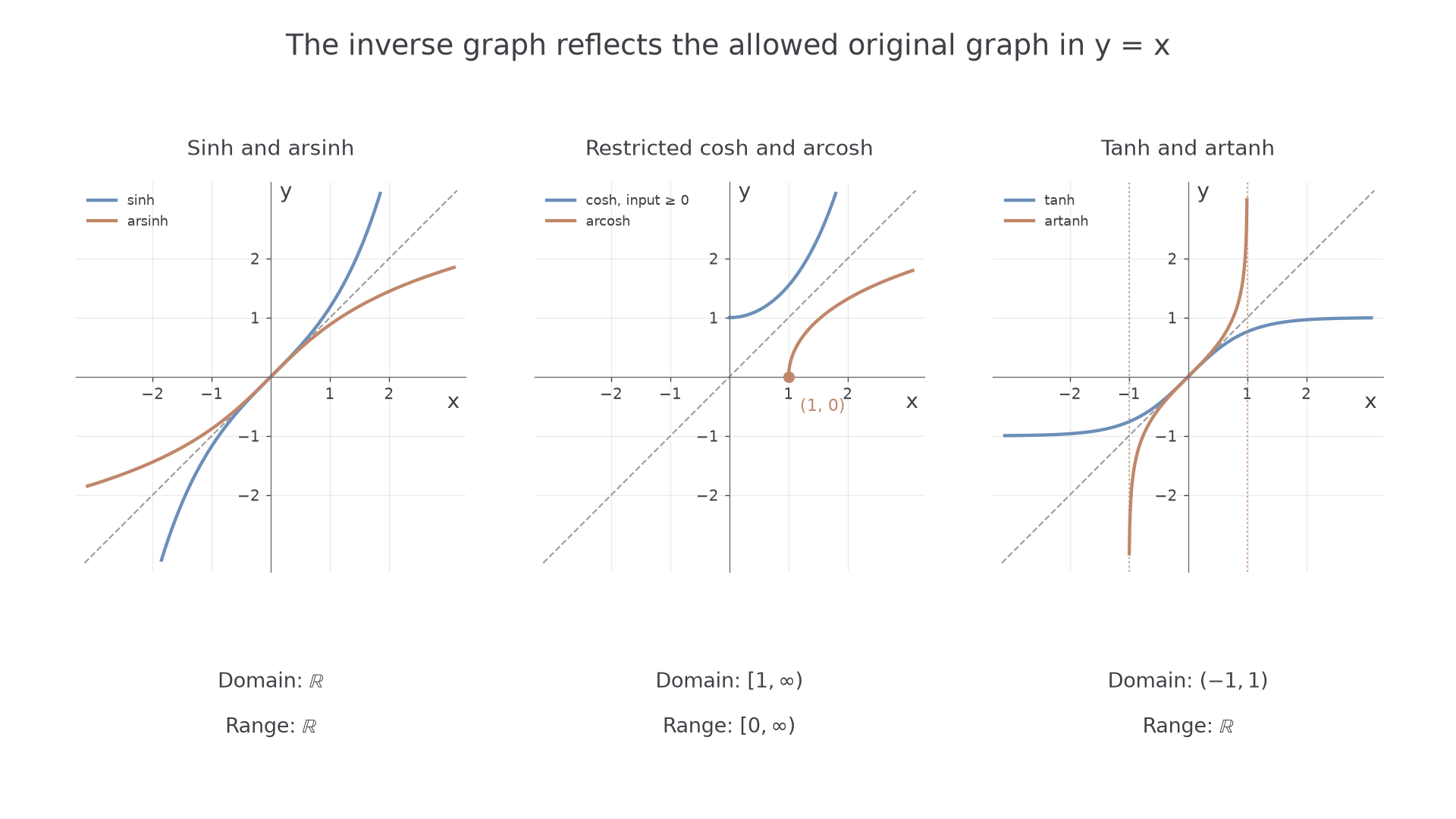
Inverse hyperbolic functions
The definitions, domains and ranges are:
| Function | Defining relation | Domain | Range |
|---|---|---|---|
For example, . Not an example: is not a real number.
The notation is also used for , and similarly for the others. It means an inverse function, rather than the reciprocal . We will use arsinh, arcosh and artanh to keep that distinction visible.
Key idea
is always non-negative. In particular, , whereas for every real .
The chosen branch makes the opening answer . It does not mean that an unrestricted equation involving cosh loses its negative solution.
Deriving and using the arsinh logarithm
The logarithmic form of arsinh comes from solving a quadratic in a positive exponential.
Let . Then
Since , the minus choice is negative for every real , and the plus choice is positive. Thus , and taking logarithms gives the inverse.
Logarithmic form of arsinh
For every real :
The expression inside the logarithm is positive even when .
In the formula booklet.
This is the first part of a useful surprise: the inverse of a hyperbolic function can be written using an ordinary logarithm and a square root. The other two inverses will do the same.
Worked example 1: solving a sinh equation
Question. Determine the exact solution of , giving your answer in logarithmic form.
Plan. Apply arsinh, use its logarithmic form and divide by the inner factor .
Why this step? The inverse returns the whole argument , rather than . That inner factor remains until the final line.
Answer. , the unique real solution.
Check. , and .
The next example changes only the sign of the right-hand side. Its logarithm has an argument between zero and one, producing a negative answer.
Worked example 2: a negative sinh value
Question. Determine the exact solution of , giving your answer in logarithmic form.
Plan. Use the same inverse formula, keeping the positive square root separate from the negative input.
Why this step? The square root is the non-negative square root. Negating it as well would make the logarithm's argument negative and destroy the real solution.
Answer. .
Check. Odd symmetry gives , so the sign is correct.
For large negative inputs the two terms inside the logarithm nearly cancel, but their sum remains positive. Exact simplification avoids mistaking a small positive number for zero.
Watch out
Wrong: . Its logarithm argument is always negative. Right: select , because it equals the positive number .
The next equation changes the inner scale and the negative value. Keep the same positive-root decision.
Deriving arcosh and retaining both cosh solutions
The arcosh derivation has two positive exponential roots, so its branch restriction makes the final choice.
Let , with and . Using , now :
For , the plus root is greater than . The roots have product , so the minus root is between and , corresponding to a negative . Select the plus root because . At , both roots coincide at , giving .
Logarithmic form of arcosh
For :
This is the non-negative inverse value.
In the formula booklet.
Using arcosh to solve an equation requires one extra decision. The function returns the non-negative argument, but the evenness of cosh can give an additional negative argument in the original equation.
Worked example 3: a restricted cosh equation
Question. Solve for , giving the exact answer in logarithmic form.
Plan. Use the non-negative inverse branch and simplify its square root.
Why this step? The restriction agrees exactly with the range of arcosh, so no second solution is allowed.
Answer. .
Check. , and .
The next example changes only the restriction: the input may now be any real number. Restore the negative solution from the cosh graph.
Worked example 4: an unrestricted cosh equation
Question. Solve for real , giving all exact solutions in logarithmic form.
Plan. Find the non-negative argument using arcosh, then use even symmetry.
Why this step? The symbol denotes one branch. Solving the original unrestricted equation is a different task and can require both signs.
Answer. or .
Check. is or ; both give . The cosh graph has exactly these two intersections with the horizontal line.
More generally, has two real arguments if , the single argument if , and no real argument if .
Watch out
Wrong: . An inverse function cannot have two outputs. Right: arcosh itself uses the positive branch; the belongs to the solution of an unrestricted cosh equation.
The next equation also has an inner scale factor. Apply both sign and scale decisions to its whole argument.
Deriving artanh and solving ratios
Hyperbolic tangent leads to a logarithm of a positive ratio, with its domain built into the algebra.
Let , so . Multiply the exponential ratio by , then rearrange:
Both numerator and denominator are positive on . At an endpoint the finite real inverse fails, agreeing with tanh's unattained asymptotes.
Logarithmic form of artanh
For :
Its range is all real numbers.
In the formula booklet.
All three inverse hyperbolic functions have now become logarithms. When a question requests logarithmic form, an inverse-function expression is an intermediate step rather than the finished answer.
Worked example 5: applying artanh directly
Question. Determine the exact solution of , giving the answer in logarithmic form.
Plan. Apply artanh and simplify the ratio before taking its logarithm.
Why this step? Simplifying the inner ratio first prevents a compound fraction from obscuring the exact answer.
Answer. , the unique real solution.
Check. .
The next example changes the way the equation is presented: a linear combination of sinh and cosh must first be turned into a tanh ratio.
Worked example 6: reducing a mixed equation to tanh
Question. Determine the real solution of , giving the exact answer in logarithmic form.
Plan. Divide by the non-zero , then use artanh.
Why this step? Dividing by cosh is always valid for real . It uses the ratio already present in the problem without creating a new quadratic in exponentials.
Answer. .
Check. Here , so . Hence , recovering the original equation after multiplication by .
Before applying artanh, check that the required tanh value lies strictly between and . A value outside that range means that the original real equation has no solution.
Exam tip
When a combination of sinh and cosh gives a tanh value, use the supplied artanh logarithm directly. Show the division, the tanh value and the logarithm. If asked for an exact logarithmic answer, do not stop at a rounded decimal or at artanh.
Continue this lesson.
You’re previewing NovaLearn without an account. Create a free account to read the rest.
Create free account