Mi4–Mi6 - Conservation of momentum in direct impacts
Choose a system and conserve its total momentum when external impulse is zero or negligible. You will state the direct-impact assumptions, calculate velocities when bodies join or separate after a collision, and handle a body dividing into parts using vector components.
Systems, external impulse and direct impact
Two stationary skaters push apart on smooth horizontal ice. How can both start moving if total momentum stays zero?
Their momenta can be equal and opposite. Zero total momentum means the vector sum is zero; it does not mean that each object is stationary. The push supplies opposite internal impulses to the two skaters.
You already know
A body's momentum is , and its change equals the total external impulse on that body. “Internal” and “external” depend on which objects you include in the system.
For a system containing both skaters, the forces they exert on each other are internal. Newton's third law makes their internal impulses equal and opposite, so they cancel when the two momentum changes are added.
Conservation of linear momentum
If the resultant external force on a system is zero, its total momentum is constant:
The equality also holds across an event with zero total external impulse. If external impulse during a short collision is negligible, conservation is an approximation to the model. Apply the vector equation in any chosen direction.
Not in the formula booklet: learn it.
A finite friction force can have negligible impulse over a very short collision because impulse depends on duration. A large collision force between the chosen bodies remains internal; “large” does not make it external.
Direct impact
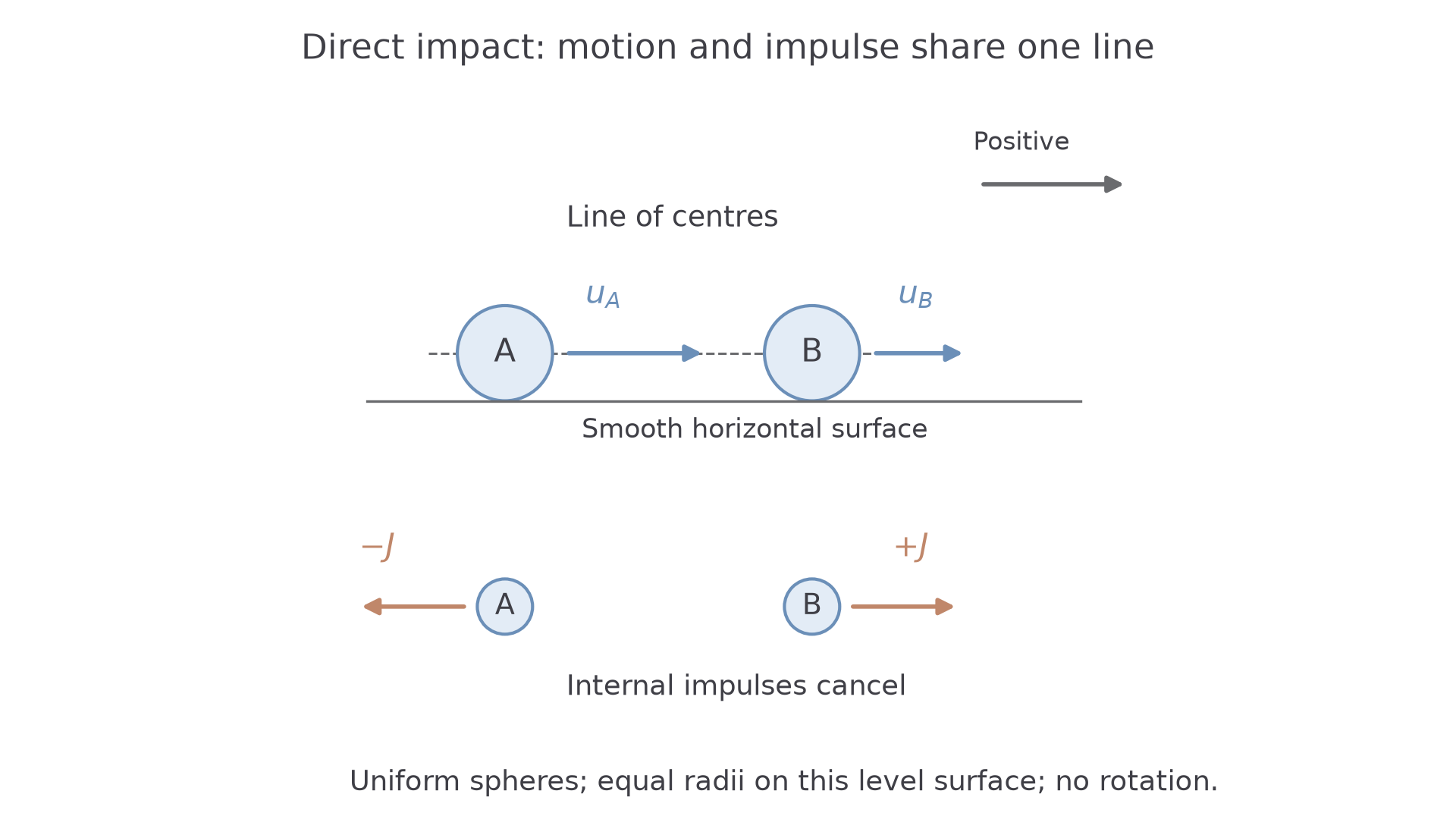
In a direct impact, motion and the collision impulse act along the same straight line. For two bodies with spherical or circular symmetry this is the line joining their centres. For impact with a plane barrier, both the motion and the collision impulse are perpendicular to the barrier.
For particles, all motion and collision impulses are along that one line. For extended bodies, assume they are uniform with spherical or circular symmetry, the impulse acts along their line of centres, and neither body rotates before or after impact. These assumptions give a single point of contact and avoid rotation. Equal radii ensure that the centres of spheres resting on a level surface are at the same height, so a horizontal collision can be direct.
[DIAGRAM: asset_name: Direct impact along the line of centres; asset_slug: direct_impact_model; caption: Motion and collision impulses lie on the line joining the centres; description: Two equal-radius uniform spheres A and B rest on a smooth horizontal surface, with their centres at the same height. A dashed horizontal line joins the centres. Blue incoming velocity arrows run along this line, and equal opposite clay impulse arrows are shown in a separate row. A positive-right arrow fixes the coordinate convention. A note states no rotation.]
A collision with a fixed wall is different for the system consisting of the ball alone: the wall's impulse is external, so the ball's momentum changes. You cannot conserve that ball's momentum through the rebound.
Key idea
Name the system first. Internal impulses cancel in its total momentum equation; an external impulse must be included or justified as negligible.
The following check distinguishes total momentum from each body's momentum and from kinetic energy.
Bodies joining in a collision
When two bodies coalesce, they have one common velocity after impact, so the final momentum is the combined mass times that velocity.
Write a positive-direction arrow before substituting. A body travelling against it has negative velocity, even if its speed is written as a positive number in the question.
Common velocity after coalescence
For two bodies with negligible external impulse during impact,
All velocities use one signed axis. This is momentum conservation with the extra condition .
Not in the formula booklet: learn it.
There is no assumption that kinetic energy is conserved when bodies join. Momentum alone supplies the common velocity.
Worked example 1: joining a stationary body
Question. A truck moves right at and couples to a stationary truck on a horizontal track. Resistance has negligible impulse during coupling. Find their common velocity.
Plan. Take right positive and conserve momentum of both trucks together.
Why this step? The coupling forces act between the trucks, so their impulses cancel for the two-truck system.
Answer. to the right.
Check. The momentum changes are and , equal and opposite.
Change only the initial motion of the second truck: it now approaches from the opposite direction.
Worked example 2: joining an oncoming body
Question. The same trucks couple, but the truck initially moves left at . Find the common velocity.
Plan. Use signed velocity for the second truck in the same system equation.
Why this step? Adding would incorrectly make both initial momenta point right.
Answer. right.
Check. The individual momentum changes are and . The common velocity also lies between the two initial velocities, and .
The sign of the answer determines which initial direction wins. If the initial momenta exactly balance, the combined body is at rest.
Watch out
Wrong: add the two speeds before multiplying by total mass. Right: add the two signed momenta separately. Different masses weight the velocities differently.
Use fresh masses and an oncoming second body.
Continue this lesson.
You’re previewing NovaLearn without an account. Create a free account to read the rest.
Create free account