Pj14–Pj17 - Exponential form and nth roots
Pj14 introduces the compact form . Pj15–Pj17 use it to find every -th root of a non-zero complex number, explain their regular-polygon arrangement, and prove why their sum is zero when .
Writing a complex number in exponential form
How many different numbers have fourth power , and why do they add to zero? Dividing one angle by finds only one of them. The others come from remembering that angles can make whole extra turns.
You already know
A non-zero complex number has modulus-argument form , with . Its principal argument satisfies , and de Moivre multiplies an argument when taking an integer power.
There is a shorter way to write the unit complex number . For example, the point at angle is , so . This is a complex exponential; it need not be a positive real number, unlike for real .
Complex exponential
For a real angle , define
Thus can be written . For example, . In contrast, is real: the in the exponent matters.
The definition gives the memorable identity : the same line contains , , , and . Its explanation here is simply the point at angle , which is . No mysterious cancellation is needed.
Exponential notation and its rules
For real , , , integer , and ,
The definition and these notation rules are not separately supplied; they follow from modulus-argument multiplication and de Moivre.
Not in the formula booklet: learn it.
For conversion, find the modulus and quadrant before writing the exponential. The coefficient outside the exponential must be positive if it is to be the modulus.
Worked example 1: a point in the second quadrant
Question. Express in the form , with and .
Plan. Find the distance from the origin, then use the quadrant to choose the argument.
Why this step? A negative real part and positive imaginary part put the point above and to the left of the origin; the inverse-tangent output alone does not identify that quadrant.
Answer. .
Check. and .
Change only the sign of the imaginary part. The modulus stays the same, while the principal argument reflects in the real axis.
Worked example 2: a conjugate point
Question. Express in the same exponential form with principal argument.
Plan. Retain modulus , then choose the clockwise angle to the third-quadrant point.
Why this step? The positive angle describes the same point, but it lies outside the requested principal range.
Answer. .
Check. .
Writing and writing describe the same number, but are different requested forms. Read the form in the question carefully.
Watch out
Wrong: .
Right: . The wrong expression has positive real part, so checking the quadrant catches it immediately.
Choose the principal argument again, this time for a steeper third-quadrant point.
Finding every nth root
To find the -th roots of a number, solve . If and , then . Matching moduli gives . Matching arguments allows every whole turn: .
For instance, the fourth roots of have modulus , with angles . The extra turns must be included before dividing by .
Nth roots of a non-zero complex number
Let , where , and let be a positive integer. Its distinct -th roots are
Equivalently,
Not in the formula booklet: learn it.
The booklet gives roots of unity, , as a special case; the general non-zero right side above must be constructed. Write the original modulus and argument first, especially under detailed reasoning.
Worked example 3: three cube roots
Question. Determine the cube roots of in exponential form.
Plan. Write , take the positive cube root of the modulus and divide all equivalent arguments by .
Why this step? Adding before division produces distinct roots apart. Adding it afterwards would only rewrite the same root.
Answer. , , .
Check. Cubing gives modulus and arguments , , , all equivalent to . In Cartesian form the roots are , and .
Change only the sign of the given imaginary number. The modulus remains , but the starting argument changes from to .
Worked example 4: a changed starting argument
Question. In this question you must show detailed reasoning. Determine the cube roots of in exponential form.
Plan. Use , then list three argument values before making them principal if desired.
Why this step? Using the negative principal argument is convenient, but not compulsory. Starting with produces the same three roots in a different order.
Answer. , , .
Check. Their Cartesian forms are , and . They are the conjugates of the preceding three roots, and cubing a conjugate conjugates the result.
For a non-zero right side there are distinct roots, not one root with different names. The next part explains why the list stops exactly where it does.
Exam tip
Under detailed reasoning, show the given number's modulus and argument, the root modulus and the complete argument list. A list from a calculator does not show the required method. If exponential form is requested, give , rather than stopping at sines and cosines.
The opening puzzle changes the degree to . Keep the whole-turn term inside the division.
Watch out
Wrong: the cube-root arguments of are . Those angles repeat the same root. Divide the whole argument by : , for .
Count distinct roots after dividing the full angle below.
Why the roots form a regular polygon
The fourth roots just found all lie at distance from the origin. Their arguments increase by , so they are the vertices of a square centred at the origin.
[DIAGRAM: asset_name: The four fourth roots of minus sixteen; asset_slug: h645_b010_fourth_roots; caption: The fourth roots of minus sixteen form a square on the circle of radius 2; description: An equal-scale Argand diagram shows a circle of radius 2 and the four vertices at angles pi over 4, 3 pi over 4, 5 pi over 4 and 7 pi over 4. Cartesian labels show square root 2 plus square root 2 i and its three sign variants. A central arc marks angular spacing pi over 2. A side panel states modulus 2, spacing 2 pi over 4, and fourth powers all equal minus sixteen.]
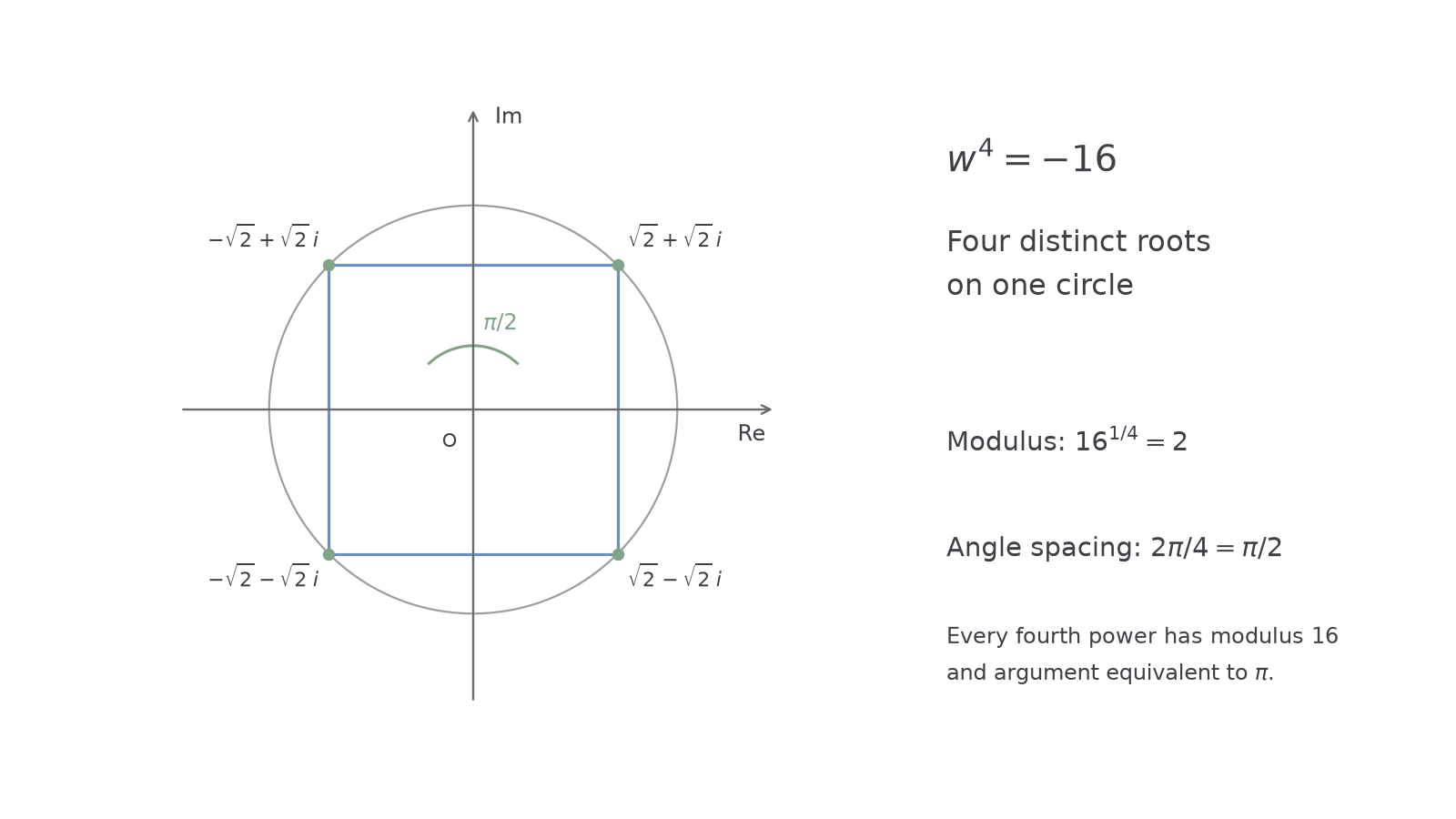
In the general formula, increasing by increases the argument by , while leaving the modulus unchanged. Thus for the roots form a regular -gon centred at the origin. For , they are opposite ends of a diameter; for , there is just the original number.
Why are there exactly distinct values? If , the angle difference lies strictly between and , so the points differ. Increasing by adds a full turn and returns to the same point. Any integer therefore reproduces one of the listed values.
Regular polygon of roots
For , the -th roots of , with , are equally spaced on the circle of radius centred at the origin. Their angular spacing is .
For example, the fourth roots of form a square of circumradius . Four points at arbitrary angles on that circle are not necessarily fourth roots of the same number.
The non-zero condition matters. The equation has only the value ; it is a repeated root algebraically, with no argument or polygon. The equal-spacing result is not in the formula booklet: learn it from the root formula.
Key idea
Taking a root divides the starting argument, but the next root is always further round. The starting number rotates the whole polygon without changing that spacing.
Use this distinction between starting angle and spacing to diagnose a tempting mistake.
Why the roots add to zero
The four roots of have Cartesian forms , , and . Adding them cancels both parts. With an odd number of roots, opposite pairs are unavailable, so we need an argument that works for every .
Let be one root and let . The roots are
This is a finite geometric series, with and when . Hence
For instance, the cube roots of give , despite having no pair of opposite roots.
There is also an algebraic explanation. In , the coefficient of is zero for , so the sum of roots is zero. The geometric-series proof makes the cancellation explicit without needing each root in Cartesian form.
Sum of all nth roots
For , the sum of all distinct -th roots of a non-zero complex number is .
The restriction matters: when , the only root is the original number and its sum need not be zero.
Not in the formula booklet: learn it.
On the diagram, the zero sum says that the position vectors balance at the origin. A regular triangle balances just as a square does; it does not need opposite vertices.
Exam tip
To establish a zero sum, show the geometric fraction and use , or identify the missing coefficient explicitly. “They are symmetrical” alone leaves the key algebra unstated.
The opening puzzle is now complete: four distinct roots sit at the square's vertices, and their position vectors sum to zero. Explain why that conclusion extends to an odd number of roots as well.
Quick Recap
- , so records a modulus and an angle compactly.
- For , take modulus and arguments , for .
- All roots are distinct and equally spaced; for they form a regular polygon centred at the origin.
- For , a geometric series proves that all roots sum to zero. The number and the case need separate treatment.
The fourth roots of are , with the signs chosen independently, and their sum is .