Md11–Md14 - Moments and couples
Md11–Md12 retain the positions of forces on a rigid body so that their turning effects can be modelled. Md13–Md14 introduce couples and calculate moments using perpendicular distances or resolved force components, including the effect of a given couple.
Force positions matter for a rigid body
Can forces add to zero and still turn an object? Put one upward force near the left end of a ruler and an equal downward force near the right end. Their vector sum is zero, but both tend to turn the ruler clockwise. The particle model has thrown away exactly the information we now need: where each force acts.
You already know
A particle's equilibrium is decided by its force resultant. A force diagram contains forces on one selected body, including weight, tensions and contact forces. A smooth contact has no frictional component.
A rigid body is modelled as keeping its shape: distances between its points remain fixed. Its size and the lines of action of its forces are retained. A force applied at a door hinge and the same force applied at its outer edge do not have the same turning effect.
Line of action
The line of action of a force is the straight line through its point of application in its direction. For turning calculations, moving a force along its own line of action leaves its moment unchanged. Moving it to a parallel line generally changes the moment.
For example, a vertical force anywhere on one fixed vertical line has the same perpendicular distance from a chosen pivot. A force on a different vertical line need not.
Place forces at the appropriate contact or attachment points. For a uniform rod, weight acts through its midpoint by symmetry; for a non-uniform body, use the stated centre of mass. A string pulls along its length. A smooth wall's reaction is perpendicular to the wall, whereas a smooth peg touching a rod exerts a force perpendicular to the rod at the contact.
[DIAGRAM: asset_name: Forces on a rigid rod against a smooth wall; asset_slug: h645_b058_rod_forces; caption: A rigid-body force diagram records the contact points and the centre of mass; description: A uniform inclined rod leans from rough horizontal ground at A to a smooth vertical wall at B. Its weight W acts vertically down at the midpoint G. At A the normal reaction acts up and friction acts towards the wall. At B the wall reaction acts horizontally away from the wall. The wall is labelled smooth and the ground rough.]
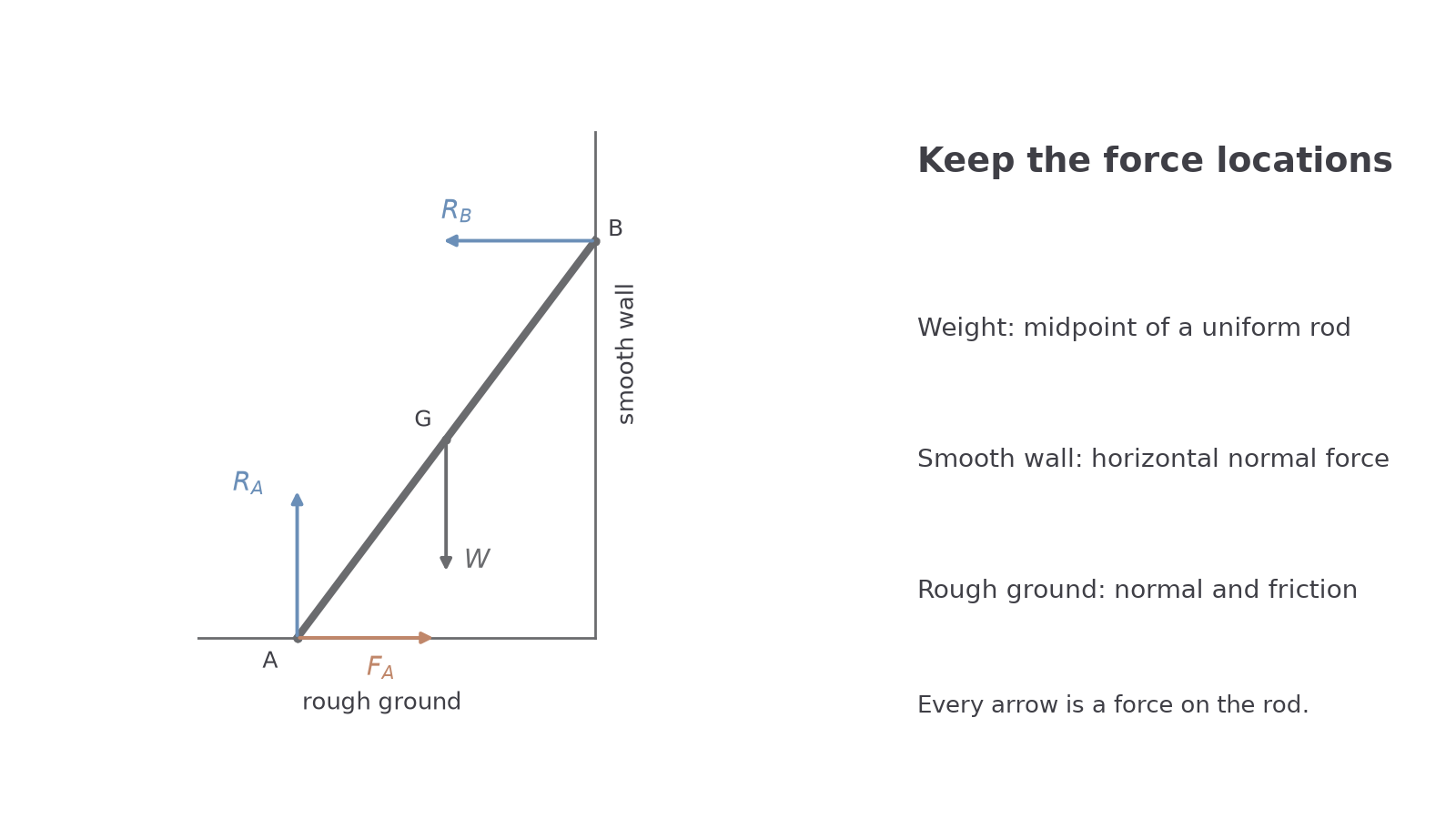
The diagram does not replace the body by a single dot: the force locations will determine their moments. Do not add as an extra force; acceleration belongs in Newton's equation when motion is considered.
Key idea
A rigid-body force diagram must preserve both the force directions and their lines of action. Correct magnitudes alone do not determine turning effects.
Use the contact description, rather than the rod's inclination, to identify a wall reaction.
Moment is force times perpendicular distance
The moment of a force about an axis measures its turning effect about that axis. For forces in a plane, take the fixed axis perpendicular to the plane through a labelled point, such as a pivot .
If the force's line of action passes through , its moment is zero, however large the force. Otherwise the relevant distance is the shortest distance from to that line, not necessarily the distance to the point where the force is applied.
Moment of a force
For force magnitude and perpendicular distance from the axis to its line of action,
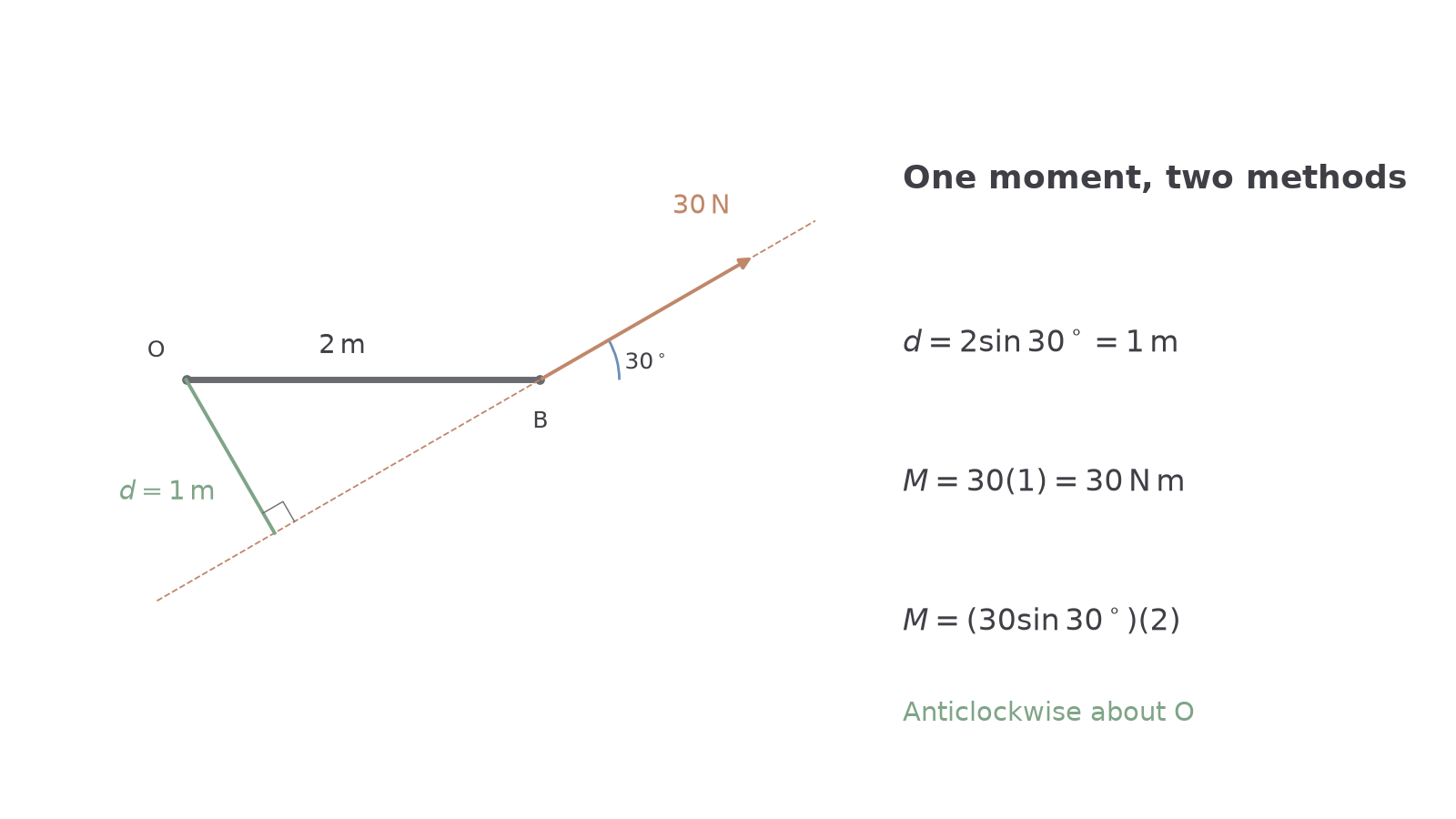
If the force is applied a distance from the pivot and makes angle with that position line, then . State whether the force turns clockwise or anticlockwise. Moments have units .
Not in the formula booklet: learn it.
Alternatively, resolve the force and add the moments of its components. A component along the position line has zero moment; the perpendicular component supplies the turning effect. Choose a positive turning sense before adding signed moments.
[DIAGRAM: asset_name: Perpendicular distance and a resolved moment; asset_slug: h645_b058_moment; caption: The same moment comes from the full force and perpendicular distance or from the perpendicular component and rod length; description: A horizontal rod extends two metres from pivot O to B. At B a force of 30 N points 30 degrees above the rod. Its line of action is extended as a dashed line, with a perpendicular from O to that line labelled d equals two sin thirty degrees equals one metre. A separate panel states moment equals thirty times one equals thirty newton metres anticlockwise and also thirty sin thirty degrees times two.]
Worked example 1: an oblique force
Question. A force of acts at the end of a horizontal rod of length , directed above the rod away from . Find its moment about .
Plan. Find the perpendicular distance from to the force's line, then multiply by the force.
Why this step? The full is not perpendicular to the force. Using would overstate its turning effect.
Answer. anticlockwise.
Check. Resolve at : the vertical component is , giving . The horizontal component passes through and contributes zero.
Change only the force angle to . The more nearly perpendicular force has a larger turning effect.
Continue this lesson.
You’re previewing NovaLearn without an account. Create a free account to read the rest.
Create free account