MG5 - Centre of mass and equilibrium
The centre of mass tells you where a body's weight acts when calculating moments. You will use it to find a suspended body's orientation, test whether supports can hold a horizontal body, and decide whether an inclined body first slides or topples.
A freely suspended body settles below its support
Can turning the same prism around on a slope change its first failure from toppling to sliding? The key is where its centre of mass lies relative to its supports. Begin with the simpler situation of a body hanging freely from one point.
You already know
Rigid-body equilibrium requires zero resultant force and zero resultant moment. A body's weight may be taken to act through its centre of mass . The centre of a composite body comes from mass-weighted part centres.
Suppose a body hangs from a light vertical wire attached at , with no other applied force apart from gravity. Tension acts through , so weight must also have zero moment about : its vertical line must pass through .
Stable suspension from one point
For a rigid body freely suspended at , under its weight and the supporting tension alone, stable hanging equilibrium places vertically below . The body-fixed direction therefore becomes the downward vertical.
Not in the formula booklet: learn it.
To find an orientation, recall the scalar-product angle formula, which is not in the formula booklet and must be learned. For a non-zero body-fixed vector , its angle with downward vertical satisfies
provided .
The point directly above also gives zero weight moment, but that inverted position is unstable: a small displacement lets the weight turn the body away. The usual freely hanging position has below . If , weight gives no preferred orientation, and the vector-angle formula above cannot be used.
[DIAGRAM: asset_name: Suspension turns PG into the vertical; asset_slug: h645_b068_suspension; caption: Body coordinates identify PG before the body turns and stable suspension makes that direction vertical; description: A triangular lamina with vertices P zero zero, A six zero and B zero three has G two one marked. A second drawing shows the same triangle rotated so PG points vertically down. The angle between PA and downward vertical is labelled theta, with tangent theta equals one half.]
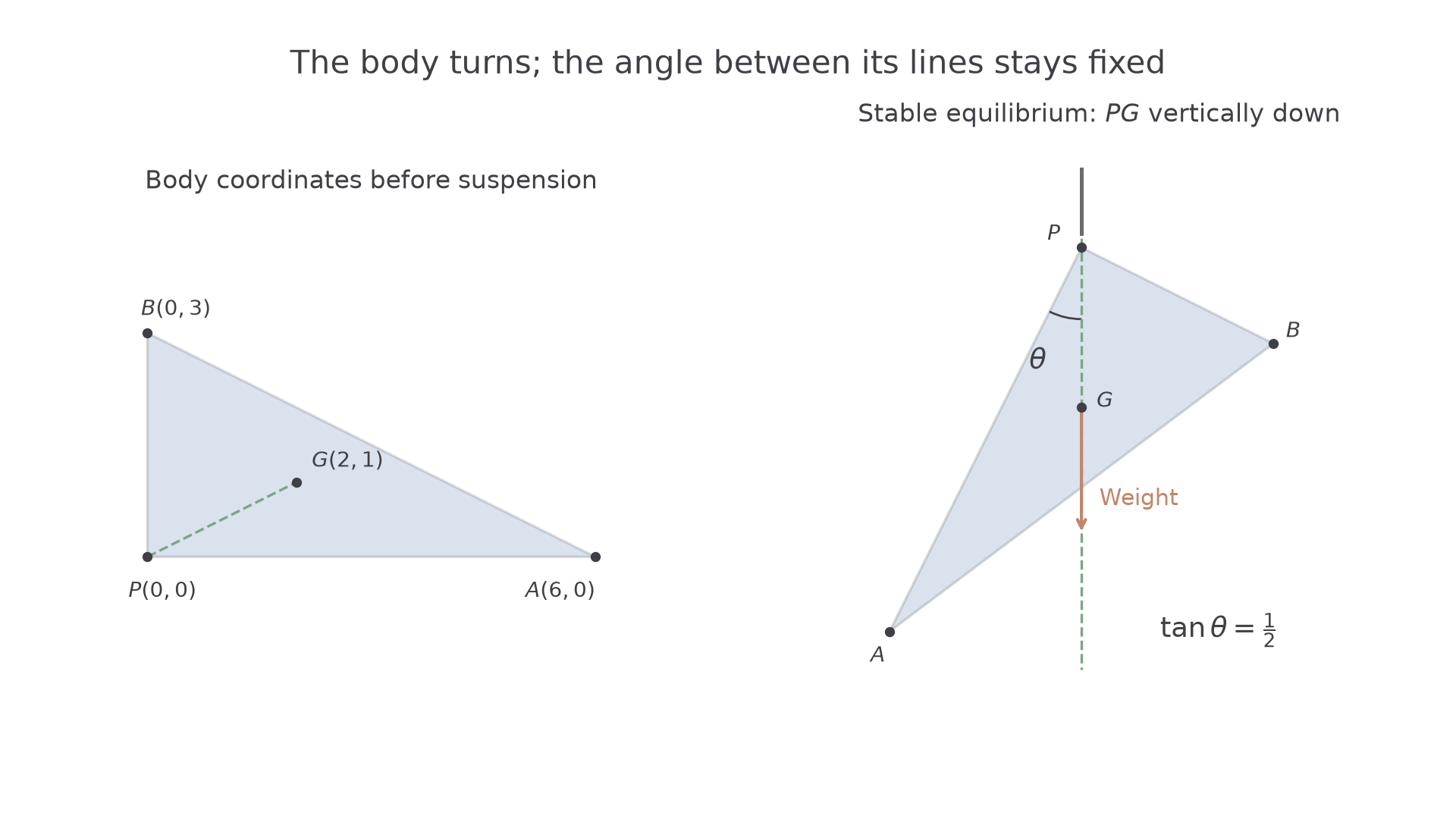
Worked example 1: a triangular sign
Question. A uniform triangular lamina has vertices , , , in centimetres. It hangs freely from in stable equilibrium. Find the angle that the direction makes with the downward vertical.
Plan. Find , then calculate the angle between and in the original body coordinates.
Why this step? The lamina rotates, but angles between its own lines do not change. There is no need to find its new coordinates.
Answer. The direction makes with the downward vertical.
Check. The scalar product gives , giving the same angle.
Keep the same horizontal projection of , but add a third coordinate. This changes the spatial angle to the chosen edge.
Worked example 2: a suspended spatial frame
Question. In body-fixed coordinates, a rigid frame has suspension point , point , and centre of mass . It hangs freely from in stable equilibrium. Find the angle between and the downward vertical.
Plan. Use the spatial angle between and .
Why this step? The distance perpendicular to involves both the - and -offsets. The planar calculation would discard part of the geometry.
Answer. The angle is .
Check. The perpendicular distance from to is , so , consistent with .
The direction of the question matters. An angle with the horizontal is complementary to an acute angle with the vertical in a vertical plane; it is not the same angle.
Watch out
Draw the weight line through and the support point. For stable free suspension, follow towards to identify downward vertical; reversing that vector gives the supplementary angle.
Retain the frame's horizontal projection while changing its third coordinate again.
A horizontal body's weight must fall within its supports
A body resting on supports underneath it needs non-negative upward reactions. If a calculation requires a support to pull down, that assumed contact cannot hold. This gives a geometric test: with gravity and upward vertical support reactions only, the vertical projection of must lie in the region spanned by the supporting contact points.
For two point supports that region is their line segment. For three non-collinear point supports it is their triangle, including its boundary for limiting equilibrium. With a broad base it is the supporting footprint. On a boundary, a reaction may be zero and toppling may be impending.
Vertical reactions at horizontal support points
Use horizontal plan coordinates for supports and for the projection of . For weight and upward reactions ,
The last two equations are moment balances about two perpendicular horizontal axes. Every contact retained in the model must have .
Not in the formula booklet: learn it.
Dividing these equations by writes the projection of as an average of the support points, with non-negative weights adding to . This explains the support-region test rather than merely memorising it.
[DIAGRAM: asset_name: Three supports seen from above; asset_slug: h645_b068_supports; caption: The drawing is a horizontal plan; the reactions act vertically out of it; description: In a horizontal plan, B is zero six, C is six six and D is d zero, with G at three two. The support triangle is shaded. A separate plan shows the limiting D positions one point five zero and four point five zero, with the corresponding boundary lines through G.]
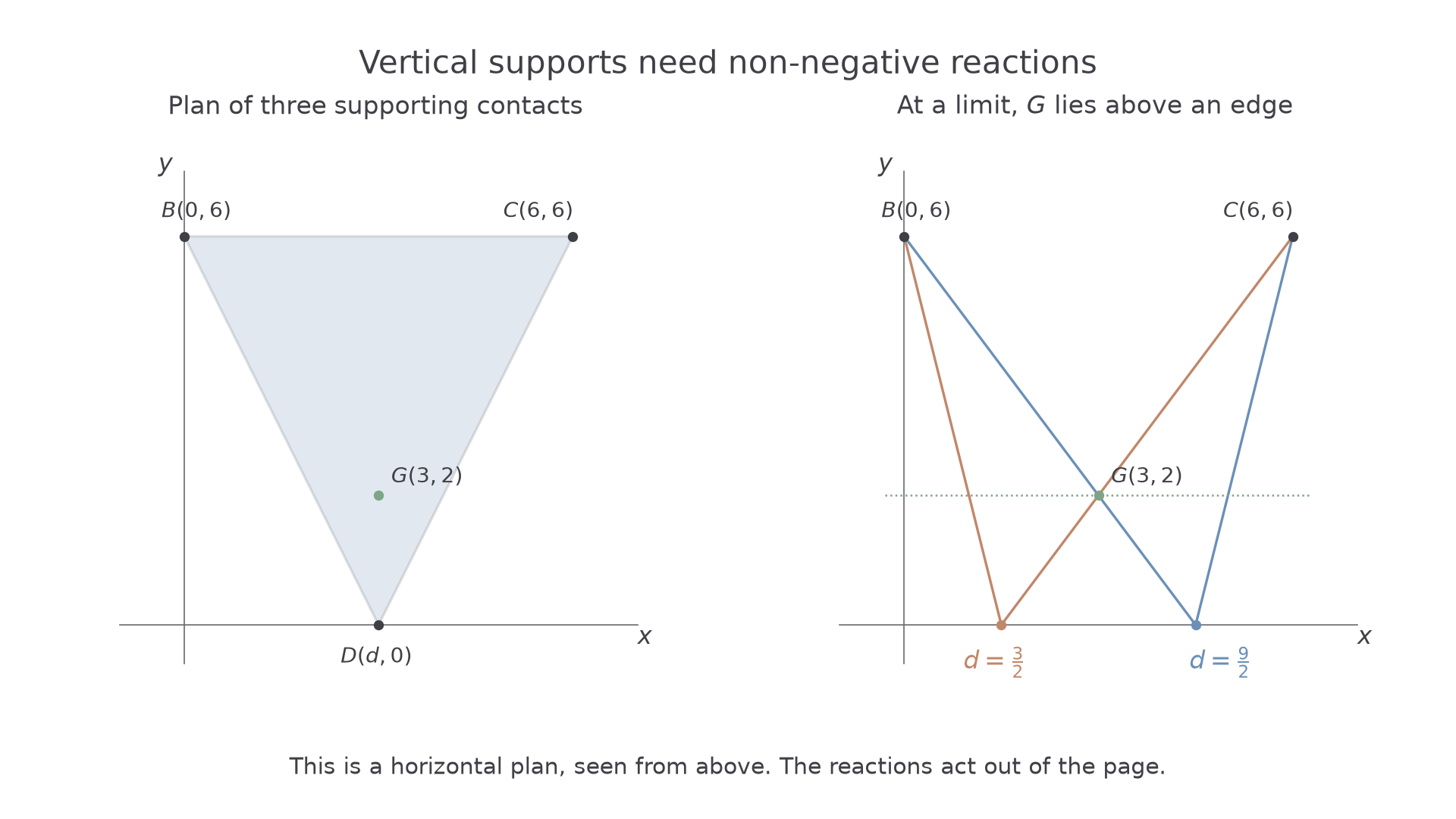
Worked example 3: three vertical reactions
Question. A horizontal rigid lamina of weight has centre of mass whose projection is . It rests on supports at , , , with coordinates in centimetres. Find the reactions.
Plan. Balance vertical forces and take moments about the horizontal - and -axes.
Why this step? The plan coordinates are perpendicular lever arms for vertical forces. Treating the plan as a vertical drawing would assign the wrong directions to the reactions.
Answer. .
Check. The reactions sum to , are all positive, and give both required moments: and .
Move only , to . Its share of the load remains fixed by the -balance, but the other two shares must change.
Continue this lesson.
You’re previewing NovaLearn without an account. Create a free account to read the rest.
Create free account