Mv11, Mv12 - Modelling with simple harmonic motion
Turn restoring-force equations into simple harmonic motion about the correct equilibrium. You will apply the Core Pure solution to springs and a small-angle pendulum, use the speed–displacement relation, and stop an SHM model when a string goes slack or contact is lost.
Equilibrium is the centre of the oscillation
A box rides on a platform moving up and down. Can the platform lose the box before it reaches the top?
Yes, if maintaining contact would require the platform to pull the box downwards. We will find the precise boundary after building the restoring-force models.
You already know
Core Pure gives the solution of : . Its amplitude is and its period is . Hooke's law gives spring stiffness .
A physical coordinate need not be zero at equilibrium. If the force vanishes at , subtract before recognising SHM. Adding a constant does not change either time derivative.
Shifted SHM and speed
If , set . Then
Here is amplitude about equilibrium, and the speed relation applies only while this SHM equation is physically valid.
Not in the formula booklet: learn it.
To see the speed relation, write , differentiate, and use . At equilibrium speed is ; at either extreme it is zero.
Worked example 1: one horizontal spring
Question. A particle on a smooth horizontal line is attached to an ideal spring of stiffness . Its equilibrium coordinate is . Released from rest at , find its motion and period.
Plan. Form the restoring-force equation, shift to equilibrium displacement and quote the SHM solution.
Why this step? The acceleration points towards , not towards the coordinate origin.
Answer. , period , within the spring's linear range.
Check. At release, force is and acceleration is , matching .
Add only a second identical spring on the opposite side, with the same equilibrium point. One extends as the other compresses, and both forces restore.
Worked example 2: two restoring springs
Question. The particle is now attached between two ideal springs, each of stiffness , both at natural length at . It is released from . Find its motion and period, assuming the needed compression is possible.
Plan. Add both restoring forces before dividing by the mass.
Why this step? The forces add; the mass is still . A compressed spring pushes in the restoring direction.
Answer. , with period .
Check. Maximum speed changes from to , consistent with the increased angular frequency.
This is an ideal linear-spring model: no buckling, coils meeting or force-law failure is allowed within the stated motion.
Watch out
Wrong: identify as SHM about . Right: its equilibrium is ; the SHM displacement is .
Use a new equilibrium and mass.
Vertical motion and a slack string
Gravity shifts the equilibrium of a vertical elastic system, but cancels from the restoring equation measured about that equilibrium.
Let be downward distance from the fixed point, natural length, and stiffness. At equilibrium, extension is , so . With ,
For a spring this can hold on both sides of natural length. For a string it holds only while the string is taut.
[DIAGRAM: asset_name: Equilibrium and the slack-string boundary; asset_slug: vertical_string_shm_boundary; caption: SHM applies only while the string can supply positive tension; description: A vertical downward coordinate shows natural length 1 metre, equilibrium length 1.2 metres and release length 1.5 metres. The displacement x is measured from equilibrium. A marked boundary x=-0.2 corresponds to zero extension and zero tension; above it the string is slack and only gravity acts.]
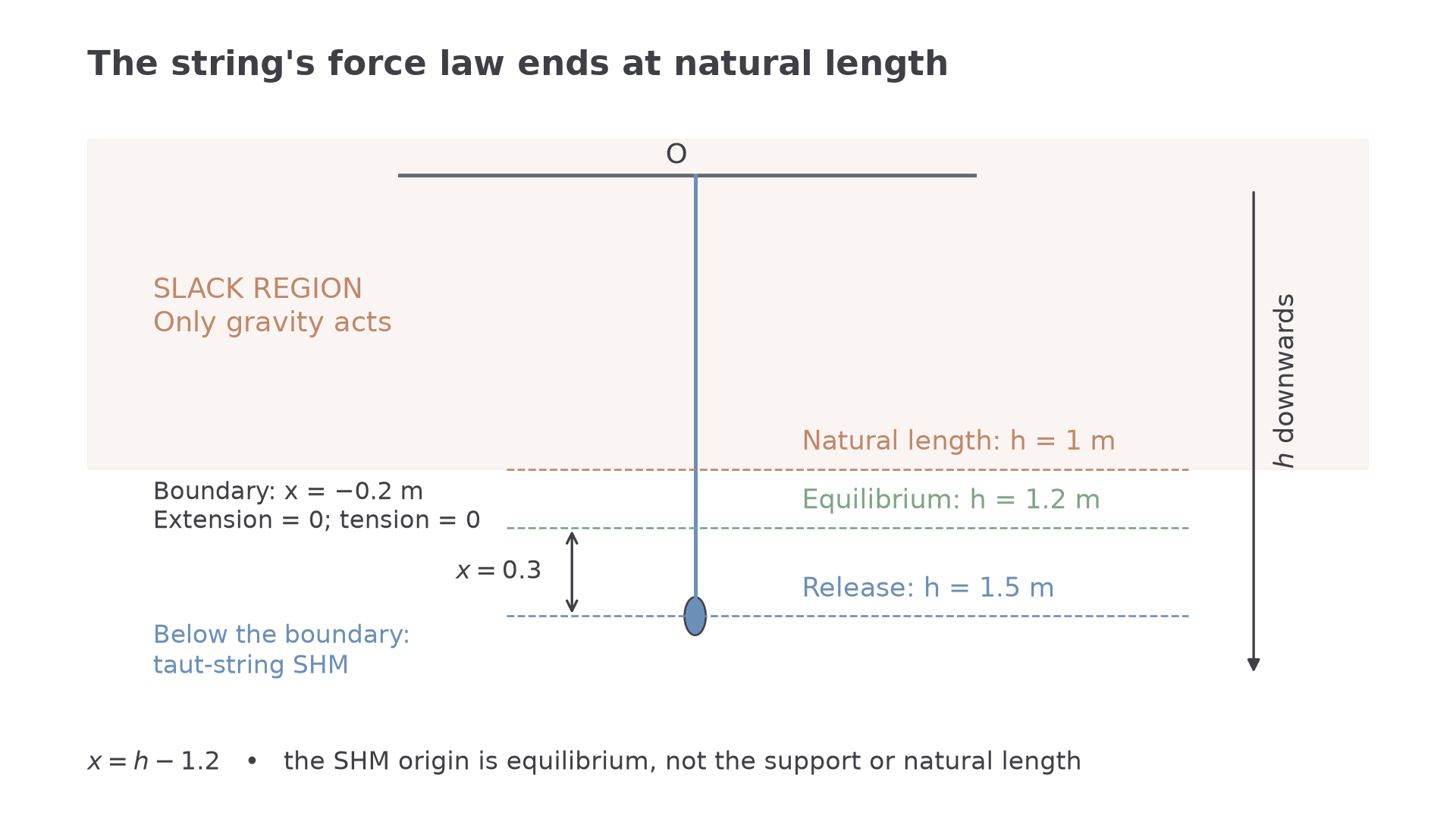
Taut-string SHM domain
For a vertical string with positive tension,
At , tension is zero. If motion carries the particle farther upwards, the string is slack and the acceleration is gravity alone, not the SHM continuation.
Not in the formula booklet: learn it.
This is why finding an SHM amplitude is not always the end of the mechanics. Check whether the predicted cycle stays within the force model.
Worked example 3: a complete taut cycle
Question. A particle hangs from an elastic string of natural length and stiffness . It is released from rest below the fixed point. Determine whether it remains taut, and find its greatest speed.
Plan. Find equilibrium, identify the amplitude and compare the upper extreme with natural length.
Why this step? Compare the actual length with natural length, not displacement with zero.
Answer. The string stays taut; greatest speed is .
Check. Minimum extension is , so minimum tension is .
Change only the release length to . The predicted amplitude now crosses the slack boundary.
Worked example 4: SHM followed by free flight
Question. With the same string and mass, release the particle from rest below the fixed point. Find its least distance from that point.
Plan. Use SHM only until tension vanishes, then use vertical free motion to the upper turning point.
Why this step? A string cannot supply the compressive force that the continued SHM equation would demand above natural length.
Answer. Least distance .
Check. The naive full-SHM prediction differs because the force law changes before that point.
Gravity has disappeared from the taut restoring coefficient , yet it still sets the equilibrium and the boundary where this SHM model ends. That distinction is often the decisive step.
Watch out
Wrong: continue a taut-string sinusoid through negative extension. Right: switch to free motion when the string becomes slack, and use the velocity at that transition as the next initial condition.
A different release length changes the transition speed.
Continue this lesson.
You’re previewing NovaLearn without an account. Create a free account to read the rest.
Create free account