Ps1 - The method of differences
Add a series by making most of its terms cancel. You will recognise consecutive differences, keep the correct boundary terms when the index gap changes, and find sums to infinity by taking the limit of a finite partial sum.
Consecutive differences cancel
Can be found by writing just two squares?
Each odd number is the difference between consecutive squares:
Adding the differences cancels the intermediate squares. Only the last positive square and first negative square survive.
You already know
A finite series is a sum of terms. In , is the upper index, not a variable appearing in every individual term. Keep the limits when splitting a summation.
Here the expansion supplies the cancellation. A square-sum formula would also work after expansion, but would hide the much shorter route.
Telescoping
A telescoping sum is one in which writing the terms as differences makes intermediate contributions cancel, leaving boundary terms. For example, . A sum does not telescope merely because its terms look similar.
Write enough terms to show which positive and negative contributions match. The general identity records that cancellation.
Consecutive-difference sum
For integers ,
Reversing every difference reverses the answer's sign.
Not in the formula booklet: learn it.
The two boundary indices come from the first negative term and the last positive term, not from guesswork.
Worked example 1: a sum of odd numbers
Question. Use differences to find .
Plan. Replace each term by , then cancel consecutive squares.
Why this step? The last positive square is , although the summation stops at index .
Answer. .
Check. At , .
Now change only the first index from to . The last boundary stays fixed while the first changes.
Worked example 2: a different starting index
Question. For , find by differences.
Plan. Start the difference list at and retain its first negative square.
Why this step? The removed boundary is , not , because the first difference is indexed by .
Answer. .
Check. At , .
The opening sum ends at , so it is . A hundred additions have collapsed to two squares.
Watch out
Wrong: cancel by similarity without checking signs and indices. Right: a contribution disappears only when the identical expression occurs with the opposite sign.
Change the lower boundary again in the matched question.
Cancellation across wider gaps
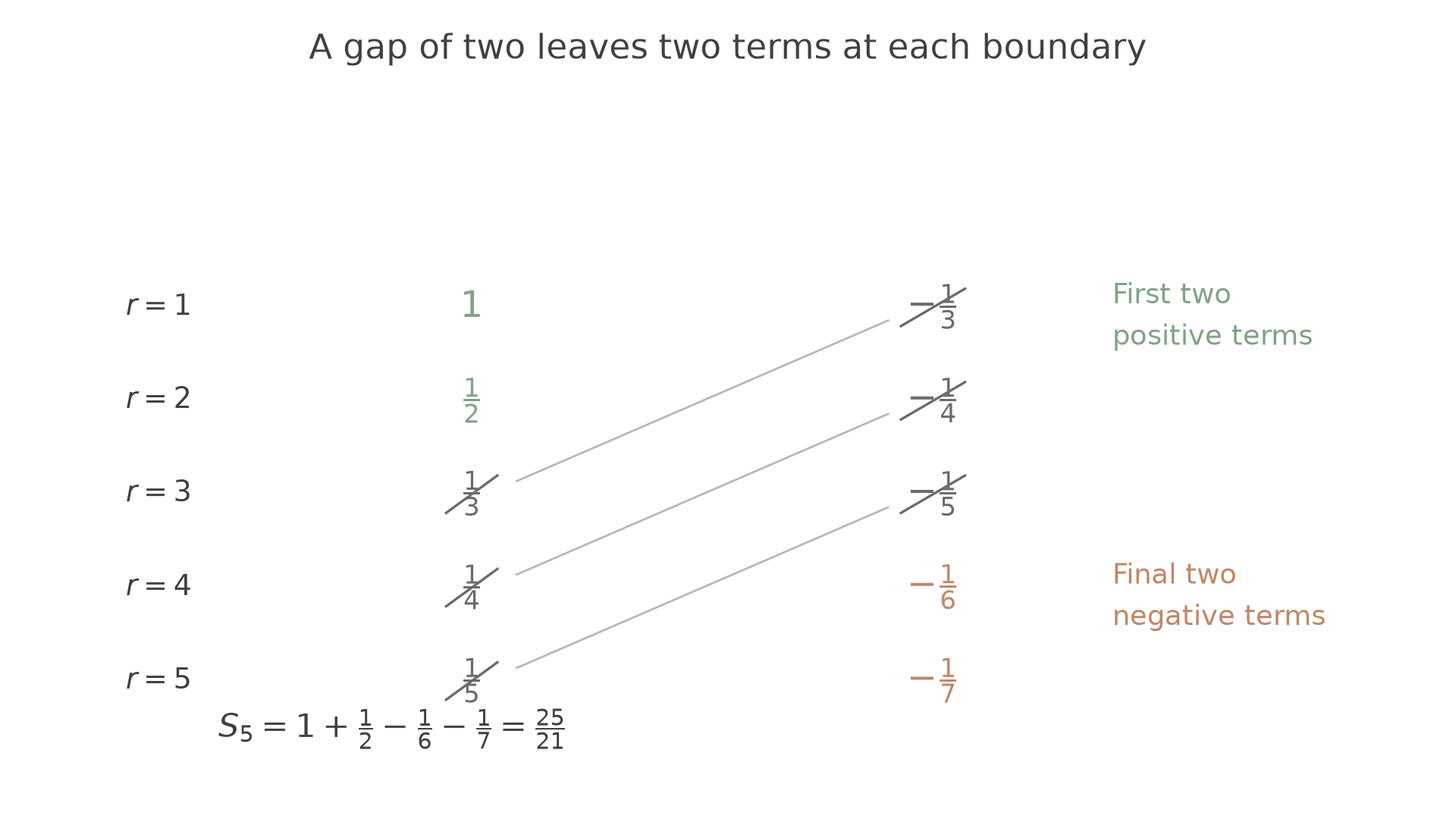
An index gap of two leaves two terms at each end; a gap of three leaves three. The interior still cancels, but a one-term boundary shortcut no longer works.
For , the negative term at index matches a positive term two rows later. The first two positive terms have no earlier partners, and the last two negative terms have no later partners.
[DIAGRAM: asset_name: Cancellation with an index gap of two; asset_slug: differences_gap_two; caption: The first two positive terms and final two negative terms survive; description: Rows for indices 1 through 5 display 1/r minus 1/(r+2). Matching interior fractions are crossed out with diagonal guide lines, leaving positive 1 and 1/2 and negative 1/6 and 1/7 for the finite example n=5.]
A gap of k
For positive integer and integer ,
Writing the actual first and last terms is safer than memorising a separate expression for each gap.
Not in the formula booklet: learn it.
At small , the written end groups can overlap and cancel further. The restriction keeps this diagram's two end groups separate.
Worked example 3: a gap of two
Question. For , find .
Plan. Show the first two rows and last two negative fractions, then cancel the interior.
Why this step? The fraction appears negatively in the penultimate row but never positively within the sum.
Answer. .
Check. At , .
Change just the gap from two to three. A third survivor appears at each end.
Worked example 4: a gap of three
Question. For , find .
Plan. Keep the first three positive fractions and the final three negative fractions.
Why this step? The gap, not the number of printed rows, determines how many unmatched fractions remain.
Answer. .
Check. At , the direct sum is , as the formula gives.
This is where a generous cancellation line earns its space: the surviving fractions can be seen, rather than asserted.
Watch out
Wrong for gap three: . Right: retain three fractions at each end. The missing and have no cancelling partners.
Keep the gap of three and change the first index to .
From a finite sum to a sum to infinity
A sum to infinity is the limit of its finite partial sums, so telescope first and take the limit afterwards.
Convergent series
A series converges to when its partial sums approach the finite number as . The terms form a sequence; their running totals form a different sequence.
For example, the terms become small, but that observation alone does not calculate their sum. A formula for tells you where the total is heading.
Worked example 5: infinitely many positive differences
Question. Find .
Plan. Find the finite sum by cancellation and then let its upper index increase without bound.
Why this step? Cancellation is performed on a finite expression, so no subtraction of divergent infinite sums is involved.
Answer. The sum to infinity is .
Check. At , ; all later terms are positive, so approaching from below is sensible.
Change only the reciprocal to a reciprocal square. The boundary term now tends to zero faster.
Worked example 6: squared denominators
Question. Find .
Plan. Telescope the finite differences, then take the limit of the remaining boundary.
Why this step? The whole sum is determined by the surviving boundary, not by an individual term's limit.
Answer. The sum to infinity is again .
Check. At , , closer to the same limit than the previous example.
Here is the surprise: two different lists of positive terms have the same total, but reach it at different speeds. Neither needs to be geometric. These particular sums and the telescoping method are not in the formula booklet.
Watch out
Wrong: each term tends to zero, therefore the sum is zero. Right: take the limit of , the running total. In both examples the terms tend to zero while the sums tend to .
The final question changes the reciprocal power and the first boundary.
Quick Recap
- Write a summand as a difference and show which terms cancel.
- A gap of leaves terms at each end before any further simplification.
- Changing the lower index changes the first surviving boundary.
- A sum to infinity is a limit of partial sums, not of individual terms.
The opening odd-number sum is .