Mr5–Mr8 - Varying speed and vertical circles
A changing speed adds tangential acceleration to the inward radial component. Mr5 and Mr6 separate those jobs; Mr7 combines forces and energy in vertical circles; Mr8 checks when a string or surface can no longer maintain the circle and follows the motion after departure.
Turning and speeding up are different components
Can a particle leave a circular path while it still has plenty of speed? Yes. Its speed may be large enough to keep moving, yet the string or surface may be unable to supply the force that would keep it on that particular circle.
First separate changes of direction from changes of speed. A particle on a radius circle with angular position has : its speed increases, so its acceleration cannot be wholly radial.
You already know
For fixed radius, and the inward acceleration is . Energy conservation connects speed to vertical height when gravity is the only force doing work. Use .
Choose the positive tangent to match increasing . Differentiating the signed tangential velocity gives . This component changes the speed; the perpendicular inward component changes the velocity's direction.
Acceleration on a fixed circle
With in radians and the positive tangent in the sense of increasing ,
The inward component is non-negative, while the tangential component is signed.
In the formula booklet.
Newton's second law applies separately in those perpendicular directions:
The acceleration magnitude is . These force and component-combination equations are not in the formula booklet: learn them. When , the whole acceleration does not point at the centre.
Worked example 1: a prescribed angular position
Question. A particle follows a horizontal circle of radius . Its angular position is radians, with in seconds. At , find the radial and tangential acceleration components, the magnitude of acceleration and the corresponding horizontal resultant-force components.
Plan. Differentiate twice, then use each derivative in its own component formula.
Why this step? The first derivative is squared for radial acceleration; the second derivative is used directly for tangential acceleration. They describe different changes of velocity.
Answer. Acceleration components inward and along increasing ; magnitude . Resultant-force components are inward and tangentially.
Check. , so . At , .
Change only the angular-position law to . The angular acceleration doubles, but the radial acceleration at the same time quadruples.
Worked example 2: the two components scale differently
Question. For the same particle and circle, let . Find the same quantities at .
Plan. Differentiate the new angular law and retain the distinction between and .
Why this step? Squaring , or omitting the square on , confuses changing speed with changing direction.
Answer. Acceleration components inward and along increasing , with magnitude . The force components are and , respectively.
Check. , so at , and , reproducing both components.
The force components describe the resultant of actual interactions. A radial guide force cannot, by itself, produce the changing speed in these examples; a tangential force is needed too.
Watch out
Wrong: call “the acceleration” when the speed is changing. Right: it is the inward component. Find the tangential component as well before giving a magnitude or a direction.
The angular law now changes its coefficient once more.
Energy gives speed; force equations give acceleration and contact
For a fixed smooth vertical circle, weight changes the speed while the radial constraint turns the velocity. The constraint force does no work because it is perpendicular to the motion.
Measure from the downward vertical, increasing as the particle rises on the right-hand side. Its height above the lowest point is . The inward direction is towards the centre; the positive tangent points in the sense of increasing .
[DIAGRAM: asset_name: Forces in vertical circular motion and surface contact; asset_slug: h645_b073_constraints; caption: Fix the angle convention before resolving; an interior surface pushes inward while an exterior surface pushes outward; description: The left panel shows a particle on the lower right of a vertical circle, angle theta measured from downward vertical, height r times one minus cos theta, weight down and interior reaction inward. A small tangent arrow points up-right. The right panel shows a particle on the upper exterior of a sphere, angle phi measured from upward vertical, reaction outward, weight down and a downward-right tangent velocity. Each panel names its angle convention explicitly.]
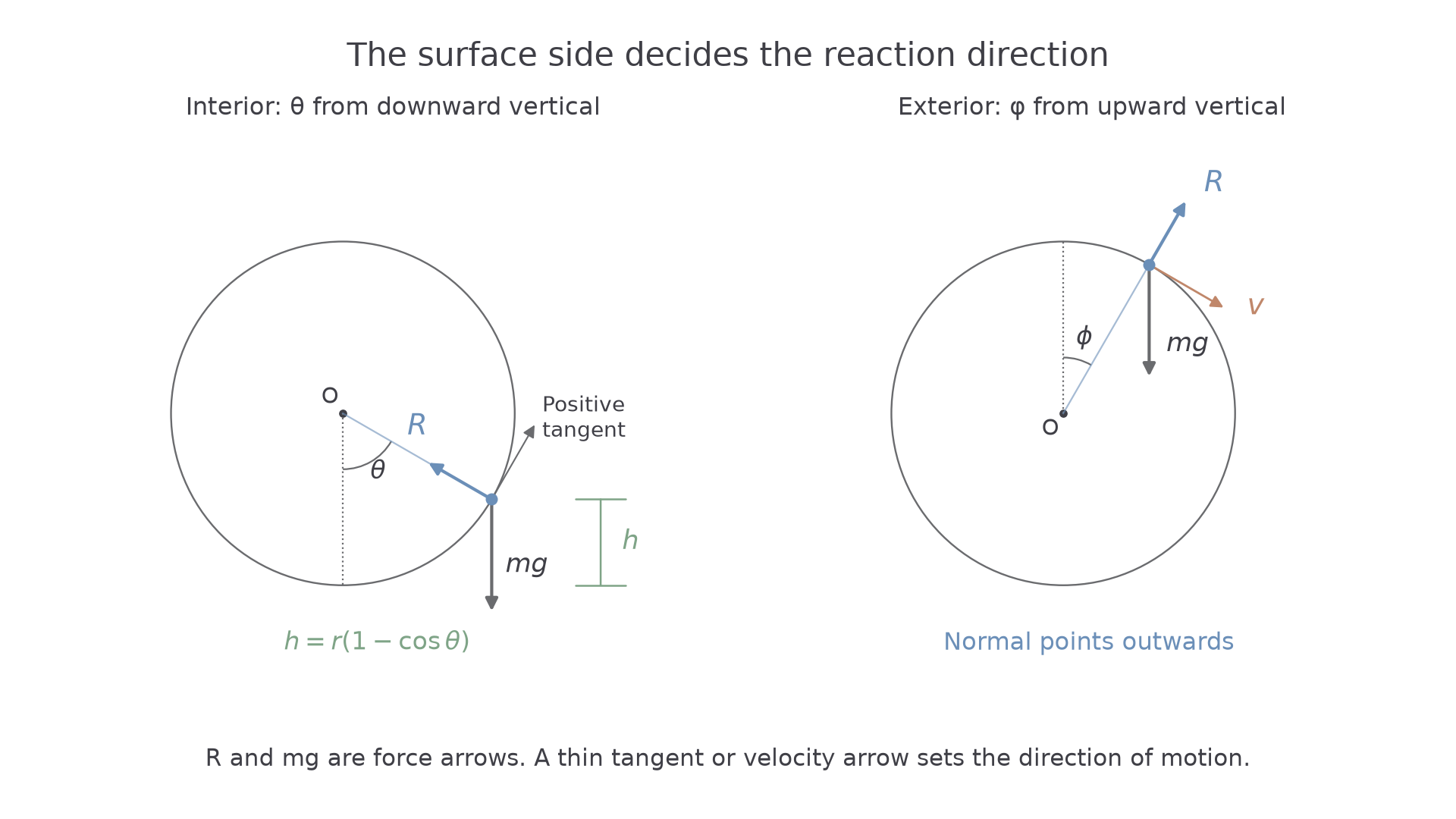
A smooth vertical circle from the lowest point
Let be speed at the lowest point of a fixed smooth circle of radius . While the circular constraint is maintained and gravity is the only force doing work,
If denotes a signed inward constraint force,
For an interior surface, ; for a taut string, .
Not in the formula booklet: learn it.
The tangential equation is . It is not exact SHM, because it involves , rather than . A bead threaded on a complete wire can have a constraint force in either radial sense, so its signed may be negative; it does not detach just because the chosen sign changes.
Worked example 3: motion on an interior surface
Question. A particle moves in a vertical plane on the inside of a fixed smooth sphere of radius . Its speed at the lowest point is . When , find its speed, normal reaction, tangential acceleration and vertical acceleration.
Plan. Use energy for speed, then resolve inward and along the tangent. Finally project both acceleration components vertically.
Why this step? The inward direction is inclined, so is not the vertical acceleration. The tangential component has a vertical projection too.
Answer. Speed , reaction , tangential acceleration , and vertical acceleration downwards.
Check. , so contact is feasible at this point. Direct vertical Newton's law gives , which divided by gives .
Change only the initial speed to . The geometry and tangential acceleration at the specified angle stay the same, but the radial component increases.
Worked example 4: a greater initial energy
Question. For the same particle and sphere, let the speed at the lowest point be . Find the same quantities at .
Plan. Update the energy equation, then use the same force directions and projections.
Why this step? Gravity's tangential component depends on the position, not the speed. The normal force adjusts to supply the larger radial acceleration.
Answer. Speed , reaction , tangential acceleration , and vertical acceleration upwards.
Check. , matching the component calculation.
At the same point, changing the speed has even reversed the vertical acceleration. The direction of gravity alone does not determine the direction of the total acceleration when a constraint force acts.
Watch out
Wrong: , ignoring the weight component, or , ignoring tangential acceleration. Right: resolve all actual forces, or project both acceleration components.
Reduce the initial speed until the particle reaches the specified point with zero speed.
Enough energy is not enough for a taut string
Energy can predict a speed at the top even when the string would already have gone slack. A light inextensible string pulls towards its pivot; it cannot push away from it.
Retain from the downward vertical and a lowest-point speed . Combining the preceding energy and radial equations gives the tension at each point. Check this alongside the requirement that is non-negative.
String feasibility and a complete circle
For a particle on a light inextensible string of length , with only tension and weight acting,
These equations apply while the string is taut. A circular motion requires . At the top,
The least lowest-point speed for a complete vertical circle is , with zero tension at the top in the limiting case.
Not in the formula booklet: learn it.
On an uninterrupted ascent, both speed squared and tension decrease as increases from to . The first event matters: a turning point , slackness , or successful passage through the top. Testing only the top energy misses that ordering.
Worked example 5: completing the circle
Question. A particle on a light inextensible string of length starts at the lowest point with speed . Show that the string remains taut throughout a complete circle, and find the speed and tension at the top.
Plan. Find the minimum tension, which occurs at the top, and check that the top speed is real.
Why this step? Positive tension at the highest point is sufficient here because the tension is greater everywhere else on the circle.
Answer. The string stays taut throughout. The top speed is , and the top tension is .
Check. At the bottom, ; the general expression varies between and .
Change only the lowest-point speed to . Energy would predict zero speed at the top, but the string constraint must be checked before that point.
Continue this lesson.
You’re previewing NovaLearn without an account. Create a free account to read the rest.
Create free account