Mi13–Mi15 - Oblique impact with a smooth plane
A slanting bounce changes one component of velocity while leaving the other untouched. Use the line of impulse to model a smooth-plane impact, find rebound directions and calculate the impulse, with the modelling assumptions stated precisely.
Find the line of impulse
Can a ball hit a wall with coefficient of restitution zero and still move immediately afterwards? A direct impact would leave it at rest. A slanting impact has another component of motion to consider; we will return to the question after resolving a bounce.
You already know
Newton's experimental law compares separation speed with approach speed. Impulse is change of momentum, . Resolve a velocity into perpendicular components before combining them to find its speed.
The new decision is which direction restitution controls. The line of impulse is the direction of the collision impulse. For a smooth fixed plane it is perpendicular to the plane, so it is the normal direction.
Oblique impact
An object strikes a plane obliquely when its incoming motion is not perpendicular to the plane. For two bodies, impact is oblique when their relative motion is not along the line joining their centres at contact.
The bodies' shape matters in the second definition: two particles have no preferred line of centres to determine an oblique collision impulse. A particle can, however, strike a plane obliquely, because the plane supplies a normal direction.
For this model, mobile bodies are uniform, with spherical or circular symmetry. Contact is smooth, and objects do not rotate before or after impact. The collision impulse passes along the line of centres for two such bodies, or perpendicular to a plane. It acts through each body's centre and produces no rotation. Rotating objects are outside this model.
Smooth contact means no impulse parallel to the plane. That is why the object's tangential momentum, and hence its tangential velocity, stays constant during impact. Its normal velocity changes.
Restitution along the impulse
For an impact with positive relative approach speed along the line of impulse,
Only the components along this line enter Newton's experimental law. For a fixed plane, the plane's velocity is zero.
Not in the formula booklet: learn it.
The direction perpendicular to the impulse is the direction parallel to the plane. Keeping those two descriptions linked prevents a common reversal of the rules.
Resolve a smooth-plane bounce
Choose a tangential unit vector along the plane and an outward normal unit vector . Write the incoming velocity as . A body approaching the plane has .
The two component rules
For a fixed smooth plane and an incoming normal component ,
The tangential component retains its sign. For , the normal component reverses sign and its magnitude is multiplied by .
Not in the formula booklet: learn it.
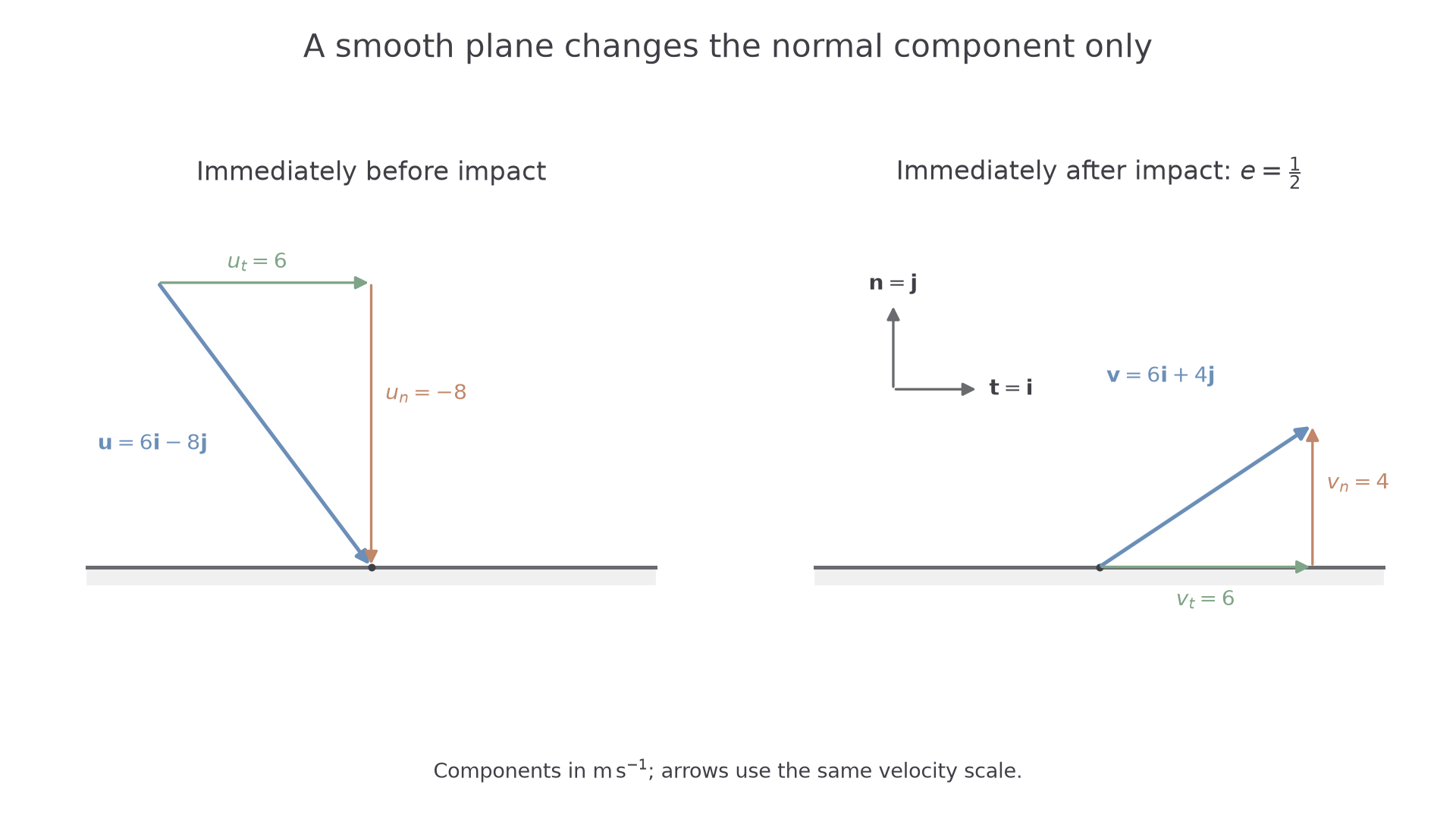
Take a horizontal plane, with rightwards along it and vertically upwards. In this case and .
[DIAGRAM: asset_name: Components of a smooth-plane bounce; asset_slug: oblique_plane_components; caption: Smooth contact preserves the rightwards component and reverses only the normal component; description: An exact vector diagram above a horizontal plane shows an incoming velocity with components 6 right and 8 down, and an outgoing velocity with components 6 right and 4 up for e equal to one half. Incoming and outgoing arrows meet the same contact point in their respective panels. The positive tangent is rightwards and the outward normal is upwards.]
Worked example 1: two signed components
Question. A smooth sphere strikes a fixed horizontal plane with velocity . The coefficient of restitution is . Find its outgoing velocity and speed.
Plan. Retain the horizontal component, apply restitution vertically and then use both components to find speed.
Why this step? The incoming normal velocity is negative, so multiplying it by produces a positive outgoing normal velocity.
Answer. , with speed .
Check. Normal separation divided by approach is . The whole speed ratio is , which is not .
Change only to . The horizontal component still has no reason to change.
Worked example 2: a more elastic bounce
Question. The same incoming sphere has coefficient of restitution with the plane. Find its outgoing velocity and speed.
Plan. Apply the same component rules using the new normal speed ratio.
Why this step? Increasing increases the outgoing normal component, while the tangential component is fixed by smoothness.
Answer. , with speed .
Check. , and the outgoing speed is below the incoming speed of .
For a tilted plane, choose axes along and perpendicular to that plane first. Horizontal and vertical components are useful only if they coincide with these directions or you resolve them again.
Watch out
Wrong: . Right: reverse and scale only the component perpendicular to the plane. The tangential component is unchanged.
Use different incoming components in the next bounce.
Find rebound angles and deflection
Label angles to a named line. Let the incoming velocity make an acute angle with the plane, and the outgoing velocity an angle with the plane. Take the tangential motion to be positive in both cases.
An incoming speed has tangential component and normal component . The outgoing components are and .
Angles measured to the plane
For , and a smooth fixed plane,
Here . The change in direction between the incoming and outgoing velocity arrows is .
Not in the formula booklet: learn it.
The sum occurs because the incoming velocity points below the positive tangent and the outgoing velocity points above it. If the angles are measured to the normal, use their complements or resolve directly; do not insert them unchanged into this formula.
Continue this lesson.
You’re previewing NovaLearn without an account. Create a free account to read the rest.
Create free account