Mv6, Mv7 - Projectiles on an inclined plane
Find where a projectile next meets a uniform slope and choose the launch direction that maximises its range. You will distinguish angles from the horizontal and from the slope, resolve gravity into rotated coordinates, and measure range along the plane.
Coordinates and angles on a slope
Is above horizontal still the best launch angle when the landing surface rises at ?
The landing surface changes the answer. A steeper upward launch can keep the projectile above that rising surface for longer. We will derive the best angle rather than guess it.
You already know
A projectile is modelled as a particle with no air resistance and constant gravitational acceleration vertically downwards. The distances must be small enough for gravity's direction and magnitude to remain constant.
Let the slope rise at signed angle as you move right: is uphill and downhill, with . Take along that direction of the slope and perpendicular above it. Launch is from the slope itself. Let be the launch angle above the slope, so the horizontal launch angle is .
[DIAGRAM: asset_name: Projectile coordinates on an inclined plane; asset_slug: inclined_projectile_axes; caption: The launch angle above the horizontal is alpha plus beta; description: A plane rising 30 degrees has a blue x-axis along it and sage y-axis normal above it. A launch arrow at 60 degrees above horizontal makes beta 30 degrees with the plane. A downward gravity arrow is resolved into negative along-slope and negative normal components. The two angle arcs have separate labels.]
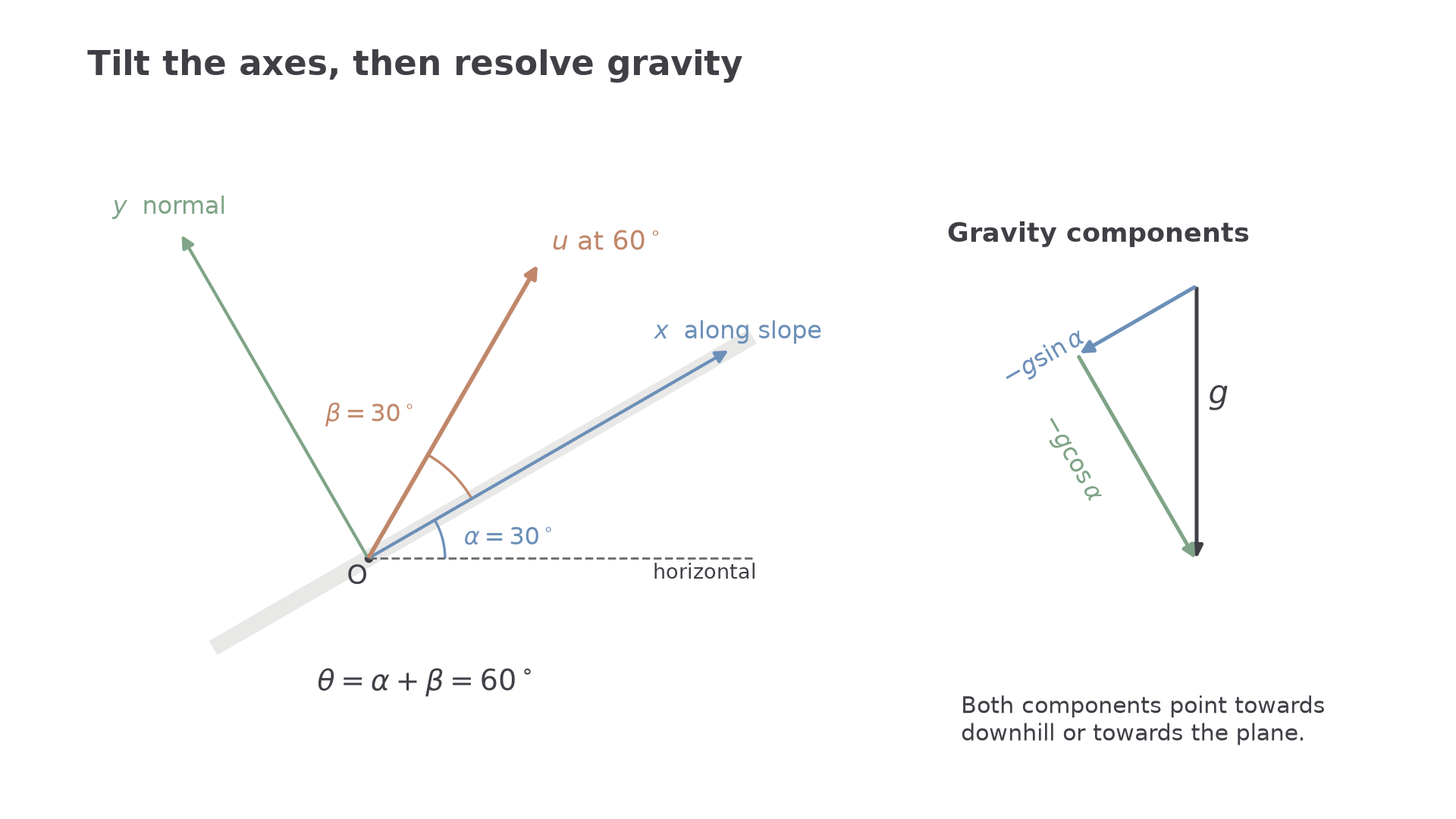
Coordinates parallel and normal to a slope
For launch speed ,
Use for an initially forward launch above the plane, and require a forward landing in the chosen direction.
These resolved equations are derived from the constant-acceleration formulae; they are not printed separately.
Not in the formula booklet: learn it.
When , the along-slope acceleration is positive: gravity helps motion downhill. The normal acceleration remains towards the plane.
Key idea
The slope angle , launch angle above the slope , and launch angle above horizontal are different quantities.
Resolve gravity before calculating a range.
Finding the next landing point
The next landing has perpendicular coordinate ; its along-slope coordinate is the range .
Factoring the normal-coordinate equation gives the launch root and the positive flight time:
Substitution into the along-slope equation, followed by
, gives the range.
Range along a uniform slope
With the launch point on the slope,
This is range along the plane; its horizontal component is . Under the stated coordinate convention, require , equivalently .
Not in the formula booklet: learn it.
You can instead use horizontal and vertical coordinates and set vertical height equal to the slope's height. Either approach must measure the final range along the plane.
Worked example 1: an uphill landing
Question. A particle is projected at , above a plane rising at . Find its range up the plane.
Plan. Use , discard the zero-time root, and calculate along-slope range.
Why this step? The cosine uses the total horizontal launch angle , not the angle above the plane.
Answer. , about , along the slope.
Check. Direct substitution gives .
Reverse only the slope angle to , retaining . The particle is now launched horizontally above a descending plane.
Continue this lesson.
You’re previewing NovaLearn without an account. Create a free account to read the rest.
Create free account