Md6–Md10 - Resolving forces and particle equilibrium
Md6–Md7 resolve forces in useful directions and add concurrent forces as vectors. Md8–Md10 use a zero resultant to solve particle-equilibrium problems, either through component equations or a closed triangle or polygon of forces.
Resolve first, then add components
Can two unequal tensions support a weight while their horizontal effects cancel? Yes: a nearly horizontal string can supply a substantial sideways force but little upward force. Resolving makes those different jobs visible.
You already know
Forces are vectors: direction matters as well as magnitude. With a force at angle above a positive horizontal axis, its components are horizontally and vertically. Use signed components outside the first quadrant.
Choose perpendicular directions that simplify the geometry. Horizontal and vertical suit hanging strings; parallel and perpendicular to a slope suit contact with an inclined plane. The force itself does not change when you change your axes.
Concurrent forces and resultant
Forces are concurrent when their lines of action pass through one point. Their resultant is their vector sum, with components obtained by adding the corresponding signed components.
For example, and have resultant , not a force of magnitude .
For perpendicular resultant components , the magnitude is . Use the signs of both components to identify the direction; inverse tangent alone can point into the wrong quadrant. These component and resultant rules are not in the formula booklet: learn them.
Worked example 1: a first-quadrant force added to a horizontal force
Question. Two concurrent forces act on a particle: horizontally right and at above the rightward horizontal. Find the magnitude and direction of their resultant.
Plan. Add horizontal and vertical components, then use Pythagoras and the component ratio.
Why this step? Adding magnitudes would give , which is possible only if both forces acted in the same direction.
Answer. , at above the rightward horizontal.
Check. Its magnitude is approximately , between and , as the triangle of vector addition requires.
Change only the direction of the force, from to . Its horizontal component now opposes the force.
Worked example 2: a component changes sign
Question. Find the resultant when the second force acts at anticlockwise from the rightward horizontal.
Plan. Retain the component signs before calculating the magnitude and direction.
Why this step? A negative horizontal component does not make the force's magnitude negative. It records which way that component acts.
Answer. , at above the rightward horizontal.
Check. The vertical component is unchanged while the horizontal component is smaller, so the resultant should be shorter and steeper. Both are true.
In vector notation the same calculation is simply . Components are a way to carry out vector addition, not a separate physical force system.
Watch out
Wrong: use as the horizontal component because the diagram looks steep.
Right: identify the angle's reference axis. The component along that axis uses cosine; the perpendicular component uses sine.
The second force now points vertically upwards, making a useful exact-value check.
Equilibrium gives two component equations
A particle is in equilibrium under concurrent forces if and only if their resultant is zero. In a plane, that means zero resultant in each of two perpendicular directions. A particle has no size, so there is no separate turning condition in this model.
Particle equilibrium
For coplanar concurrent forces,
These equations are equivalent to a zero resultant. For an initially resting particle, they describe continued rest; more generally zero resultant means zero acceleration.
Not in the formula booklet: learn it.
Draw one free-body diagram, choose your axes, then label each equation with its direction. Unknown string tensions must be non-negative: a string pulls along its length and cannot push. A negative calculated tension indicates that the assumed taut-string equilibrium is impossible.
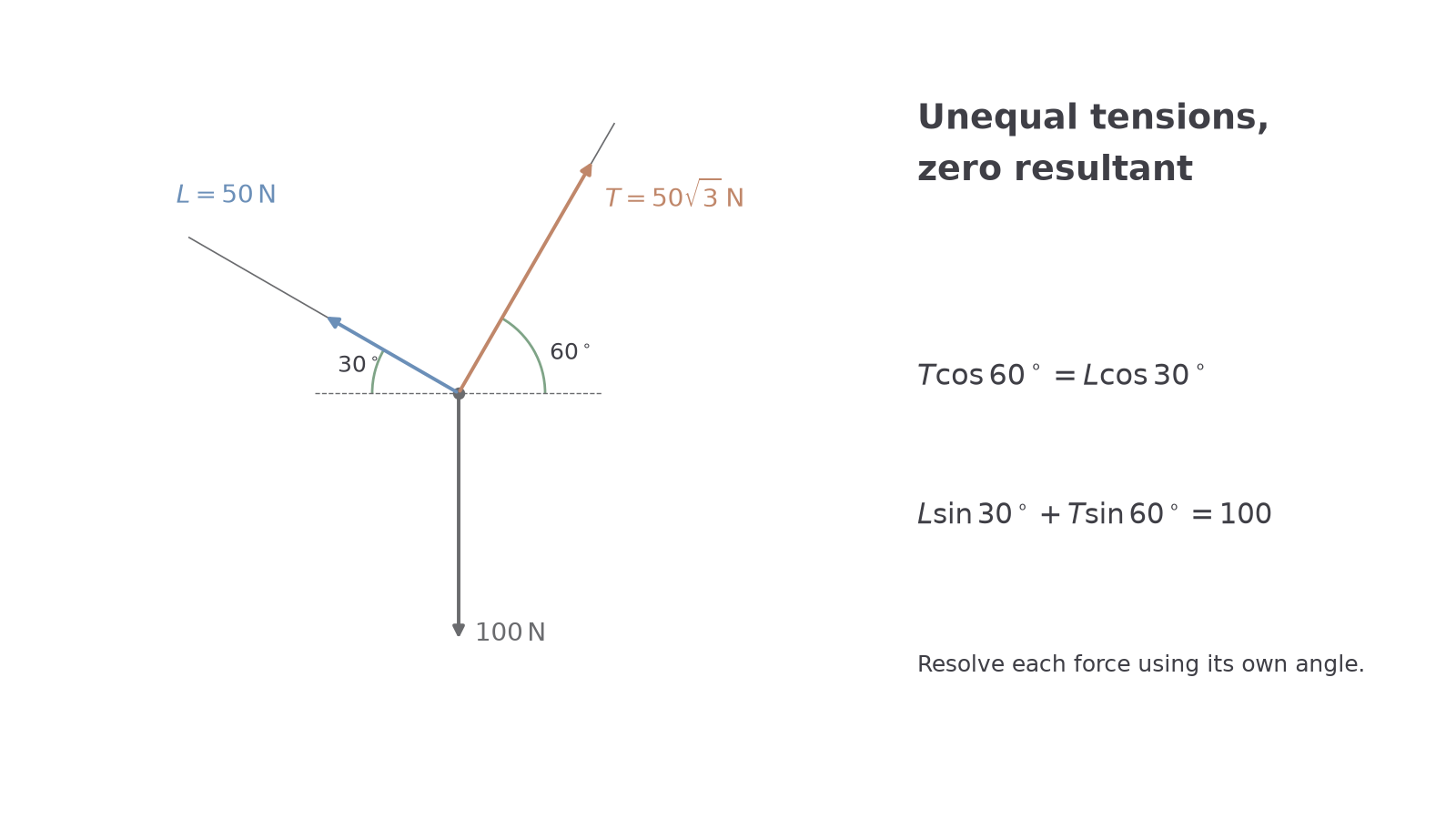
[DIAGRAM: asset_name: A weight supported by two unequal tensions; asset_slug: h645_b057_strings; caption: The horizontal components cancel while the vertical components support the weight; description: A particle has downward weight 100 N, a left string directed 30 degrees above the leftward horizontal and a right string directed 60 degrees above the rightward horizontal. Tension arrows act away from the particle along each string. Labels state left tension 50 N and right tension 50 square root three N. Horizontal reference rays identify both given angles.]
Worked example 3: two supporting strings
Question. A particle of weight hangs in equilibrium from two light strings. The left string is above the horizontal and the right string above the horizontal. Find the tensions and , respectively.
Plan. Balance horizontal components to relate the tensions, then use vertical balance to find their sizes.
Why this step? The strings' angles differ, so their tensions need not be equal. It is their horizontal components, rather than the full tensions, that cancel.
Answer. , .
Check. The horizontal magnitudes are both . The vertical contributions are and , summing to .
Change only the weight to . The string geometry stays fixed, so each required tension scales in the same proportion.
Continue this lesson.
You’re previewing NovaLearn without an account. Create a free account to read the rest.
Create free account