Pa3, Pa4 - Sinh, cosh and tanh
Hyperbolic functions are built from exponentials, despite having names that sound like trigonometry. In Pa3 you learn their definitions, graphs, domains and ranges; in Pa4 you establish the identity that links them. Their graphs and signs will help you choose valid answers before you calculate.
Building sinh, cosh and tanh from exponentials
Why do sums and differences of exponentials produce points on a hyperbola?
Start with a positive number and its reciprocal. Using and , their half-sum is and their half-difference is . These satisfy . Using and instead gives and , with the same difference of squares. The final part will explain why this always happens.
You already know
For every real , , and . In particular, for . Squaring a sum includes its cross term.
Take the two exponentials and . Their half-difference changes sign when changes sign; their half-sum does not. These two combinations have names.
Hyperbolic sine and cosine
For real , the hyperbolic sine and hyperbolic cosine are
They are functions of a real variable, not periodic angle functions. For example, and .
Adding the two definitions cancels the negative exponential; subtracting them cancels the positive exponential. Thus and . These follow from the definitions; they are not in the formula booklet and need not be learnt as separate identities.
Hyperbolic tangent and exponential definitions
For every real :
The ratio defining hyperbolic tangent is always defined because .
Not in the formula booklet: learn it.
When an input is a logarithm, evaluate the two exponentials first. Exact fractions are often simpler than decimals.
Worked example 1: exact values at a logarithm
Question. Find the exact values of , and .
Plan. Replace and by reciprocal numbers, then use the definitions.
Why this step? is , not . The negative sign belongs to the exponent, so it takes a reciprocal.
Answer. , , .
Check. Their signs agree with a positive input, , and the ratio is less than .
The next example changes only the sign of the input. The two exponentials exchange roles, so the half-difference changes sign while the half-sum does not.
Worked example 2: a negative input
Question. Find the exact values of , and .
Plan. Evaluate the exponentials for the negative input and compare with the positive-input values.
Why this step? The input sign affects the entire function. Hyperbolic cosine is not negated by a negative input because its two terms merely swap places.
Answer. , and , respectively.
Check. Adding the first two values gives , as the definitions predict.
The same swapping argument works for any real input: , , and . We will use these symmetries to sketch the graphs.
Watch out
Wrong: . The factor is missing. Right: the half-difference defines ; both terms are divided by . The corresponding half-sum defines .
Change the positive reciprocal pair to and , then account for the negative input.
Graphs, domains and ranges
The graphs reveal why hyperbolic functions need different instincts from ordinary sine, cosine and tangent.
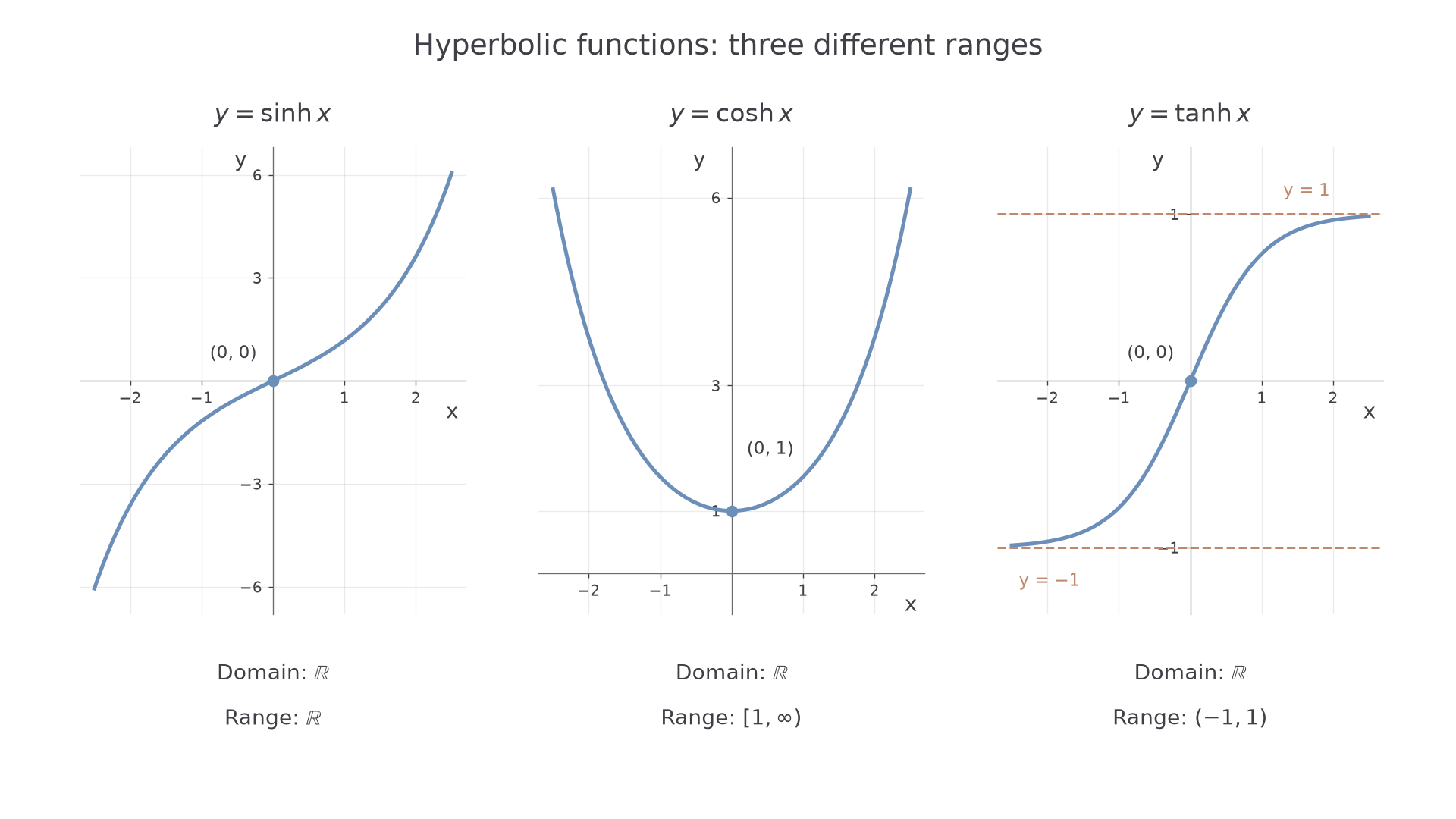
For , , so . As grows, the first exponential grows without bound and the second tends to zero. Hyperbolic sine therefore grows without bound. Its odd symmetry gives the corresponding negative behaviour for , and it passes through . It is increasing throughout its domain: as increases, increases and increases too.
For hyperbolic cosine, the sum is always positive and symmetric about the -axis. Its minimum is exactly , because
Equality requires . Thus has a minimum at , falls towards that point from the left and rises afterwards.
Hyperbolic tangent is bounded even though its numerator and denominator are unbounded. Multiplying the top and bottom of its exponential form by gives
The final fraction is positive and tends to zero as . Therefore from below. Odd symmetry gives as . Neither boundary value is attained at a finite input.
[DIAGRAM: asset_name: Graphs of the three hyperbolic functions; asset_slug: hyperbolic_graphs; caption: Sinh is unbounded and odd, cosh has minimum 1 and is even, and tanh approaches the unattained levels -1 and 1; description: Three coordinate panels plot sinh x, cosh x and tanh x with their intercepts marked. Sinh passes through 0,0 and increases throughout. Cosh is symmetric about the vertical axis with minimum 0,1. Tanh is increasing and passes through the origin, with horizontal dashed asymptotes y equals minus 1 and y equals 1. Every panel states its domain and range.]
Continue this lesson.
You’re previewing NovaLearn without an account. Create a free account to read the rest.
Create free account