Mh1–Mh5 - Elastic tension and equilibrium
Turn stretched lengths into forces, distinguish strings from springs, and locate equilibrium positions. You will use stiffness and modulus of elasticity consistently, then check whether the physical arrangement permits your answer.
Strings, springs and natural length
A uniform elastic cord is cut into two equal pieces. Does one piece need more force, less force or the same force as the original cord to extend it by ?
The shorter piece needs more force. The same extension is a larger fraction of its natural length. We will quantify this without pretending that a string can push.
You already know
For equilibrium, the resultant force is zero: resolve in independent directions. A light object has negligible mass in the model. Use .
An elastic model adds a relation between a connector's deformation and the force it exerts. It does not replace the force balance.
Natural length and extension
The natural length is the length of a string or spring when it is neither stretched nor compressed. If its current length is , its signed extension is
A positive value means stretching. For a spring, describes compression of magnitude . A string with its endpoints closer than is slack, rather than compressed.
For example, a spring of natural length and current length is compressed by . An elastic string with the same natural length and endpoint separation has no tension. It can droop; it cannot provide a compressive thrust.
Elastic string and spring
An ideal elastic string exerts tension only when stretched, pulling its ends towards one another. An ideal spring can exert tension when stretched or thrust when compressed, always tending to restore its natural length. At natural length the elastic force is zero.
Hooke's law is a linear model: within its stated range, doubling the extension doubles the tension. A compressed spring behaves similarly with compression and thrust. The law concerns deformation from natural length, not the current length itself.
[DIAGRAM: asset_name: Strings can pull while springs can also push; asset_slug: string_spring_force_models; caption: An ideal string is slack below natural length; a spring develops a restoring force on either side; description: Two force graphs use signed extension x horizontally and the elastic force on the moving right endpoint horizontally resolved to the right vertically. The string graph is zero for x at or below zero and decreases linearly for positive x. The spring graph is a straight decreasing line through the origin for both signs of x. Blue indicates tension for positive extension, clay indicates spring thrust for negative extension, and the zero string branch is grey. Labels say stretched pulls left, compressed spring pushes right and slack string has zero tension.]
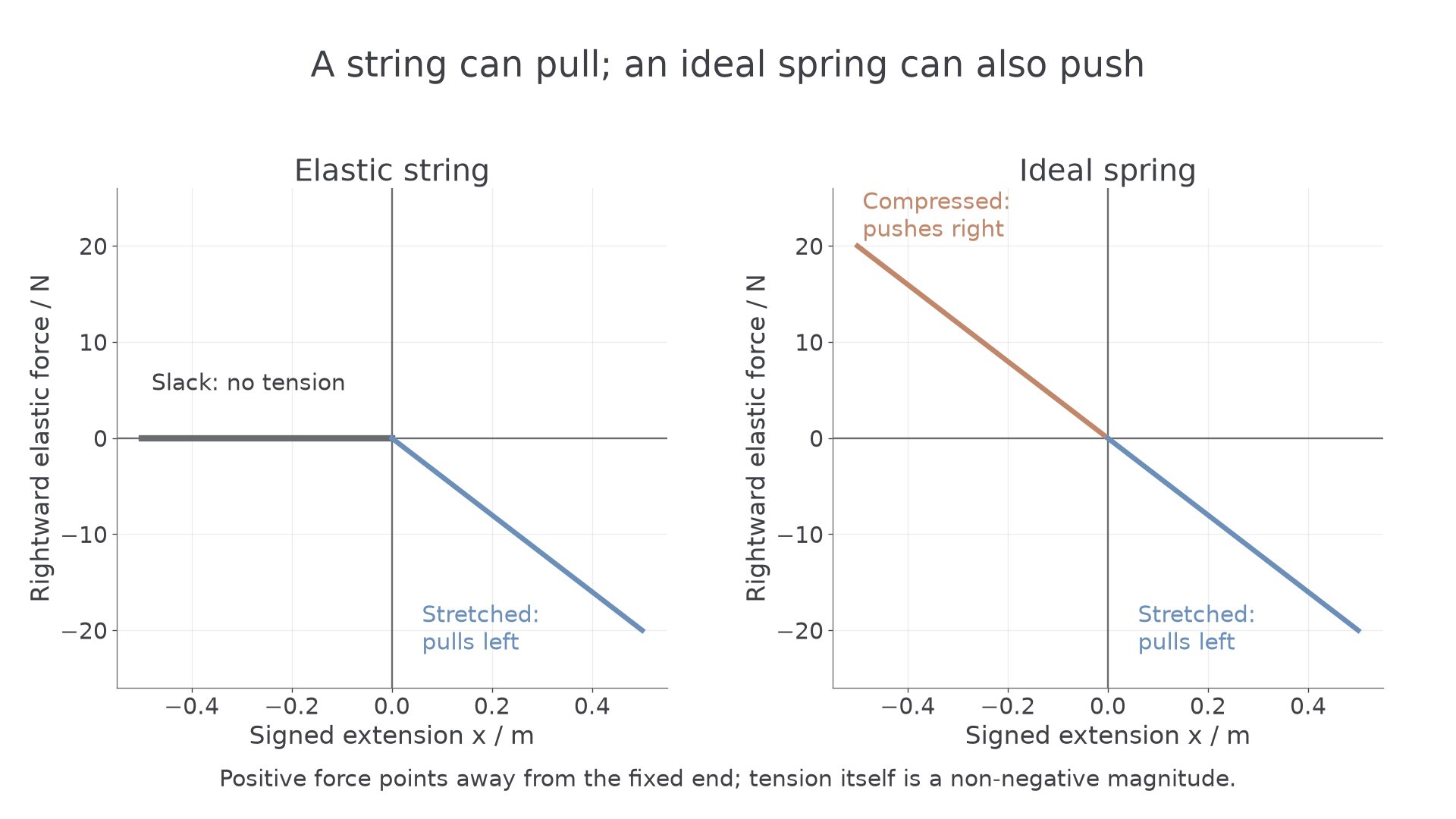
The signed force in this picture is positive to the right. Thus a stretched connector exerts a negative force on its right endpoint. Its tension is nevertheless a positive magnitude.
Key idea
First decide whether the connector is stretched, slack or compressed; then choose the force's magnitude and direction.
Use that distinction to diagnose the proposed force.
Stiffness and modulus of elasticity
A force-extension graph gives a practical measure of how hard a connector is to stretch: its gradient.
Stiffness and modulus of elasticity
The stiffness , measured in , is the tension or thrust per unit extension or compression in a Hooke's-law model. The modulus of elasticity , measured in , is the tension divided by the fractional extension .
The modulus used here is not Young's modulus in . For a given uniform elastic string, it packages the material and cross-sectional properties into a force.
Hooke's law
For a stretched string or spring of extension :
For an ideal compressed spring, the thrust has magnitude . Assume the connector obeys the linear law throughout the deformation considered.
Not in the formula booklet: learn it.
You may rearrange the same law to find , or . Convert centimetres into metres before calculating stiffness.
Worked example 1: finding both elastic constants
Question. A uniform elastic cord has natural length . A tension of stretches it to . Find its stiffness and modulus of elasticity.
Plan. Subtract the natural length, divide force by extension, then use .
Why this step? The straight-line law relates tension to the extra length. Dividing by would use the wrong horizontal variable.
Answer. and .
Check. , the given tension.
Now change only the natural length by cutting the uniform cord in half. Each piece has the same modulus as the original, provided its material and cross-section are unchanged.
Worked example 2: cutting the cord
Question. The cord in Example 1 is cut into two equal pieces. For one piece, find its stiffness and the tension needed to produce an extension of . Compare this with the force needed for the same extension of the uncut cord.
Plan. Keep fixed, use the shorter natural length to find , then apply Hooke's law to both lengths.
Why this step? A extension is one tenth of the shorter natural length but only one twentieth of the original.
Answer. The half-length piece has stiffness and needs , twice the uncut cord's .
Check. The original cord's extension splits equally between its two halves under , so each half extends .
There is the opening puzzle's surprise: cutting a uniform cord changes its stiffness even though it does not change its modulus. Stiffness describes the whole connector, including its length.
Watch out
Wrong: quote both and in newtons. Right: has units , while has units .
Cut the same cord into a different number of pieces.
Force from the current length
Draw the connector and mark its natural and current lengths before choosing a direction for its force.
For a stretched connector, the force pulls towards its fixed end. For a compressed spring, the force pushes away from that end. A negative signed extension is useful information; it is not a negative tension magnitude.
Signed restoring force for a spring
Take the positive direction from the fixed end towards the moving end. If , the spring's force on the moving end is
This describes an ideal spring in tension or compression. For a string, use only when , and when it is slack.
Not in the formula booklet: learn it.
The sign and magnitude now come from separate decisions: compute , apply the appropriate model, then state how the force acts.
Worked example 3: a stretched spring
Question. A light spring of natural length and modulus has one end fixed. Its length is . Find the elastic force on its moving end.
Plan. Find extension and stiffness, then give the restoring force's magnitude and direction.
Why this step? A stretched spring tries to shorten, so its force on the moving end points towards the fixed end.
Answer. A tension of , towards the fixed end.
Check. With positive direction away from the fixed end, , consistent with that direction.
Keep the spring unchanged and change only its current length to the opposite side of natural length.
Worked example 4: the same spring compressed
Question. The spring in Example 3 is compressed to a length of . Find the elastic force on its moving end.
Plan. Use the signed extension to establish compression, then calculate the thrust.
Why this step? Compression reverses the restoring force. If the connector were an elastic string instead, the force would be zero.
Answer. A thrust of , away from the fixed end.
Check. Equal stretch and compression magnitudes give equal force magnitudes in this ideal linear spring model, with opposite directions.
These are idealised springs: assume the stated compression is physically possible, without coils meeting or the spring buckling.
Continue this lesson.
You’re previewing NovaLearn without an account. Create a free account to read the rest.
Create free account