SR10 - The binomial distribution
Connect the familiar binomial model to independent zero-or-one trials. Check its assumptions in context, calculate probabilities and prove its mean and variance in particular cases instead of simply quoting the results.
Check the binomial model in context
Can a count of successes in independent trials have variance greater than ? The answer follows from understanding the variation in one trial before adding the trials together.
You already know
A binomial variable counts successes in a fixed number of independent trials, with the same success probability in every trial. For independent variables, means add and variances add; multiplying one variable by instead multiplies its variance by .
Suppose a quality-control worker tests eight lamps and records how many fail. A fixed count of eight lamps and two categories, failure or no failure, are features of the task. To use a binomial model, also assume that failure outcomes are independent and that each lamp has the same failure probability.
Binomial model
Write when counts successes among independent Bernoulli trials, each with success probability . Its possible values are . “Success” means the event being counted, even if that event is a fault.
Explain the assumptions using the outcome. Say “whether one lamp fails is independent of whether another lamp fails”, rather than “the probabilities are independent”. A shared manufacturing fault could make this assumption doubtful. Testing until the first failure would also change the variable: the number of trials would no longer be fixed.
Exam tip
Distinguish facts given by the setting from assumptions you add. Give independence and constant probability in the context of the particular success event.
Decide which proposed justification actually supplies the missing condition.
Calculate binomial probabilities
For exactly successes, one specified ordering has probability . There are positions for those successes. This explains the familiar probability function.
Binomial probability function
For , with a non-negative integer and ,
The booklet writes .
In the formula booklet.
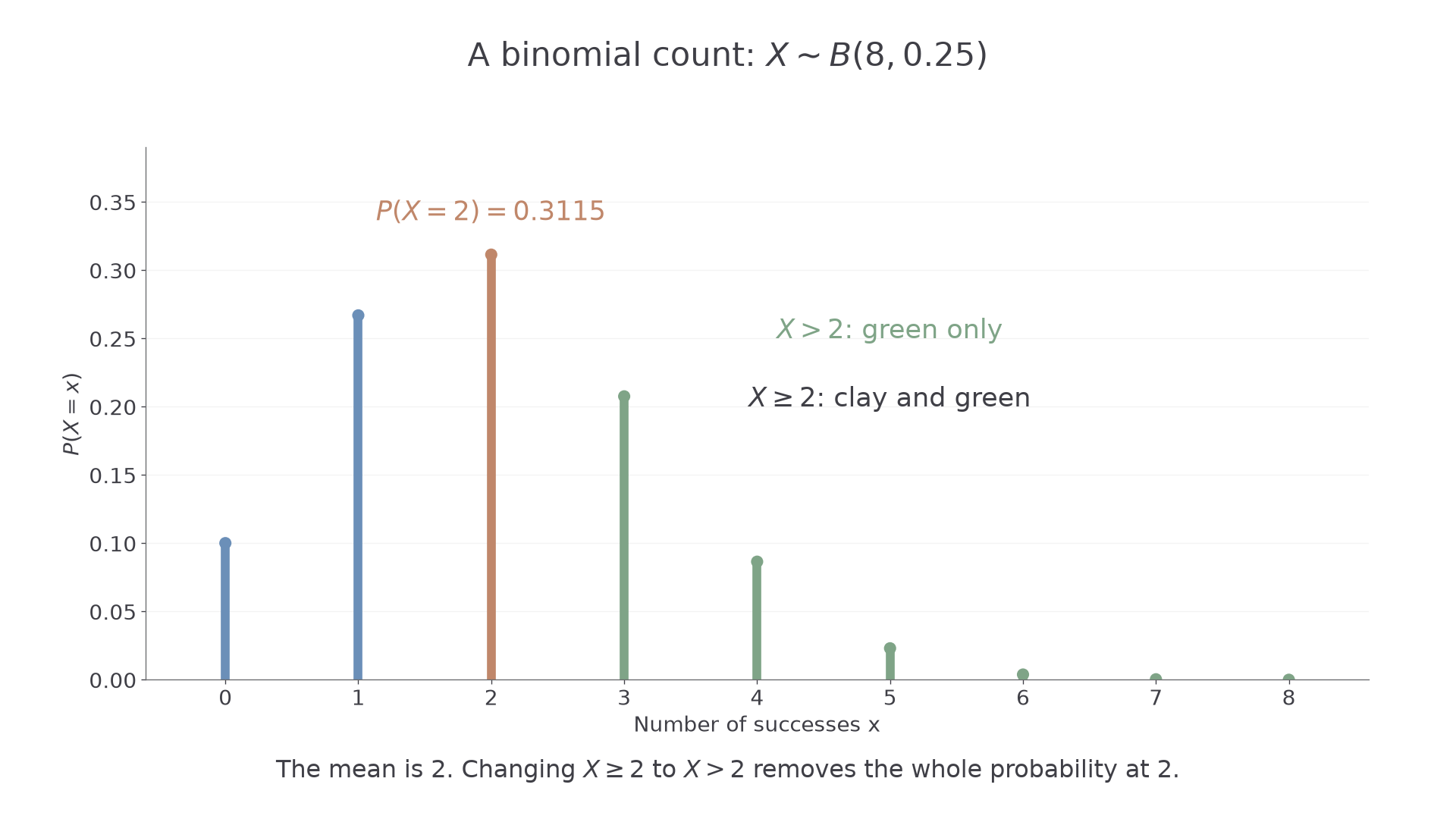
For calculator cumulative output, define for the stated distribution. Then , whereas . These complement translations are not printed as separate formulae; understand which integer outcomes are excluded.
[DIAGRAM: asset_name: A binomial count and an integer boundary; asset_slug: binomial_probability_boundary; caption: At least two successes includes the probability at two, while more than two excludes it; description: The exact probability graph for B with n equal to 8 and p equal to one quarter shows integer values zero through eight. Values from three upwards are sage, the value two is clay, and zero and one are blue. The separate mass at two is labelled and the mean at two is identified in the caption.]
Worked example 1: exactly and at least
Question. Independent lamp tests have failure probability , and counts failures in eight tests. Find and .
Plan. Use , calculate the point probability and complement the lower tail through one.
Why this step? The cumulative cutoff is one below the first included integer, so the probability at two stays in the event.
Answer. ; , to decimal places.
Check. The at-least probability exceeds the exactly-two probability because it includes additional possible counts.
Change only the second event from “at least two” to “more than two”. Its cutoff moves by one integer.
Worked example 2: exclude the boundary count
Question. For the same model, find .
Plan. Complement the cumulative probability through two, including the boundary in the excluded tail.
Why this step? means ; it removes the whole probability at two from the previous event.
Answer. , to decimal places.
Check. .
Write the distribution and the mathematical event before using the calculator. A bare output does not show which parameters or inequality were entered.
Watch out
Wrong: . That removes the probability at two, which belongs to the event. Correct: ; instead gives .
Continue this lesson.
You’re previewing NovaLearn without an account. Create a free account to read the rest.
Create free account