Pj12, Pj13 - De Moivre's theorem and multiple angles
De Moivre's theorem turns powers of complex numbers into multiples of angles. Pj12 gives the theorem and its meaning; Pj13 uses it to derive multiple-angle identities and to express powers of sine and cosine in terms of multiple angles.
Powers multiply arguments
Can you find exactly without expanding twelve brackets? The answer will be a real integer, although the number being multiplied has a non-zero imaginary part.
You already know
For non-zero complex numbers, multiplication multiplies moduli and adds arguments. In modulus-argument form, , with ; arguments differing by describe the same point.
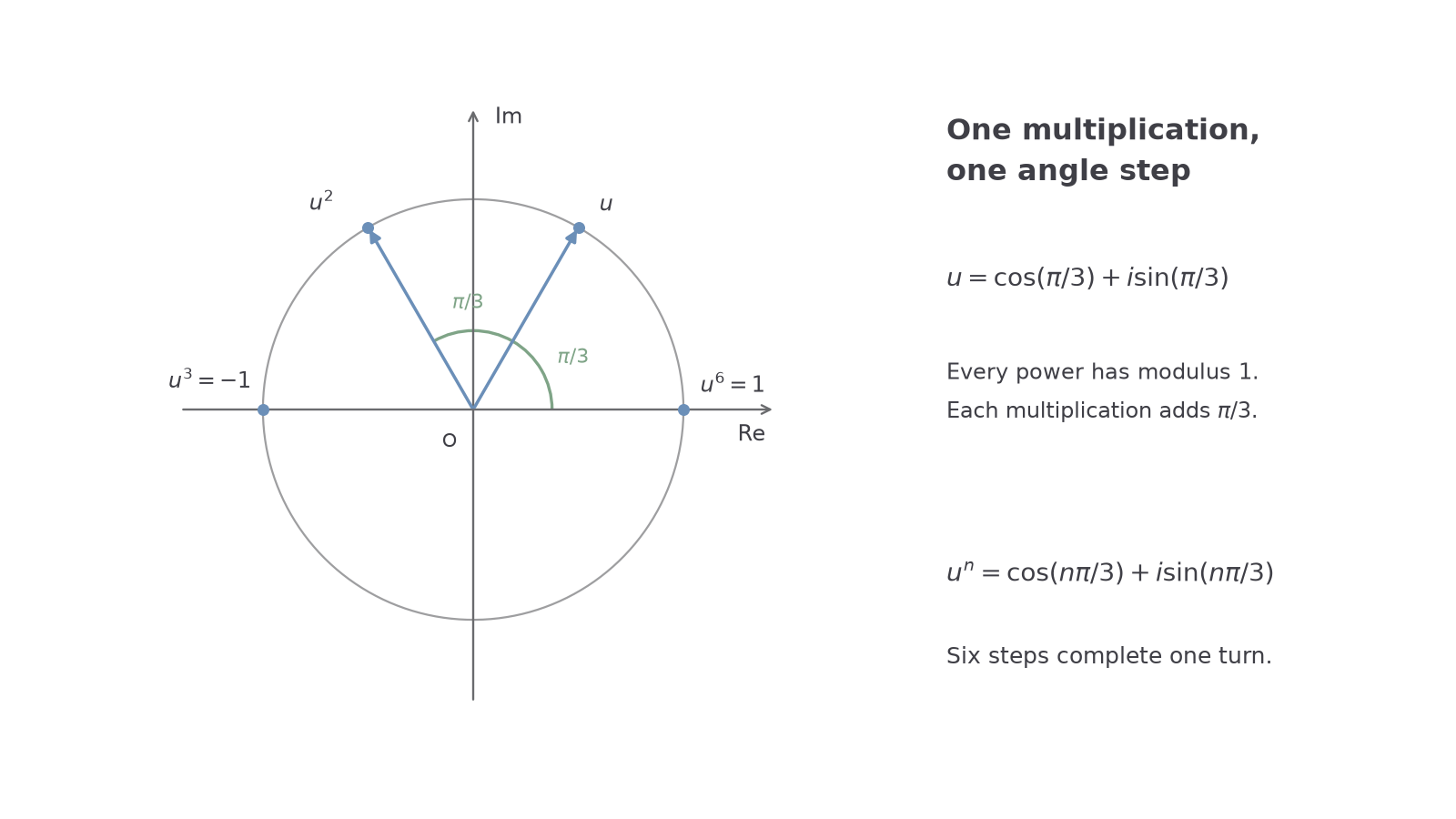
Take . Multiplying by itself gives modulus and argument , so . Each further multiplication adds another . For example, a point at angle reaches angle after six multiplications: its sixth power is , despite the point itself being non-real.
[DIAGRAM: asset_name: Powers turn through equal angles; asset_slug: h645_b008_powers; caption: Successive powers of a unit complex number add the same angle each time; description: An Argand diagram shows the unit circle and u at pi over 3, u squared at 2 pi over 3, u cubed at pi, and u to the sixth at 1. Blue arrows from the origin indicate u and u squared, with equal angle arcs. A side panel states that moduli stay 1 and arguments are multiplied by the power.]
De Moivre's theorem
For real and any integer ,
Thus, for ,
In the formula booklet.
The multiplication rule proves the positive-integer case directly by repeated multiplication. At , both sides are . Also ; applying the positive case to this reciprocal gives the negative-integer case. The theorem as stated is for integers: substituting does not produce both square roots.
Worked example 1: a high power
Question. Find exactly.
Plan. Write the base in modulus-argument form, then raise the modulus and multiply the argument by .
Why this step? The whole base has modulus . Raising only the angle and forgetting would put the answer on the wrong circle.
Answer. .
Check. Squaring the base gives ; cubing it gives . Squaring gives .
The next example changes the sign of the power. The argument now turns backwards, and the modulus becomes a reciprocal.
Worked example 2: a negative power
Question. Find exactly.
Plan. Use the same modulus and argument, with exponent .
Why this step? A negative power changes both and . It does not merely change the sign of the final number.
Answer. .
Check. Multiplying this by the sixth power gives , as reciprocal powers must.
For the opening question, doubling the sixth-power angle gives , while squaring its modulus gives . We will return to this after seeing what else the theorem can do.
Watch out
Wrong: .
Right: the modulus is , so the expression is .
Write the modulus and the multiplied angle before evaluating the trigonometric functions; this also makes a negative power easy to check.
Extracting multiple-angle identities
One complex expression can yield two real identities. Expand by the binomial theorem, and also write it using de Moivre. Equating real parts gives a cosine identity; equating imaginary parts gives a sine identity.
For the next calculations, write and . These are real numbers, so terms containing can be separated cleanly.
Worked example 3: the cosine triple-angle identity
Question. Use de Moivre's theorem to show that .
Plan. Expand the cube, equate real parts, and replace by .
Why this step? Replacing leaves a formula entirely in , as the requested form requires.
Answer. , as required.
Check. At , the right side is .
Keep the same expansion, but now change the part you extract: the imaginary part gives the sine identity.
Worked example 4: the sine triple-angle identity
Question. Use de Moivre's theorem to show that .
Plan. Equate imaginary parts of the expanded cube, then eliminate .
Why this step? The imaginary part of is , so there is no in the resulting real identity.
Answer. , as required.
Check. At , the right side is .
Dividing the imaginary part by the real part gives a tangent identity. The fourth power, for example, gives
The last step divides every term by , so it requires . The denominator must also be non-zero: otherwise is undefined. At , the expression gives , agreeing with .
Derived multiple-angle identities
For real ,
With , where both sides are defined,
Not in the formula booklet: learn it.
You can reconstruct these identities from the booklet's theorem; the important skill is choosing the part or ratio that matches the requested function.
Watch out
Wrong: .
Right: , because the imaginary part is the real coefficient of . Keep during the expansion, then equate coefficients.
Apply that same ratio idea to the cube. The powers are smaller, but every term still needs to be divided by the same power of .
Turning powers into multiple angles
The previous part turned a multiple angle into powers. Reversing the direction is useful when an expression contains or : a sum of multiple angles is often easier to integrate later.
Let . Since , its reciprocal is . Adding and subtracting gives the two starting points below.
Pairing reciprocal powers
For and any positive integer ,
Not in the formula booklet: learn it.
Choose a sum for a cosine power and a difference for a sine power. After expanding, pair terms with opposite exponents.
Worked example 5: a cube of cosine
Question. Express as a sum of cosines of multiples of .
Plan. Cube , then pair reciprocal powers.
Why this step? Pairing a positive power with its reciprocal makes a real cosine term, so all complex numbers disappear from the answer.
Answer. .
Check. At , both sides are ; rearranging also recovers the triple-angle identity.
Increase only the exponent, from to . Now a constant term survives because the middle binomial term has exponent zero.
Worked example 6: a fourth power of cosine
Question. Express in terms of cosines of multiple angles.
Plan. Expand , pair opposite powers and retain the constant.
Why this step? The middle term is , not . Tracking exponents prevents a spurious angle term.
Answer. .
Check. At , the right side is , agreeing with .
These power-reduction identities are not in the formula booklet: learn the method of deriving them. For sine, the factor must stay until the last division: . Losing that minus sign reverses the answer.
Exam tip
In a “Show that” identity, write the expansion, the paired powers and the conversion to sine or cosine. A correct final identity copied without the connecting algebra does not establish a given answer.
The method has also answered our opening puzzle: has modulus and argument , so its twelfth power is . A large expansion has become one turn around a circle.
Watch out
Wrong: . Cubing includes . The correct line is ; keep that minus sign when dividing.
Track the power of alongside the binomial coefficients in your proof.
Quick Recap
- De Moivre raises the modulus to the power and multiplies the argument by the integer exponent; it includes negative integer powers.
- Expand a power and equate real or imaginary parts to derive multiple-angle formulae. Divide those parts for tangent, checking where the expressions are defined.
- For a unit complex number, pair for cosine and for sine.
- Expanding or expresses powers of trigonometric functions in multiple angles.
The opening power is : its argument completes one turn and its modulus becomes .