Pm6 - Invariant points and lines
A transformation can leave a point fixed or leave a whole line in the same place while moving its points. You learn to distinguish these two meanings of invariance and use coordinate equations to find every invariant point and line of a plane transformation. Checking vertical lines will be just as important as solving for a gradient.
Finding points that stay fixed
Can an entire line stay in the same place even though none of its points stays put?
The shear gives a clue. It moves to , then to . Both images are on , but neither point stays fixed. We will find exactly what remains unchanged by the end of the lesson.
You already know
A transformation with matrix sends to . A shear's fixed axis consists of points that do not move at all.
An invariant point must return to its own coordinates, not merely to the same axis or the same distance from the origin.
Invariant point
A point is invariant under a transformation if its image is the point itself. Thus is invariant precisely when and . For example, every point on a reflection's mirror line is invariant. A point sent to a different point on that mirror line would not be invariant.
The matrix equation expresses both coordinate conditions at once. Subtracting the original vector gives two homogeneous linear equations.
Invariant-point equations
For , invariant points satisfy
Both equations must hold. The origin is always invariant under a linear transformation.
Not in the formula booklet: learn it.
Do not assume that the two equations determine a unique point. They may be the same condition written twice, or one may reduce to .
Worked example 1: a line of invariant points
Question. Find all invariant points of the transformation with matrix .
Plan. Equate each image coordinate to its original coordinate and solve both conditions.
Why this step? The second equation is true for every ; it does not force to be any particular number. The first equation supplies the condition .
Answer. All points on the line are invariant.
Check. for every real , proving the whole line is fixed.
The next example changes one matrix entry, from to in the upper-left corner. The fixed points now lie on a different line.
Worked example 2: a tilted fixed line
Question. Find all invariant points of the transformation with matrix .
Plan. Write both fixed-coordinate equations and retain any free variable.
Why this step? There is only one independent condition on two coordinates, so the answer is a line rather than a single point.
Answer. All points on are invariant.
Check. A general point is , and .
Other matrices have different fixed sets. For , the equations and leave only the origin. For the identity matrix, both equations are identities and every point is fixed. These conclusions follow from the equations, rather than from the appearance of a few plotted points.
Watch out
Wrong: from , conclude . This equation imposes no restriction. Right: solve the actual non-trivial equations and state which coordinate is free.
The next matrix changes the same upper-left entry again. Check the whole fixed set, not just one point on it.
Lines that keep their direction
An invariant line stays the same line as a set, although its individual points may move along it.
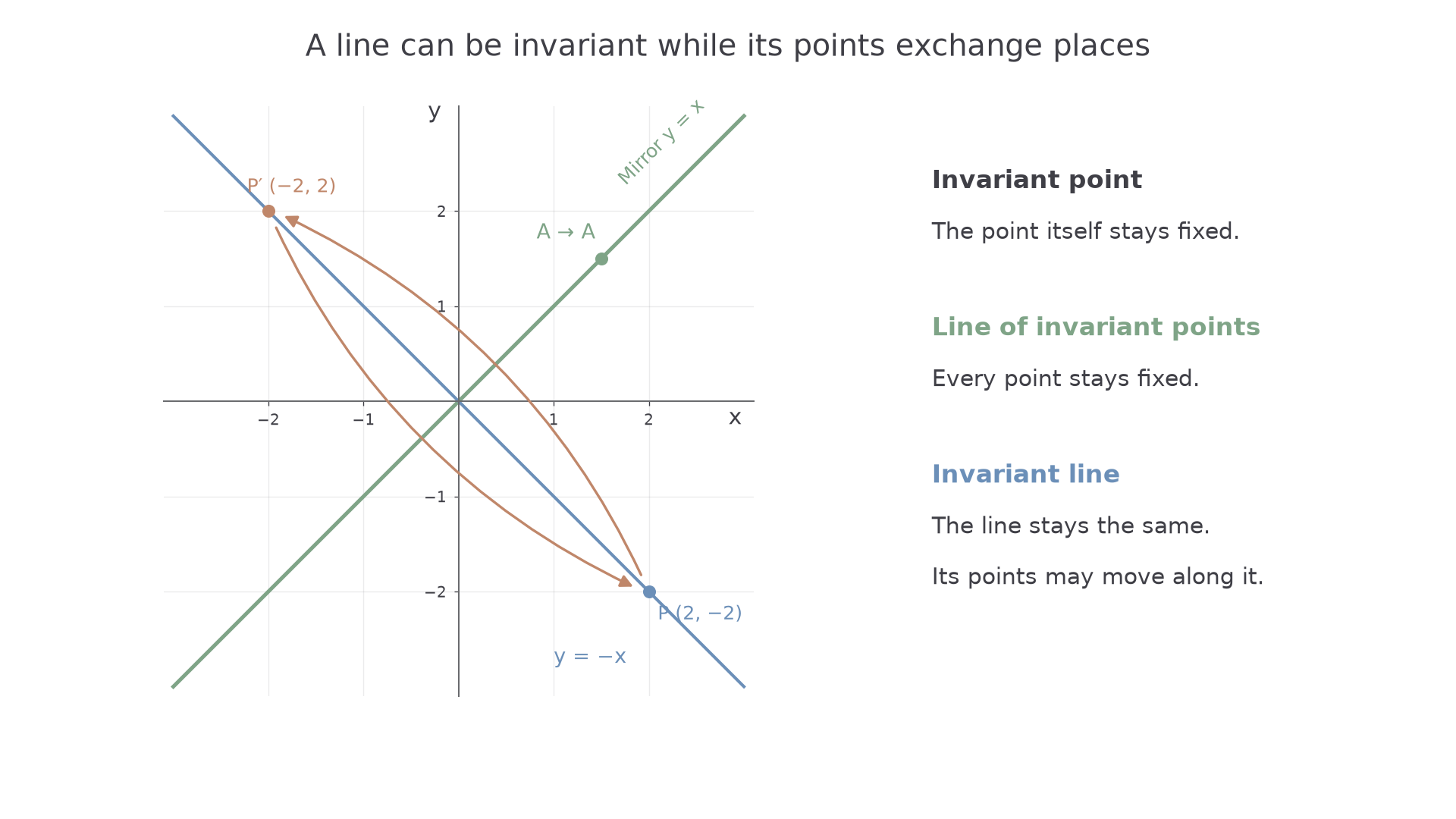
Reflection in fixes every point on its mirror. It also leaves the line invariant: moves to , on the same line. Apart from the origin, those points move. “Invariant line” and “line of invariant points” therefore describe different things.
[DIAGRAM: asset_name: An invariant line need not be fixed point by point; asset_slug: invariant_line_vs_points; caption: Reflection in y = x fixes its mirror point by point but exchanges points along y = -x; description: An equal-scale coordinate diagram shows the mirror y equals x in sage, with point A at 1.5,1.5 labelled A maps to A. The line y equals minus x is blue, with P at 2,minus2 and its clay image P prime at minus2,2. Opposing curved arrows indicate that reflection swaps these two points. A side panel distinguishes an invariant point, a line of invariant points and an invariant line.]
Invariant line
An invariant line is a line whose image is the same line. Its points can move to other positions on the line. A line of invariant points is stronger: every point on it is individually fixed. For example, the mirror line of a reflection has invariant points; a perpendicular line can be invariant while its points exchange places.
For a non-vertical line through the origin, write a general point as . The image must satisfy the same equation for every . It is the relation between the image coordinates that matters, not equality of each old and new coordinate.
Gradient condition for an invariant line
For , a point on has image
Requiring for every gives
Use the coordinate relation directly rather than dividing by . Check the vertical line separately, using .
Not in the formula booklet: learn it.
This condition says that the image stays on the candidate line. In the examples below the coordinate along that line is multiplied by a non-zero factor, so its image is indeed the whole original line.
Worked example 3: two invariant directions
Question. Find all invariant lines through the origin for .
Plan. Apply the matrix to , impose the same gradient, then check the missing vertical line.
For the vertical line,
The image does not generally have first coordinate zero, so is not invariant.
Why this step? A gradient represents every line through the origin except a vertical one. Checking it separately makes the answer complete.
Answer. Exactly and .
Check. , so is invariant while its non-zero points move. Also , so is a line of invariant points.
The next example changes only the sign of the upper-right entry. A small algebraic change removes every real invariant direction.
Worked example 4: no real invariant line through the origin
Question. Find all invariant lines through the origin for .
Plan. Repeat the gradient condition, but accept that it may have no real solution.
No real gradient satisfies this. For a vertical line,
so the image is not generally on .
Why this step? A line in the real coordinate plane needs a real direction. Complex solutions for would not describe additional lines in that plane.
Answer. There are no invariant lines through the origin.
Check. The horizontal direction becomes , already turning away from its original line. The algebra proves that every other real direction turns too, including the separately checked vertical direction.
In contrast, an enlargement centre the origin has every line through the origin invariant: multiplying a position vector by a non-zero scalar keeps it on its line. This is another reason that checking one point is not enough to decide whether an entire line is invariant.
Watch out
Wrong: solve to find all invariant lines. That finds invariant points only. Right: points may move along an invariant line, so require their image coordinates to satisfy that line's equation.
The next matrix has the same sign pattern as Worked example 4, with a different amount of mixing between coordinates.
Invariant lines away from the origin
To find invariant lines that may miss the origin, keep the intercept in the line equation throughout the calculation.
The origin staying fixed does not mean that every invariant line must pass through it. The opening shear keeps the height of every point unchanged, so every horizontal line is a candidate. Using a general intercept lets you establish the entire family rather than guessing a few members.
General line condition
For the line and matrix :
Require for every . Matching the coefficient of and the constant term gives
For a vertical line , substitute a general point and require for every . Derive these conditions from the image coordinates whenever you use them.
Not in the formula booklet: learn it.
The coefficient condition determines possible directions. The constant condition decides which parallel lines in each direction are allowed.
Worked example 5: the opening shear
Question. Find all invariant lines of the transformation with matrix . State which of them consist entirely of invariant points.
Plan. Transform a general point on , compare coefficients, then check every possible vertical line.
For , a general point maps as
The first coordinate is not always , so no vertical line is invariant.
Why this step? Choosing at the start would have lost every horizontal line except the -axis. The intercept carries the information needed for the whole family.
Answer. Exactly the lines , for every real , are invariant. Only consists entirely of invariant points: on , every point moves horizontally by .
Check. Along any , the rule is . As ranges over all real values, so does , so the image is the whole original line. If , none of its points is fixed.
The next example changes the transformation while retaining the unchanged -coordinate. A stretch preserves the same horizontal family and gains one vertical invariant line.
Worked example 6: a horizontal family and a vertical line
Question. Find all invariant lines of the transformation with matrix .
Plan. Substitute a general point on , then treat separately.
For vertical lines,
Why this step? The equation cannot represent . Omitting the separate test would give an incomplete answer.
Answer. All horizontal lines , together with the vertical line .
Check. On , the first coordinate ranges through every real value under . On , every point is actually fixed.
For an invariant line, test a general point. Two isolated examples can suggest the answer but do not establish it algebraically. Likewise, showing that one family is invariant does not prove that it is the only family: solving for all and checking vertical lines supplies that stronger conclusion.
Exam tip
If asked to show that all lines parallel to the -axis are invariant, use with arbitrary and show that its image has second coordinate . Using only proves a statement about the -axis alone.
The next matrix changes the vertical scale from to . The constant-term condition now removes the shifted horizontal lines.
Watch out
Wrong: every point on an invariant line must satisfy . That condition finds fixed points. For the shear, the correct line condition allows : the point can move while remaining on the same line .
Require membership of the same line, then test vertical lines separately.
Quick Recap
- Invariant points satisfy and ; solve both equations and retain any free coordinate.
- An invariant line maps to the same line, while its points may move along it.
- For , require for a general point and match both coefficients and constants.
- Check vertical lines separately; they have no finite gradient.
Yes: under the opening shear, every line is invariant, but if , all its points move by . The line stays put even though none of its points does.