PP1, PP2 - Polar conversions and curve sketching
Locate points by a radial coordinate and an angle, then use those coordinates to describe curves. PP1 connects polar and Cartesian coordinates; PP2 uses symmetry, zeros and the sign of the radial coordinate to sketch circles, heart-shaped curves and petal-shaped curves accurately.
A radial coordinate and a direction
For , why does part of the curve lie below the horizontal axis while runs through angles pointing upwards? The answer is a negative radial coordinate: it sends you backwards along the indicated direction.
You already know
Angles are measured in radians. A displacement of length at angle has horizontal component and vertical component . Exact trigonometric values and quadrant signs determine both components.
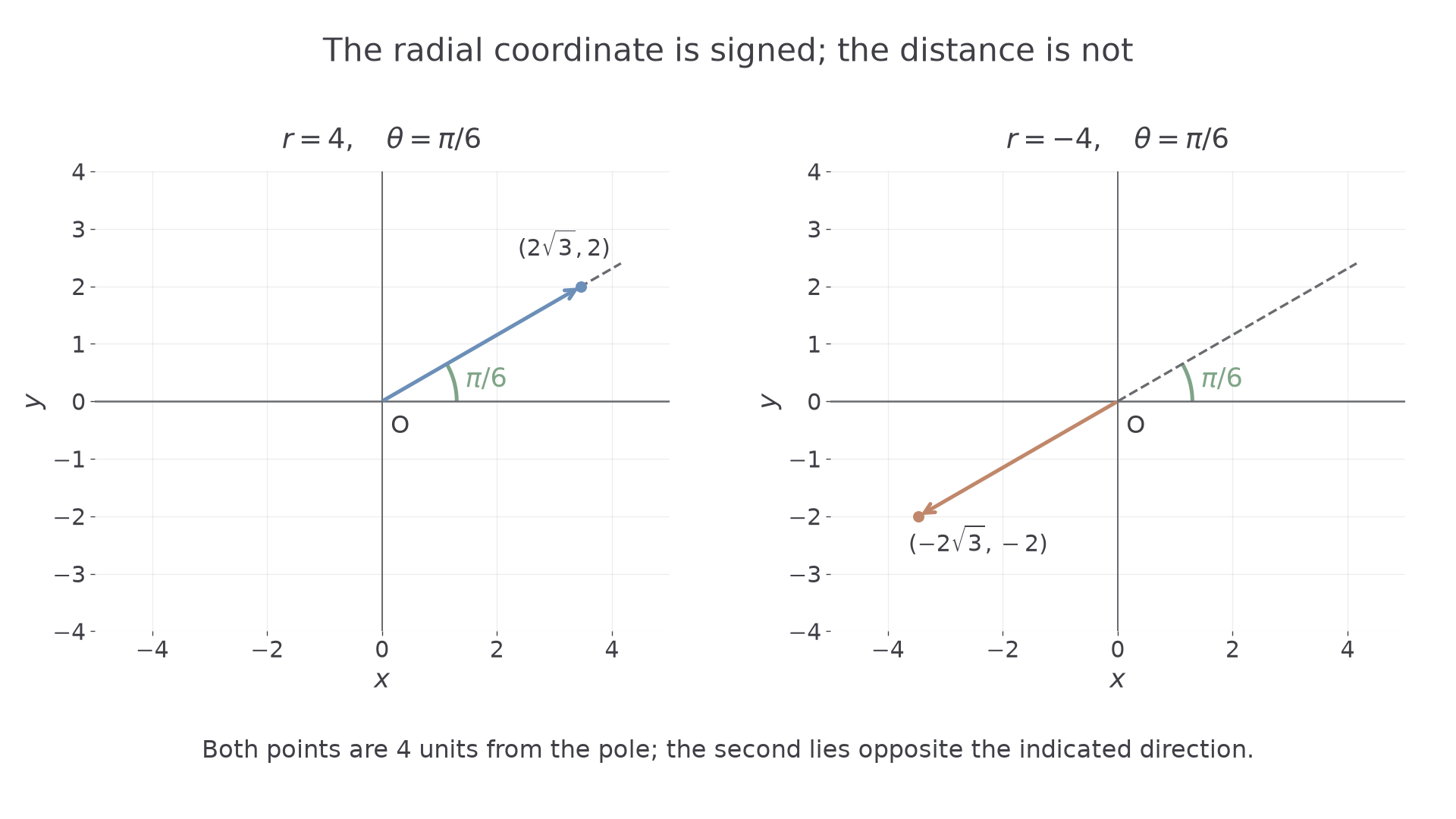
Start with . Turn anticlockwise through , then travel units along that ray. For , make the same turn but travel units in the opposite direction. These are different points.
Polar coordinates
The pole is the fixed origin . The initial line is the fixed ray from which angles are measured, normally the positive Cartesian -axis. In polar coordinates , gives a direction and the signed radial coordinate gives a displacement along it: forwards if , backwards if . The distance from the pole is . If , the point is the pole, whatever is.
Thus is not the Cartesian -coordinate, and it is a distance only when non-negative. In particular, a negative is allowed; it does not mean a negative distance.
Polar to Cartesian coordinates
With the same origin and the positive -axis as initial line,
These relations hold for positive, zero and negative .
Not in the formula booklet: learn it.
Calculate both coordinates using the signed value of . Do not move the point a second time after the calculation: the minus sign has already done that.
Worked example 1: a positive radial coordinate
Question. Find the Cartesian coordinates of .
Plan. Substitute and the exact sine and cosine of .
Why this step? The first polar coordinate is a displacement along a ray, so it must be resolved into two Cartesian components.
Answer. .
Check. , and the point is in the first quadrant.
Change only from to . Both Cartesian components change sign; the indicated angle stays .
Worked example 2: a negative radial coordinate
Question. Find the Cartesian coordinates of .
Plan. Use the same trigonometric values and multiply both by the negative radial coordinate.
Why this step? Multiplying by a negative reverses the whole displacement, rather than just its horizontal component.
Answer. . An alternative polar representation is .
Check. The distance is still , and adding to the indicated direction takes you to the third quadrant.
The two points are opposite ends of a diameter through the pole.
[DIAGRAM: asset_name: A negative radial coordinate reverses the ray; asset_slug: b042_043_signed_radius; caption: The angle is the same, but changing the sign of r moves to the opposite side of the pole; description: Two equal-scale Cartesian panels use the initial line as the positive x-axis and mark a ray at pi over 6. The first shows r equals 4 at (2 square root 3,2). The second shows r equals minus 4 at (-2 square root 3,-2), opposite the indicated ray. Both show distance 4 from the pole.]
Watch out
Wrong: has distance from the pole. Right: its distance is , and its position is opposite the direction . The signed value and the distance are different quantities.
Keep the negative radial coordinate and change the reference angle for your turn.
Choose a radius and the correct quadrant
A point has many polar representations. You can add a full turn to its angle, or reverse the sign of and add a half-turn. Unless asked otherwise, choose when converting from Cartesian coordinates, then give in the interval requested.
Cartesian to polar coordinates
For a point , choosing gives
Choose the quadrant from both signs. When , alone does not identify the quadrant. For any integer ,
represent the same point. At the pole, and the angle is arbitrary.
Not in the formula booklet: learn it.
Polar coordinates do not automatically use the principal-argument interval from complex numbers. Here the questions specify ; use a different interval if it is requested.
Worked example 3: a first-quadrant point
Question. Find polar coordinates of , with and .
Plan. Find the distance, then identify the angle from its cosine and sine.
Why this step? Choosing means the angle points towards the actual point, rather than towards its opposite.
Answer. .
Check. Substitution into returns .
Change only the sign of . The distance is unchanged, but the point moves into the second quadrant.
Worked example 4: a second-quadrant point
Question. Find polar coordinates of , with and .
Plan. Keep the positive distance and choose the second-quadrant angle with reference angle .
Why this step? would put the point in the fourth quadrant, with both signs wrong.
Answer. .
Check. and .
The interval also matters below the horizontal axis, where a negative angle may need a full turn added.
Watch out
Wrong: report when the question requires . Right: use the equivalent direction . Equivalent points can still fail a stated coordinate convention.
Change the imaginary-direction sign from the last example so that the point moves below the horizontal axis.
Convert the equation without losing the pole
The same coordinate relations convert equations. Substitute for every and , simplify using trigonometric identities, and check the pole separately whenever you divide by .
For example, the Cartesian equation becomes . If , division gives . The original curve also contains the pole, so keep it: the polar equation reaches it when .
Worked example 5: a circle through the pole
Question. Convert , for , into a Cartesian equation and identify the curve.
Plan. Multiply by to create and , then complete the square.
Why this step? alone is not ; the product is. Multiplying first produces the correct Cartesian expression.
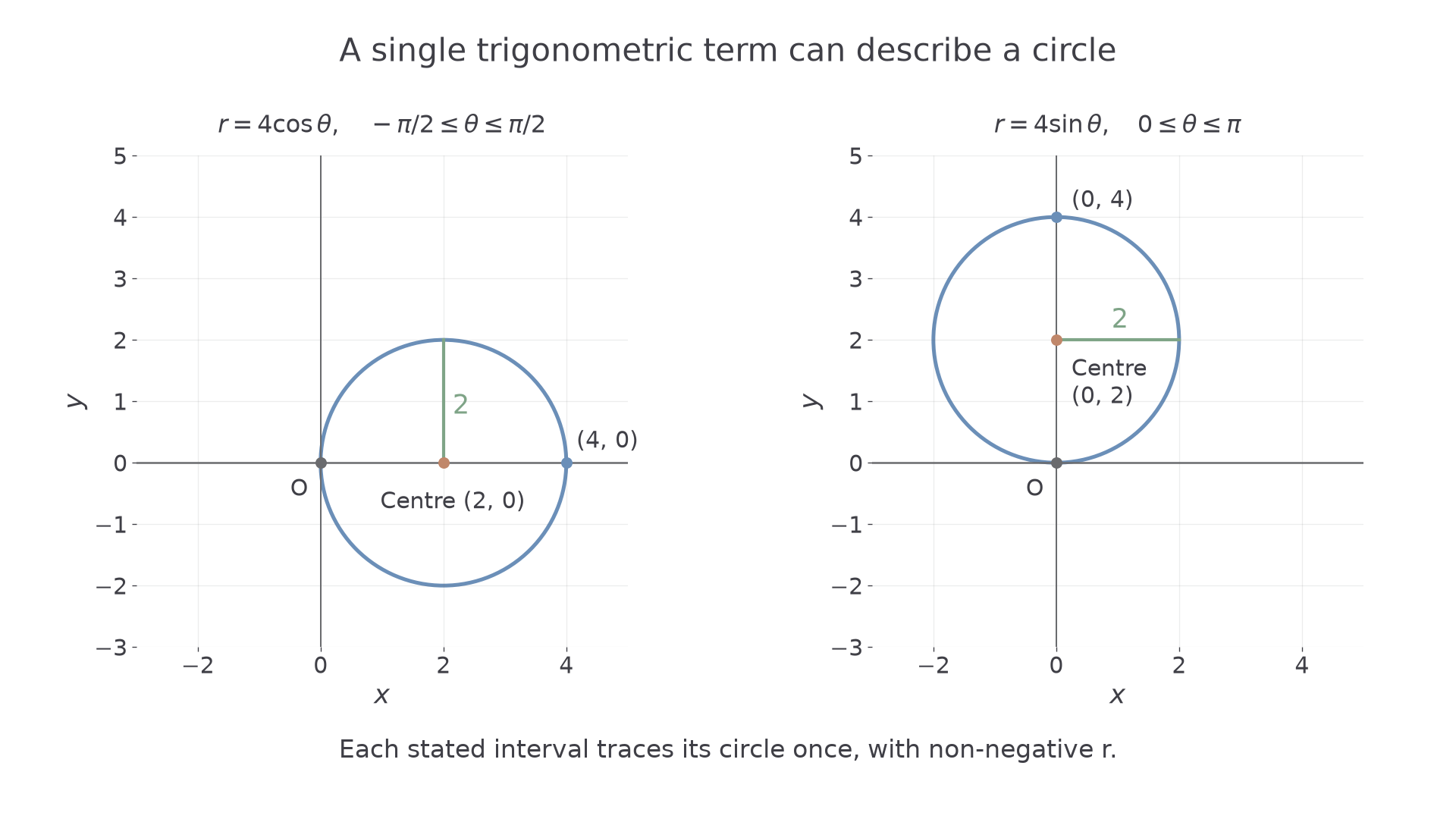
Answer. The circle with centre and radius , traced once over the given interval.
Check. At , gives . At both endpoints, gives the pole, also on the circle.
Change only cosine to sine, rotating the circle to lie above the initial line. The interval changes to trace that circle once with .
Worked example 6: the same circle turned upwards
Question. Convert , for , into a Cartesian equation and identify the curve.
Plan. Multiply by , substitute , and complete the square in .
Why this step? The sine term gives the vertical coordinate, so the circle's centre moves onto the -axis.
Answer. The circle with centre and radius , traced once over the stated interval.
Check. gives , the point , while and give the pole.
A circle through the pole needs only a single trigonometric term in polar form, even though its centre is away from the pole. On the first curve, is units from the pole but only units from the circle's centre. Those two lengths measure different things.
[DIAGRAM: asset_name: Polar equations of circles through the pole; asset_slug: b042_043_polar_circles; caption: r equals 4 cosine theta gives a circle centred on the initial line; replacing cosine by sine turns it upwards; description: Two equal-scale panels show the circles centred at (2,0) and (0,2), each with radius 2 and passing through the pole. The points furthest from the pole are (4,0) and (0,4). The first panel gives the interval minus pi over 2 to pi over 2 and the second zero to pi, each tracing once with non-negative r.]
Watch out
Wrong: cancel from an equation and conclude that the pole is absent. Right: cancellation assumes , so check in the original equation separately. Also avoid introducing an extra branch by squaring without checking the original equation and its angle range.
The next conversion uses a double-angle identity. Keep an explicit note about the point where cancellation is unavailable.
Continue this lesson.
You’re previewing NovaLearn without an account. Create a free account to read the rest.
Create free account