Pa5 - Calculus of sinh, cosh and tanh
The exponential definitions make hyperbolic differentiation and integration surprisingly direct. You derive the derivatives, use the chain and product rules, and recognise the corresponding antiderivatives, including a logarithm when you integrate tanh. Differentiating your answers will catch both missing scale factors and familiar trigonometric sign slips.
Differentiating sinh and cosh
Can you find the exact area under from to ?
It looks like three new integration problems. By the third part, each term will have a simple antiderivative and the area will reduce to a fraction. First, derive the differentiation rules rather than guessing from ordinary trigonometry.
You already know
and . The chain rule gives ; the product rule is .
Differentiate the definitions term by term:
The second derivative of each function is the function itself: and . Ordinary sine and cosine instead return with a minus sign. A tiny sign change produces very different curves.
Sinh and cosh derivatives
For a differentiable real function :
There is no extra minus sign when differentiating hyperbolic cosine.
Not in the formula booklet: learn it.
When a hyperbolic function is multiplied by another function, use the product rule outside and the chain rule inside.
Worked example 1: product and chain rules together
Question. Differentiate .
Plan. Differentiate each factor in turn, including the inner derivative .
Why this step? Differentiating only would treat the factor as a constant. The product rule supplies the additional term.
Answer. .
Check. At , the gradient is . Near zero, is close to , so is close to , agreeing with that gradient.
The next example changes only cosine to sine. Follow the same product-rule structure and notice that no sign reversal appears.
Worked example 2: changing the hyperbolic factor
Question. Differentiate .
Plan. Use the product rule and differentiate the inner by the chain rule.
Why this step? Hyperbolic sine differentiates to hyperbolic cosine, while hyperbolic cosine differentiates back to hyperbolic sine. The sign difference from ordinary cosine has already been accounted for in the derivation.
Answer. .
Check. The derivative is at . The original function is even, since it is the product of two odd functions, so a horizontal tangent at the origin is consistent.
Writing the derivative of each factor before assembling the product helps keep the two rules separate.
Watch out
Wrong: , copied from cosine. Right: . Derive it from the exponentials if the sign is uncertain.
The next question changes the power of the factor outside the hyperbolic function, so that factor's derivative changes too.
The derivative of tanh
Differentiating the ratio brings the fundamental identity into the calculation.
Apply the quotient rule and simplify its numerator:
The derivative is positive everywhere, so the graph is increasing. At zero it is ; far from zero, is large and the derivative is small. That explains the flattening near the two horizontal asymptotes.
[DIAGRAM: asset_name: Tanh and its positive derivative; asset_slug: tanh_and_derivative; caption: Tanh increases everywhere, with its largest slope 1 at the origin and slopes tending to zero in both tails; description: Two aligned coordinate panels show tanh x in blue with dashed asymptotes y equals plus or minus 1, and its derivative 1 over cosh squared x in sage. The derivative panel peaks at 0,1 and stays above the x-axis. A tangent line at the origin in the first panel has gradient 1. Matching vertical guides at x equals minus 2,0,2 connect the idea of flatter tails to smaller derivative values.]
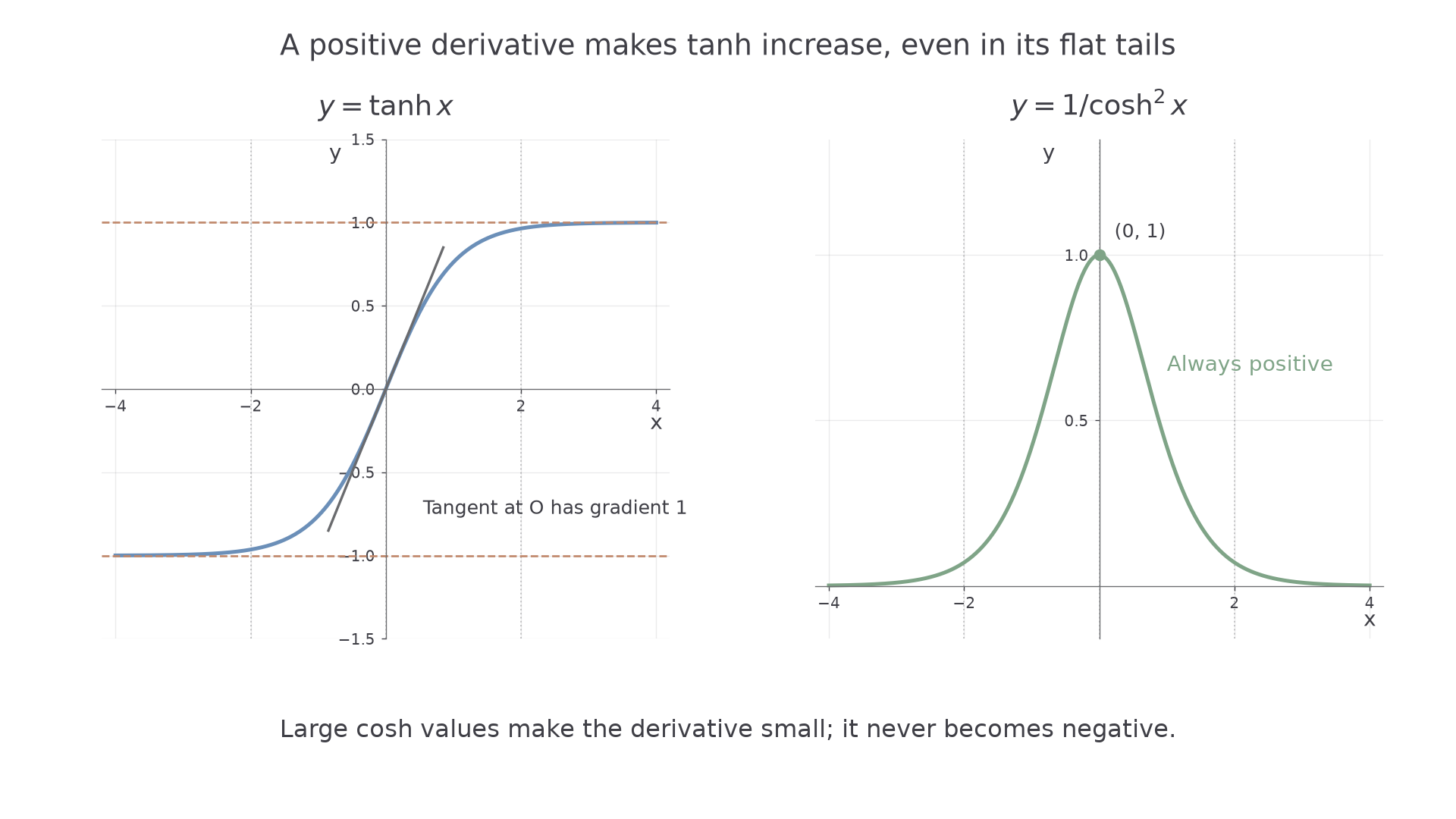
Tanh derivative
For a differentiable real function :
The reciprocal square is also written , where .
Not in the formula booklet: learn it.
Dividing the fundamental identity by also gives . This is a derived equivalent form, not a separate identity to memorise; it is not printed in the formula booklet.
Worked example 3: a scaled argument
Question. Differentiate .
Plan. Use the tanh derivative and multiply by the derivative of .
Why this step? The derivative of the inner function multiplies the reciprocal square; it does not replace the argument inside .
Answer. .
Check. At , the slope is . Replacing by compresses the tanh graph horizontally and doubles its initial slope.
The next example adds one outer square. Differentiate that square before using the derivative from Worked example 3.
Worked example 4: a squared hyperbolic tangent
Question. Differentiate .
Plan. Regard the function as the square of , then apply the chain rule twice.
Why this step? has a squared output. It is not , whose input has been doubled.
Answer. .
Check. The function is even and has minimum zero at the origin. Its derivative is odd and zero there, with the expected signs on either side.
Equivalent derivative forms are welcome when they are algebraically consistent. Keep powers and arguments visibly different.
Watch out
Wrong: , copied from ordinary tangent. Right: . The minus sign follows from the hyperbolic identity.
Continue this lesson.
You’re previewing NovaLearn without an account. Create a free account to read the rest.
Create free account