Pv9, Pv10 - Lines and the angle between them
Describe a straight line using a point and a direction, convert between vector and Cartesian forms, and calculate the smaller angle between two lines from their direction vectors. You will handle zero direction components without dividing by zero and recognise different equations of the same line.
A point plus a direction
A cable runs through in direction . Does it pass through , or ?
From , two lots of the direction vector reach . The same two lots cannot reach : its third coordinate fails. One parameter must describe the movement in every coordinate at once.
You already know
The displacement from to is . Multiplying a non-zero direction vector by any non-zero scalar keeps the same parallel direction, possibly with its sense reversed.
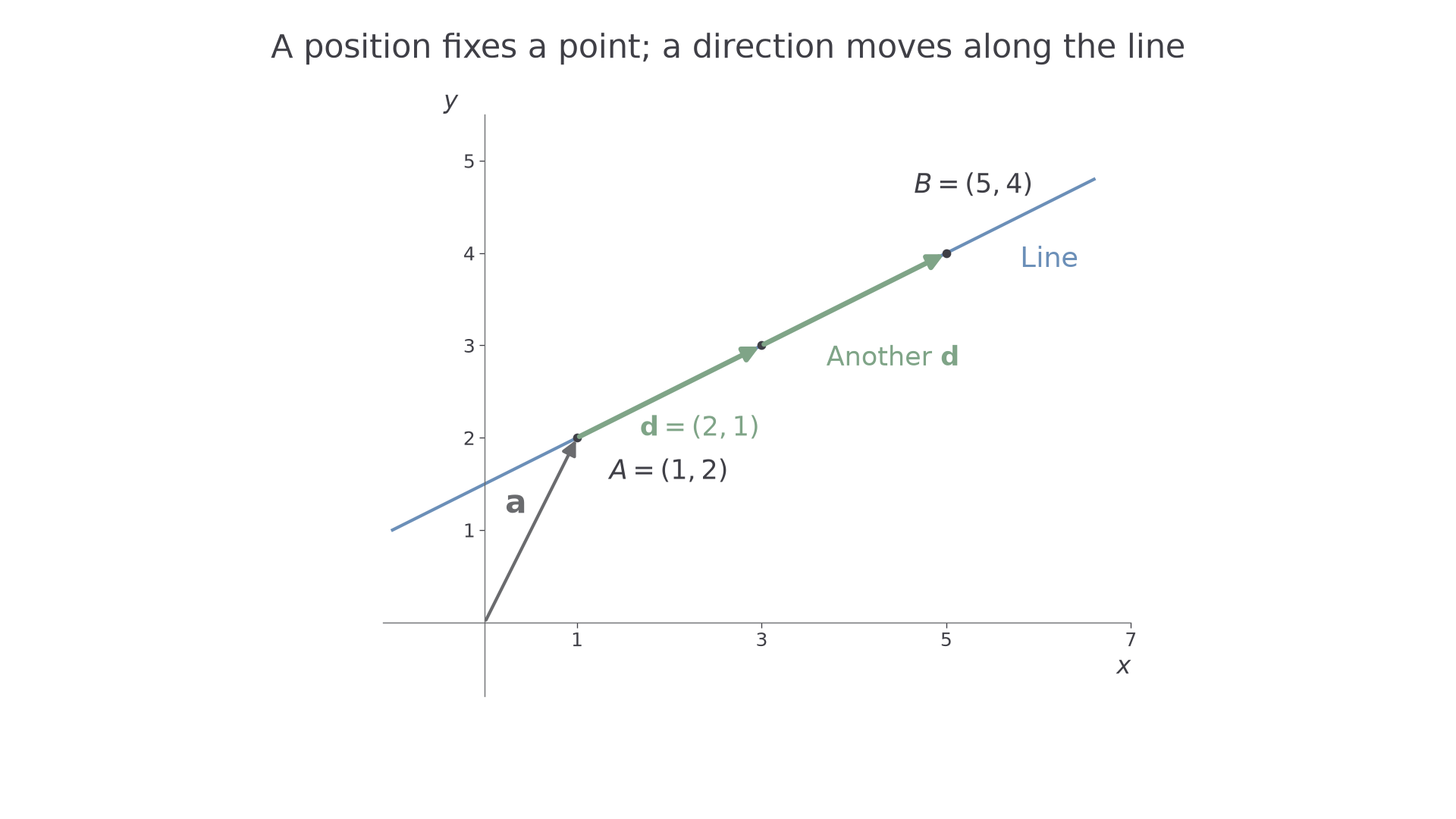
A direction vector gives the line's tilt, while a position vector fixes one point on it. They have different jobs, even though both are written as vectors.
[DIAGRAM: asset_name: A point and a direction define a line; asset_slug: line_point_direction; caption: Changing the parameter moves along the line while its starting point stays fixed; description: Equal two-dimensional axes show a blue line through A=(1,2) and B=(5,4). A grey position arrow runs from the origin to A. A sage arrow from A to (3,3) is labelled d=(2,1), and a further arrow to B shows a second copy of d. The labels distinguish a position vector from a direction vector.]
Vector equation of a line
A line through the point with position vector , parallel to a non-zero vector , has equation
The same form works in two or three dimensions. The parameter runs over all real values for the whole line.
Not in the formula booklet: learn it.
At , you are at the chosen point. Positive and negative values travel in opposite senses, and a direction vector does not have to be a unit vector.
Worked example 1: a two-dimensional line
Question. Find a vector equation of the line through parallel to , and find the point corresponding to .
Plan. Add a real multiple of the direction vector to the position vector of .
Why this step? The same parameter multiplies both components, so the movement remains parallel to one fixed vector.
Answer. , with point at .
Check. The displacement is twice .
Now add a third coordinate. The structure stays exactly the same; the parameter controls three coordinates rather than two.
Worked example 2: a three-dimensional line
Question. Find a vector equation of the line through parallel to , and find the point at .
Plan. Use the three-dimensional point and direction in the same equation.
Why this step? A three-dimensional line still needs only one parameter: you have one independent direction of travel.
Answer. The stated equation gives point at .
Check. .
A useful surprise is that a line has infinitely many correct vector equations. For the second example, describes the same line: it starts at another point and uses twice the direction vector. Here , so every real value of one parameter corresponds to a real value of the other.
Watch out
Wrong: use a different parameter for each coordinate of a line. Right: , , all use the same . Separate independent parameters would allow extra directions of movement.
Two points supply the direction by subtraction. Check that they are distinct so the resulting direction vector is non-zero.
Cartesian equations and zero components
Eliminating the shared parameter turns a vector equation into Cartesian equations without changing which points belong to the line.
From , you get when . Do the same for the other coordinates and equate the expressions for .
Cartesian equations of a line
If all three direction components are non-zero,
In two dimensions, use just the first two ratios. If a direction component is zero, keep that coordinate fixed instead of forming its ratio.
The three-dimensional Cartesian form is provided.
In the formula booklet.
The numerator is always coordinate minus point coordinate. A negative point coordinate therefore produces a plus sign. In two dimensions, cross-multiplying the two ratios also gives an ordinary Cartesian line equation.
Worked example 3: eliminating the parameter
Question. Convert to Cartesian form.
Plan. Write the three component equations, rearrange each for , then equate.
Why this step? Equal ratios ensure that all three coordinates use the same parameter value.
Answer. .
Check. At , the point is , and all three expressions equal .
Change only the middle direction component to zero. The line no longer moves in the -direction, so that coordinate must be written separately.
Worked example 4: a fixed coordinate
Question. Convert to Cartesian form.
Plan. Keep the constant -coordinate and eliminate only from the other two equations.
Why this step? Writing would divide by zero. The equation expresses the geometry directly.
Answer. , together with .
Check. At , gives both variable ratios equal to , and the fixed coordinate is correct.
The reverse conversion simply names the common ratio . For example, in two dimensions gives , , or . Cross-multiplying gives the equivalent equation . These conversion steps follow from the line equation; the two-dimensional ratio form and the zero-component rule are not separately printed in the booklet.
Watch out
Wrong: . Right: replace the last ratio by . Zero movement means a fixed coordinate, not a zero denominator.
Now read the point and direction from a Cartesian line with a different fixed coordinate.
The smaller angle between lines
The angle between lines depends on their directions, so their starting points do not enter the calculation.
For lines in space, move copies of the direction vectors to one point before imagining their angle. This definition works even when the original lines do not meet. Since either sense describes the same line direction, the required angle between non-perpendicular lines is acute.
Angle between lines
For non-zero direction vectors and , the smaller angle , with , satisfies
Parallel directions give zero angle; perpendicular directions give a right angle.
Not in the formula booklet: learn it.
An absolute value removes the arbitrary choice of which way the direction arrow points. It is appropriate for lines, but not for the full angle between two specified vectors.
Worked example 5: using direction vectors
Question. Find the acute angle between
Give your answer to one decimal place.
Plan. Use the two direction vectors in the scalar-product formula and ignore the position vectors.
Why this step? Translating a line changes its position vector but cannot change its direction or the angle it makes with another line.
Answer. .
Check. Both directions rise one unit in for one unit in ; the extra -movement produces a moderate acute angle.
Reverse only the second direction. The second line is unchanged, so the smaller angle must stay the same.
Worked example 6: opposite direction arrows
Question. Determine the acute angle between lines with direction vectors and , to one decimal place.
Plan. Take the absolute scalar product, or find the obtuse vector angle and take its supplement.
Why this step? The arrows have angle , but a line has no preferred forward sense. The requested acute angle is its supplement.
Answer. .
Check. Negating a direction vector gives the same line, so the answer agrees with the previous example.
For a Cartesian line, the denominators supply the direction components; a fixed coordinate contributes a zero component. Do not use the constants in the numerators as a direction vector.
Watch out
Wrong: use the position vectors to find the angle between lines. Right: use their direction vectors. Positions locate lines; directions determine their angle.
For the opening cable, the common parameter gives . The point has the right first two coordinates but fails the third, so it is off the cable.
Quick Recap
- A line is , with non-zero and real .
- Two points supply a direction by subtraction; different points and scaled directions can describe the same line.
- Eliminate one shared parameter for Cartesian form; keep any zero-direction coordinate fixed.
- Use direction vectors and the absolute scalar product to find the smaller line angle.
The opening cable passes through and misses .