Pv2, Pv3 - Equations of planes
Describe a flat surface using a point and a perpendicular direction. You will explain what a normal vector tells you, form and use vector and Cartesian equations of planes, and find a normal from two non-parallel directions in a plane.
What a normal vector tells you
A flat sheet passes through , and the vector points straight out of it. Which other points lie on the sheet?
A point alone leaves the sheet free to swivel. A perpendicular direction fixes its tilt. Together they determine one plane, extending indefinitely in every direction along the sheet.
You already know
The displacement from to is , where and are their position vectors. Two non-zero vectors are perpendicular when their scalar product is zero.
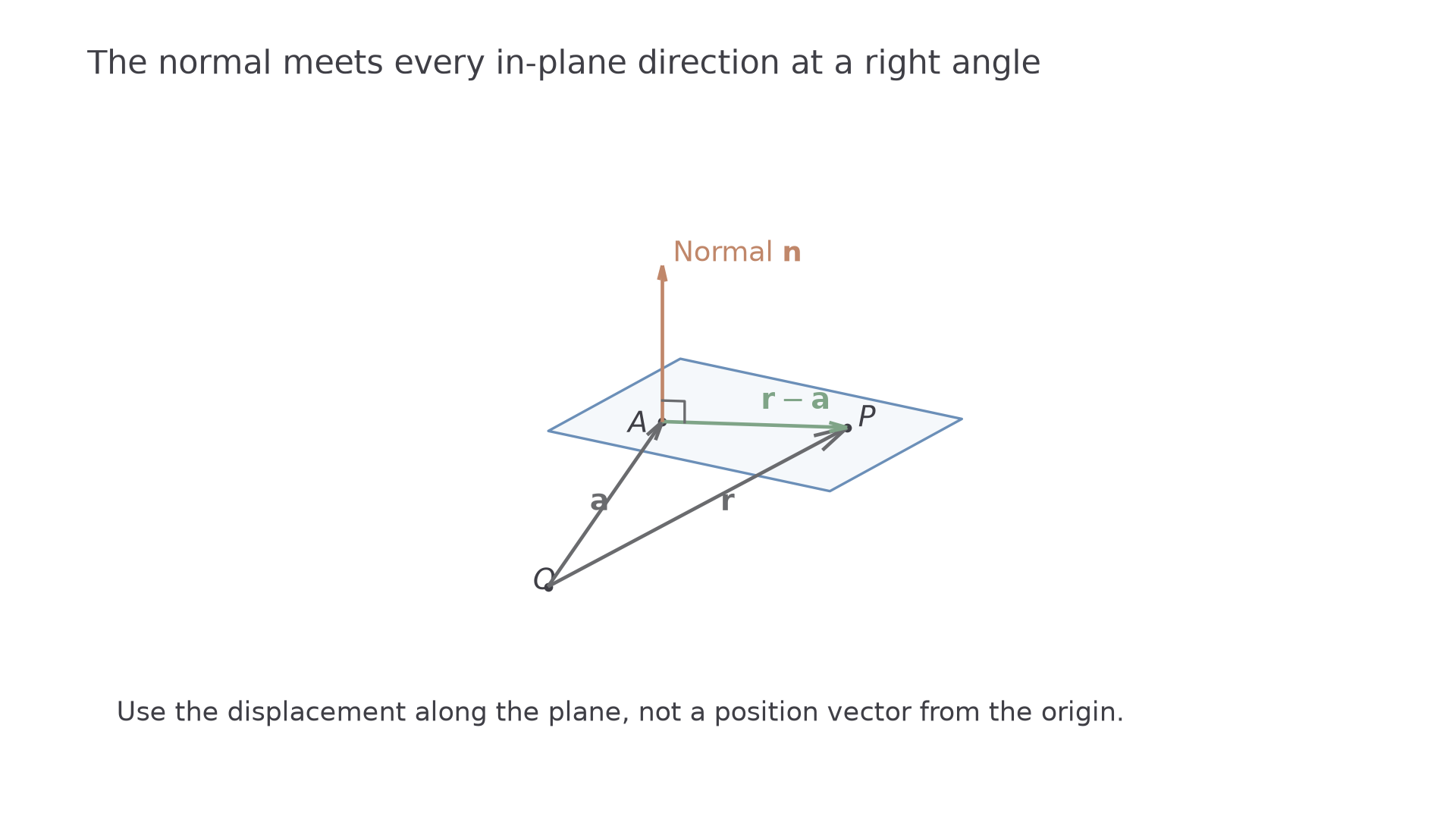
The important vectors are displacements along the surface. A position vector from the origin need not lie along the plane: the origin might be somewhere else entirely.
[DIAGRAM: asset_name: A plane and its normal; asset_slug: plane_normal; caption: The normal is perpendicular to every displacement along the plane; description: A pale blue oblique plane contains labelled points A and P. A clay normal arrow leaves A, and a sage displacement AP lies in the plane. A right-angle marker identifies their perpendicular relationship. The origin is below and outside the plane, with grey position arrows to A and P.]
Normal to a plane
A normal vector is a non-zero vector perpendicular to a plane. It is perpendicular to every non-zero direction vector lying in that plane. For example, is normal to . A vector lying along that plane, such as , is not a normal.
Conversely, if a non-zero vector is perpendicular to two non-parallel directions in a plane, it is normal to the plane. Every direction in the plane can be built by adding multiples of those two directions, and the scalar product distributes over that addition. One perpendicular direction is not enough: infinitely many planes contain one line.
A plane has infinitely many normal vectors. If works, so does , or : they give the same perpendicular direction, with a different length or sense. The zero vector does not work because it fixes no direction.
Key idea
To identify a plane's normal, establish perpendicularity to two non-parallel directions in the plane. To use a known normal, take its scalar product with a displacement along the plane.
The requirement for two different directions is the key distinction in this check.
Vector and Cartesian plane equations
Every point on a plane gives a displacement perpendicular to its normal, so one scalar-product equation describes the whole surface.
For the opening sheet, becomes , or . Here is a useful surprise: infinitely many points share the same scalar product . One fixed number labels an entire plane.
Plane through a point with a normal
A plane through the point with position vector , with non-zero normal , has vector equation
Its Cartesian equation is
Cartesian equation: In the formula booklet.
Normal-vector form and the relation for : Not in the formula booklet: learn it.
Expanding the dot product converts vector form to Cartesian form. In the reverse direction, the three coordinate coefficients give a normal immediately; find any point satisfying the equation to supply .
Worked example 1: forming a plane equation
Question. A plane passes through and has normal . Find its vector and Cartesian equations.
Plan. Insert the point and normal into the perpendicular-displacement equation, then expand.
Why this step? The third displacement component is , not .
Answer. The first line is a vector equation; the Cartesian equation is .
Check. At , , as required.
The next example reverses the conversion: the plane is supplied in Cartesian form, so its coefficients give the normal before you choose a point.
Worked example 2: reading the normal from coefficients
Question. Write as .
Plan. Read off a normal and set two coordinates to zero to find an easy point on the plane.
Why this step? The constant locates the plane; it is not a fourth component of the normal.
Answer. .
Check. Expanding gives , exactly the original equation.
To use a plane equation, substitute a point's coordinates. For example, lies in the second plane since ; does not. Multiplying the whole equation by any non-zero number leaves the same set of points.
Watch out
Wrong: the plane through has equation . That forces it through the origin. Right: use , or .
The following question changes the coordinate on which the convenient intercept lies.
Finding a plane from two directions
Two non-parallel directions let you find a normal by imposing two perpendicularity conditions, then a point fixes the plane's position.
Write the unknown normal as . The equations and determine its ratios. You may choose a convenient non-zero scale because the normal's length does not matter. This is a consequence of the normal-vector definition, rather than a further formula in the booklet.
Worked example 3: two given directions
Question. A plane passes through and contains the directions and . Determine its Cartesian equation.
Plan. Find a non-zero vector perpendicular to both directions, then use the given point.
Why this step? The directions are not parallel, so a vector perpendicular to both is normal to the whole plane.
Answer. .
Check. and ; also .
Change the way the directions are supplied: three non-collinear points give two displacements within the plane. Subtract first; position vectors alone usually point elsewhere.
Worked example 4: a plane through three points
Question. Determine the plane through , and .
Plan. Use and as the two directions, then find their common normal.
Why this step? Three collinear points would give parallel displacements and would not select one plane. These two displacements are not multiples.
Answer. .
Check. Substituting , and gives , , and .
You have now built the opening sheet's equation: its points are exactly those satisfying . In particular, moving by any displacement perpendicular to keeps that value unchanged.
Watch out
Wrong: use the position vectors of and as directions in the plane. Right: use and . The origin has not been stated to lie in the plane.
Use the same three-point route with a different final displacement.
Quick Recap
- A normal is perpendicular to every direction along a plane.
- A point and a non-zero normal give .
- Expanding gives a Cartesian equation; its coordinate coefficients give a normal.
- Two non-parallel directions determine the normal's ratios; three non-collinear points supply those directions.
The opening sheet consists of all points satisfying .