Ps1 - Standard summation formulae
Sum expressions involving integers, squares and cubes without adding every term. You will combine the standard formulae, handle a changed starting index, and prove the square and cube formulae when a question requires justification.
Combining the standard sums
What is , without a hundred separate squarings?
The odd numbers are , for . Squaring gives . That turns the puzzle into three familiar types of sum. We will finish it after practising that conversion.
You already know
adds the terms for integer indices through , inclusive. Split a sum across addition and take constant factors outside it. The sum of copies of is , not .
The three formulae below all start at . Match both the expression and the limits before substituting.
Integers, squares and cubes
For every positive integer ,
The integer sum follows from the arithmetic-series formula in the booklet. The square and cube formulae are printed explicitly.
In the formula booklet.
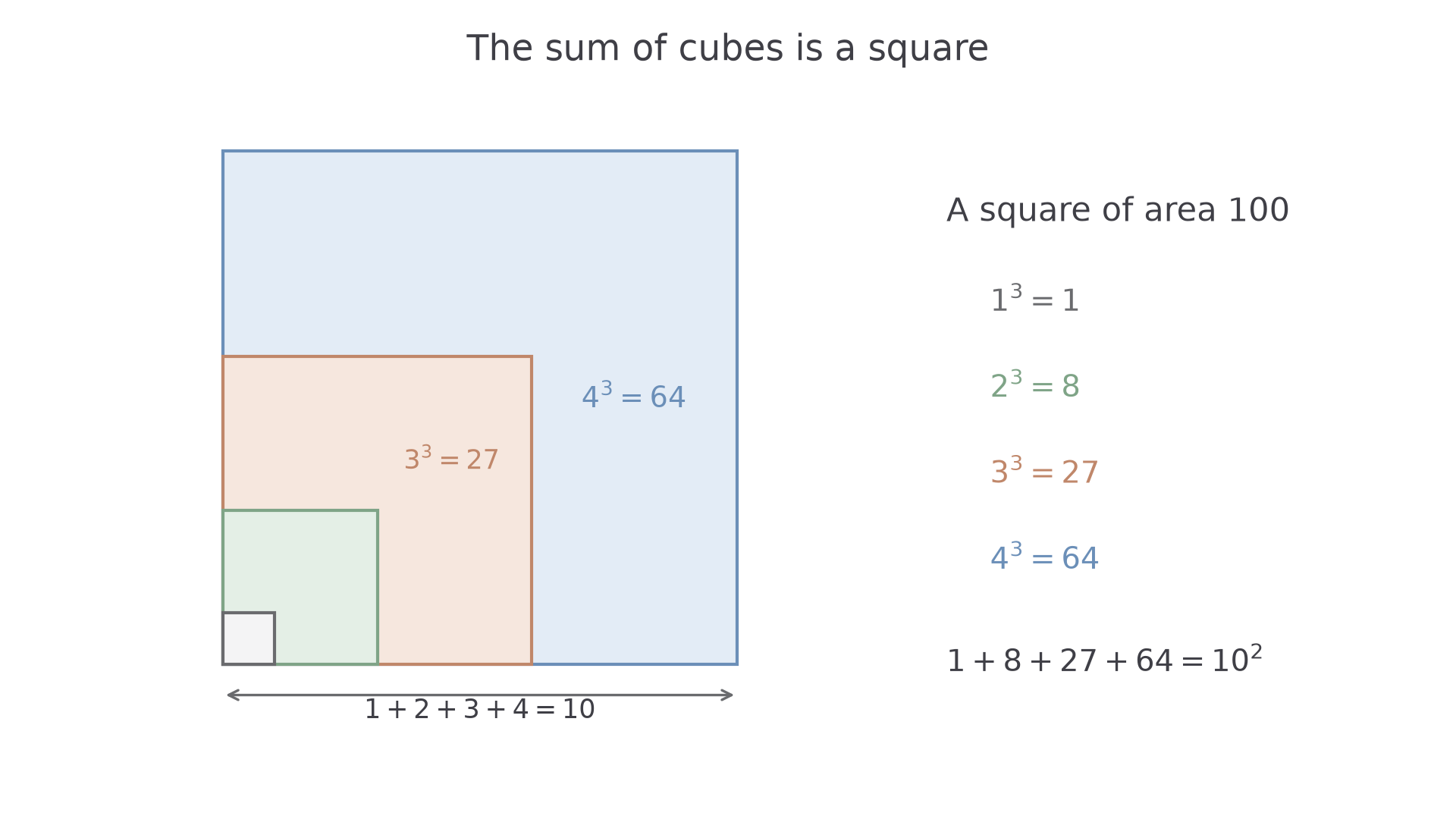
The cube formula has a lovely consequence: the sum of the first cubes is the square of the sum of the first integers. For , . The nested-square picture makes the identity less mysterious.
[DIAGRAM: asset_name: Cubes inside a triangular-number square; asset_slug: cubes_triangular_square; caption: Successive square bands have areas 1 cubed, 2 cubed, 3 cubed and 4 cubed; description: Nested squares with side lengths 1, 3, 6 and 10 occupy a ten by ten square. The successive L-shaped bands have areas 1, 8, 27 and 64, labelled in a colour-matched legend. The full side is labelled 1+2+3+4=10 and the total area is 100.]
Worked example 1: expanding before summing
Question. Find in factorised form.
Plan. Expand, apply the integer and square formulae, then factorise.
Why this step? Expansion exposes the two formulae already available, so there is no separate product-sum formula to memorise.
Answer. .
Check. At , the sum is , and the formula gives .
Change only the second factor from to . The coefficient of the integer sum changes.
Worked example 2: a changed linear factor
Question. Show that .
Plan. Expand the product, separate the sums and simplify to the given expression.
Why this step? The factor multiplies the whole integer sum, since it occurs at every index.
Answer. The required expression follows.
Check. For , both sides equal .
A “show that” answer needs the expansion and formula substitutions. Quoting the given expression does not establish it.
Watch out
Wrong: . Right: . The contribution occurs at every index.
Change the second factor once more and choose the same route.
Changed limits and shifted terms
A sum starting after is the full sum minus the unwanted beginning; a shifted expression is expanded before the standard formulae are used.
For example, summing from through includes seven terms, and removes the terms indexed . It does not remove the term indexed .
Subtracting an initial section
If are integers,
When , the second sum is empty and equals zero.
Not in the formula booklet: learn it.
Write the last removed index explicitly to prevent an off-by-one error.
Worked example 3: a tail of squares
Question. Find .
Plan. Subtract the first five squares from the first twelve squares.
Why this step? Subtracting through would remove the first term you want to keep.
Answer. .
Check. .
Now change the starting index to , with the upper index . The subtraction becomes symbolic.
Worked example 4: the second block of squares
Question. Show that , for positive integers .
Plan. Subtract the first squares from the first squares.
Why this step? The square formula uses its upper index everywhere: replacing by changes to too.
Answer. The given formula is established.
Check. At , .
For the opening odd squares, expansion now gives
Thus the hundred odd squares total . This derived identity is not printed separately in the booklet.
Watch out
Wrong: is the first squares. Right: either expand , or sum the squares from to . The shift changes the terms.
Apply block subtraction with cubes instead of squares.
Proving a summation formula
A supplied formula can still need a proof: induction verifies the first sum and shows that adding the next term preserves the claimed form.
You already know
An induction proof needs a base case, an assumption for an arbitrary integer , an implication proving the case , and a conclusion. The next sum is the previous sum plus its next term.
Use the assumed expression for the first terms. Substituting into the target formula alone would just restate what you must prove.
Worked example 5: proving the square formula
Question. Prove by induction that for all positive integers .
Plan. Check , assume the sum through , then add .
For , both sides equal . Assume the result for an arbitrary integer . Then
Why this step? The last line is the proposed formula at , because .
Answer. The result holds for , and truth for implies truth for ; hence it holds for every positive integer , by induction.
Check. At , .
Change only the power from squares to cubes. The added term becomes .
Worked example 6: proving the cube formula
Question. Prove by induction that for positive integers .
Plan. Verify , assume the sum through , and add the next cube.
At , both sides equal . Assume the result for an arbitrary integer . Then
Why this step? Factoring out leaves the exact square needed for the next case.
Answer. The result holds for , and truth for implies truth for ; therefore it holds for all positive integers, by induction.
Check. At , .
These proofs explain the formulae printed in the booklet; the induction arguments themselves are not provided.
Watch out
Wrong: add to the sum through . Right: add . The term indexed is already included.
Keep the cube method but multiply each input by . The added term and the claimed total both change.
Quick Recap
- Expand polynomial summands before applying the standard sums.
- A constant is added once for each index.
- For changed limits, subtract through the index immediately before the desired start.
- Proving a supplied formula still needs an actual induction step and conclusion.
The hundred odd squares add to .