Pm4, Pm5 - Successive and 3-D transformations
Combining two transformations means multiplying their matrices in the correct order. You learn that connection in Pm5, then extend Pm4 to reflections in coordinate planes and quarter-turn multiples about coordinate axes in three dimensions. Unit-vector images keep the larger matrices manageable.
The first transformation goes on the right
If you reflect a point and then rotate it, will reversing those two moves give the same answer?
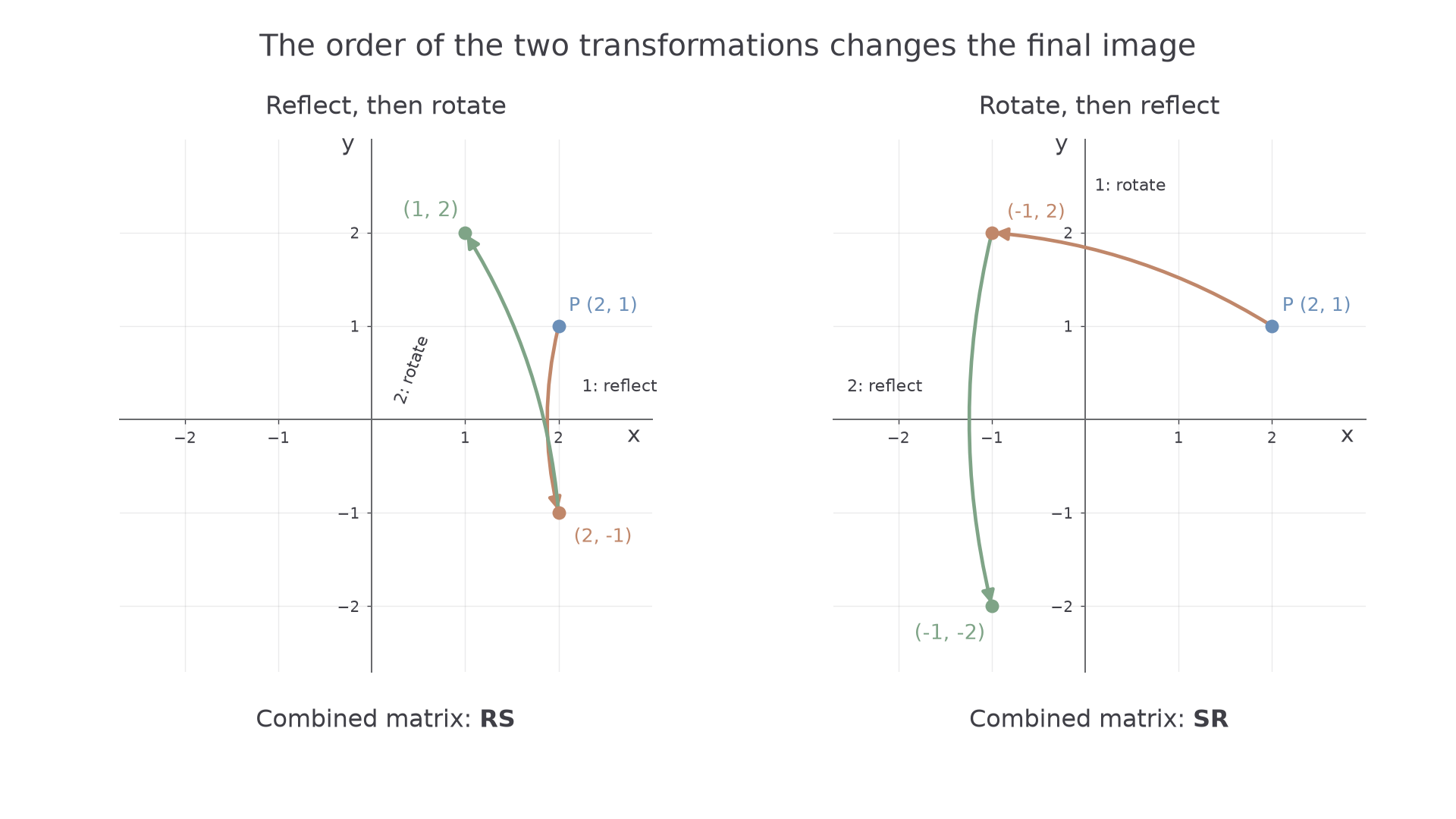
Start with . Reflecting in the -axis gives ; a anticlockwise rotation then gives . Reverse the moves: the rotation gives , and the reflection gives . The same two instructions have produced different destinations.
You already know
A transformation with matrix sends a column vector to . The columns are the images of the unit vectors. Matrix multiplication is associative, but its factors cannot generally be exchanged.
Suppose the first transformation has matrix and the second has matrix . The intermediate vector is , so the final vector is . This derives the order rule rather than leaving it as a memory trick.
Successive transformations
For column position vectors in two dimensions:
The rightmost matrix acts first. Thus a matrix represents the transformation associated with , followed by the one associated with .
Not in the formula booklet: learn it.
Writing a short arrow chain beside the product makes it harder to reverse the instructions.
[DIAGRAM: asset_name: Reversing two transformations; asset_slug: transformation_order; caption: Reflection followed by rotation and rotation followed by reflection send the same point to different images; description: Two equal-scale coordinate panels begin with P at 2,1 in blue. The left panel shows reflection in the x-axis to 2,minus1 and then a 90 degree anticlockwise rotation to 1,2 in sage. The right panel shows the rotation first to minus1,2 and then reflection to minus1,minus2 in sage. Intermediate points are clay, and arrows are numbered first and second. Each panel states its matrix order.]
Worked example 1: reflection followed by rotation
Question. Find the matrix for reflection in the -axis followed by rotation centre the origin through anticlockwise. Hence find the image of .
Plan. Write the reflection matrix and rotation matrix , calculate , then apply it to the point.
Why this step? The first operation must touch the vector first, so belongs next to the vector, on the right of .
Answer. The combined matrix is , and the image is . This combination is also the single reflection in .
Check. The two-step point calculation is , agreeing with the product.
The next example changes the second transformation from a rotation to a shear. Its full description must include the fixed axis and a point image.
Worked example 2: recognising a combination
Question. Show that represents reflection in the -axis followed by a shear with the -axis fixed, mapping to . Find the image of .
Plan. Construct each matrix from its description and multiply in the stated order.
Why this step? A combined matrix need not itself be one of the named basic matrices. Describing it as two precise transformations is a complete geometric description.
Answer. The product confirms the stated reflection followed by shear. The image is .
Check. First ; the shear then gives .
There is another pleasant consequence: two reflections can make a rotation. Reflection in the -axis followed by reflection in has matrix
This is a anticlockwise rotation. Two mirror lines meeting at have produced a turn twice that angle.
Watch out
Wrong: “first , then ” gives . Right: the vector follows , so the product is . If the products differ, say that the order of the transformations matters when asked for the geometric significance.
The next combination changes the fixed axis of the shear. Construct it from its unit-vector images before multiplying.
Reflections in coordinate planes
In three dimensions, a coordinate-plane reflection reverses one coordinate and leaves the other two unchanged.
The plane is the -plane. Reflecting in it gives : only the perpendicular distance, measured in the -direction, changes sign. The planes and work in the same way.
Three-dimensional transformation matrix
For a linear transformation in three dimensions, columns , and of its matrix are the images of , and , respectively. The image of is .
These three columns have exactly the same role as the two unit-vector images in the plane. Each coordinate-plane reflection reverses one of them.
Coordinate-plane reflection matrices
The matrices for reflection in the three coordinate planes are
The negative entry is in the coordinate perpendicular to the reflecting plane.
Not in the formula booklet: learn it.
The plane's equation tells you which coordinate is perpendicular; there is no need to rely on a perspective sketch.
Worked example 3: reflecting in the yz-plane
Question. Find the matrix for reflection in , and the image of .
Plan. Reverse the first unit vector and retain the other two as matrix columns.
Why this step? Reflection in fixes every point whose first coordinate is zero, so the other two coordinates must remain unchanged.
Answer. Matrix ; image .
Check. The midpoint is , in the mirror plane, and the point-image segment is perpendicular to that plane.
The next example changes only the negative diagonal position. Read it back into a geometric description.
Worked example 4: identifying the reflecting plane
Question. Specify fully the transformation associated with , and find the image of .
Plan. Identify the changed coordinate and the plane on which every point stays fixed.
Why this step? Two coordinates staying unchanged identify a reflection in a plane, rather than a half-turn about an axis.
Answer. Reflection in the plane ; image .
Check. The midpoint lies in ; both points are distance from that plane.
A coordinate axis and a coordinate plane have different dimensions, so their names cannot be exchanged.
Watch out
Wrong: is reflection in . That reflection reverses only. Right: reflects in ; instead makes a half-turn about the -axis.
The next matrix has its single negative entry in the remaining position.
Quarter-turn multiples about coordinate axes
A rotation about a coordinate axis keeps that coordinate fixed and rotates the other two in their perpendicular plane.
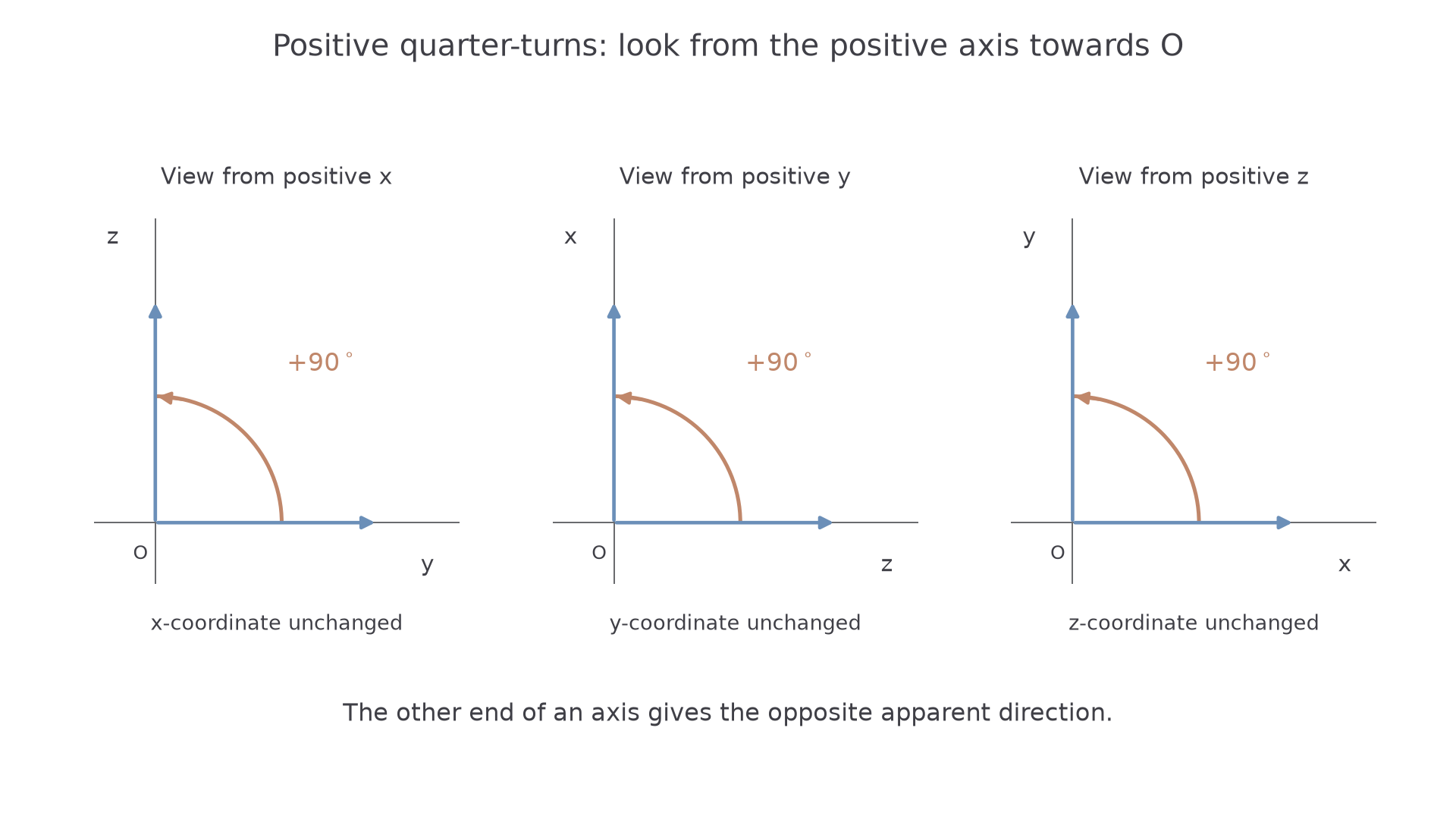
For a positive rotation, look towards the origin from the positive side of the rotation axis: positive means anticlockwise in that view. Looking from the other end reverses what appears clockwise, which is why the viewing direction matters.
For a positive quarter-turn, the coordinate directions cycle as follows:
Here are the unit vectors along the positive -, - and -axes. Notice the cyclic order .
[DIAGRAM: asset_name: Positive axis rotation views; asset_slug: positive_axis_views; caption: Looking towards the origin from each positive axis makes a positive quarter-turn anticlockwise; description: Three planar viewing diagrams are labelled viewed from positive x, positive y and positive z towards O. The first has y to the right and z upwards, the second z to the right and x upwards, and the third x to the right and y upwards. A clay anticlockwise quarter-circle arrow in each panel maps the rightward positive direction to the upward positive direction. A note says that the coordinate along the viewing axis is unchanged.]
Positive quarter-turn matrices
For rotation through , with the viewing convention above:
A turn reverses both off-diagonal signs. A turn leaves the axis coordinate unchanged and negates the other two. A turn equals a turn, and a turn is the identity. These rules cover all integer multiples of .
Not in the formula booklet: learn it.
The matrices follow from the three unit-vector images, just as in two dimensions. For an axis rotation you only need to rebuild the two moving columns.
Worked example 5: a positive turn about the x-axis
Question. Find the matrix for rotation through about the -axis, and the image of .
Plan. Keep fixed and rotate anticlockwise in the view from positive .
Why this step? The pair in the viewing plane is . Applying the ordinary rule to this pair gives , while the axis coordinate stays unchanged.
Answer. Matrix ; image .
Check. The -coordinate stays , and squared distance from the -axis is before and after the turn.
The next example changes the rotation axis to , keeping the same positive angle. The viewing-plane coordinates are now , in that order.
Worked example 6: a positive turn about the y-axis
Question. Find the matrix for rotation through about the -axis, and the image of .
Plan. Keep fixed; map the viewing-plane pair to , then put the coordinates back in order.
Why this step? Treating as the ordinary viewing-plane pair would reverse the direction. From positive , use to the right and upwards.
Answer. Matrix ; image .
Check. The positive -unit vector maps to the positive -unit vector, as required. The -coordinate stays , and is preserved.
For a half-turn about , the rule becomes , with matrix . For a negative quarter-turn, reverse the positive quarter-turn arrows. For example, about gives
A turn about has this same matrix. You can therefore find or recognise any permitted angle without memorising a separate matrix for every case.
Watch out
Wrong: describe a three-dimensional rotation only as “ anticlockwise”. Its axis and viewing direction are missing. Right: give the axis and use a positive or negative angle with the convention of looking towards the origin from the positive side of that axis.
The last question changes the axis once more. Check the unchanged coordinate before considering the other two.
Quick Recap
- For two successive plane transformations, the first matrix goes on the right: first , then , gives .
- Describe a combination by stating both transformations fully and in their actual order.
- In three dimensions, use the three unit-vector images as the columns of the matrix.
- Reflection in a coordinate plane reverses its perpendicular coordinate; rotation about an axis preserves its axis coordinate.
- A positive axis rotation is anticlockwise when viewed towards the origin from the positive side of that axis.
Reversing the opening reflection and rotation changes into : the order of the transformations matters.