Pj11 - Loci on the Argand diagram
Translate a complex equation into a set of points. You will recognise circles, half-lines and perpendicular bisectors, locate them accurately, and state the features needed to describe each locus completely.
A fixed distance gives a circle
Can an equation involving infinitely many complex numbers describe a familiar shape? Consider . Its answer is a circle, and the expression tells you its centre and radius without expanding a single square.
You already know
On an Argand diagram, is the point . The number represents the displacement from to , so is their distance. The argument of a non-zero displacement gives its direction.
The points and both lie units from , so both satisfy the opening equation. The point itself does not: its distance from that centre is .
Locus
A locus is the set of all points satisfying a stated condition. A locus is the whole set, not just a few examples of points on it. For example, a circle contains every point at its stated distance from its centre.
Distance turns the complex equation into ordinary coordinate geometry.
Circle locus
For a fixed complex number and a real ,
This is the circle with centre and radius . If , the set is the single point ; if , it is empty.
Not in the formula booklet: learn it.
Read the centre from , rather than from a sign spotted in isolation. Brackets make the centre unambiguous.
Worked example 1: reading a circle
Question. Describe the locus , and give its Cartesian equation.
Plan. Rewrite the displacement as , then use the distance formula.
Why this step? The number subtracted from is the centre, so the signs inside the displacement are opposite to its coordinates.
Answer. A circle with centre and radius , with equation .
Check. gives , while the proposed centre gives , as it should.
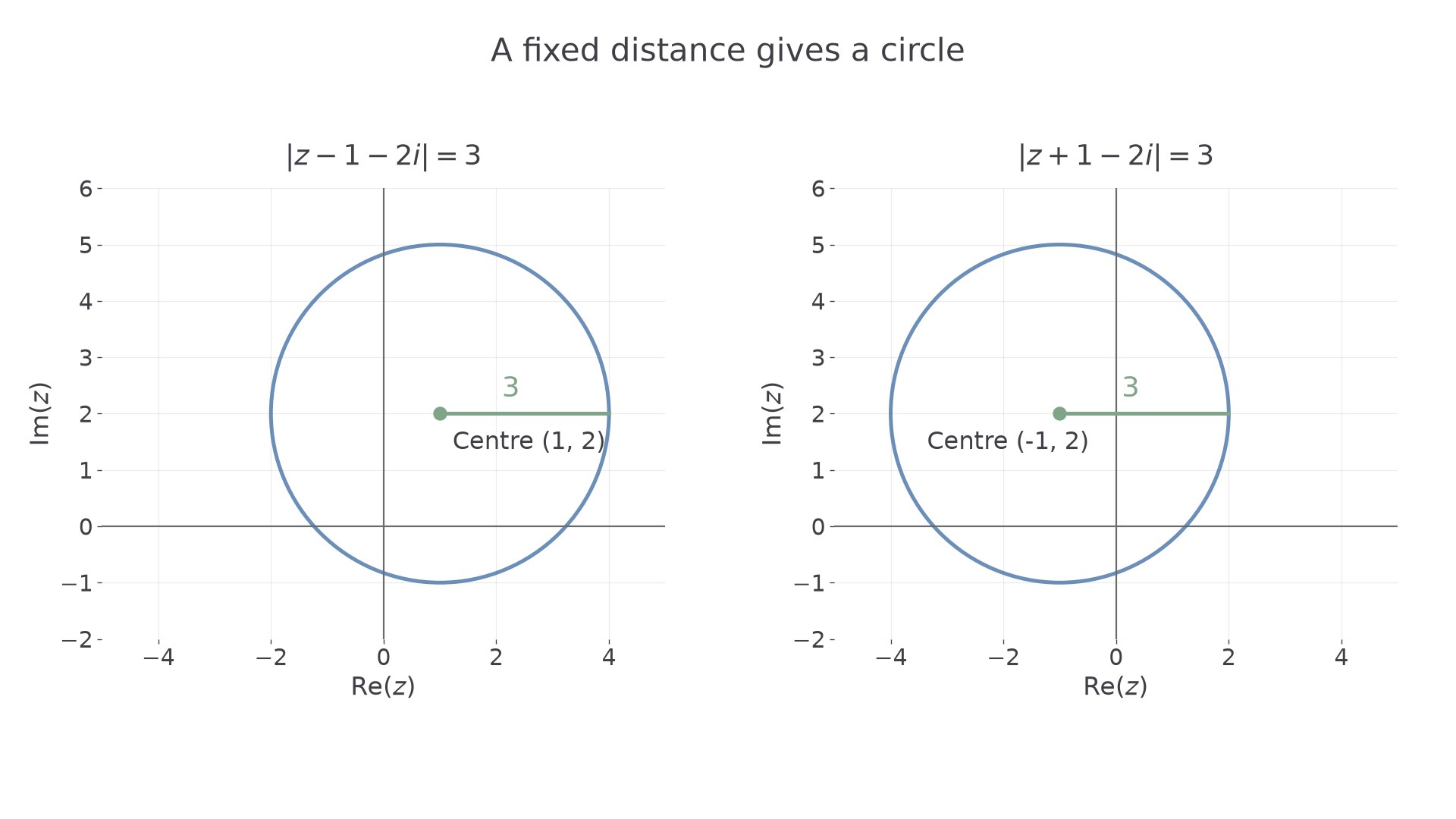
Change only the centre's real coordinate from to . The plus sign inside the modulus is the clue to that change.
Worked example 2: a plus sign in the displacement
Question. Describe , and give its Cartesian equation.
Plan. Write , then read the centre and radius.
Why this step? Moving the centre left changes to ; it does not change the radius.
Answer. A circle with centre , radius , and equation .
Check. The leftmost and rightmost points are and , both units from .
The picture makes the sign change visible. Both circles have the same size; only their centres move.
[DIAGRAM: asset_name: Reading a translated circle; asset_slug: b003_007_circle_loci; caption: The sign inside z minus a determines the centre, while the modulus value determines the radius; description: Two equal-scale Argand panels show circles of radius 3 centred at (1,2) and (-1,2). Each centre is marked and a horizontal radius is drawn and labelled 3. The first corresponds to absolute value z minus 1 minus 2i equals 3; the second to absolute value z plus 1 minus 2i equals 3.]
Watch out
Wrong: has centre . Right: rewrite it as , giving centre . The equation describes the circumference only; its interior has smaller distance.
Describe the next circle by its centre, radius and equation. No drawing is needed for this check.
A fixed direction gives a half-line
The condition fixes the direction of the displacement from to , but not its length. Start at and travel any positive distance in that direction. Travelling the other way changes the argument by , so the locus is half a line, not a whole line.
Half-line locus
For fixed and ,
The endpoint is excluded, because would make the argument , which is undefined. The angle is measured from a horizontal ray pointing right from .
Not in the formula booklet: learn it.
Use an open circle at the excluded endpoint, an arrow to show the direction, and a labelled angle. A Cartesian line equation needs an extra restriction to select the correct half.
Worked example 3: a half-line above its endpoint
Question. Describe , and express it using Cartesian coordinates.
Plan. Locate the endpoint , then use a direction anticlockwise from the positive horizontal.
Why this step? makes both displacements positive. Without , the equation would also include the opposite ray.
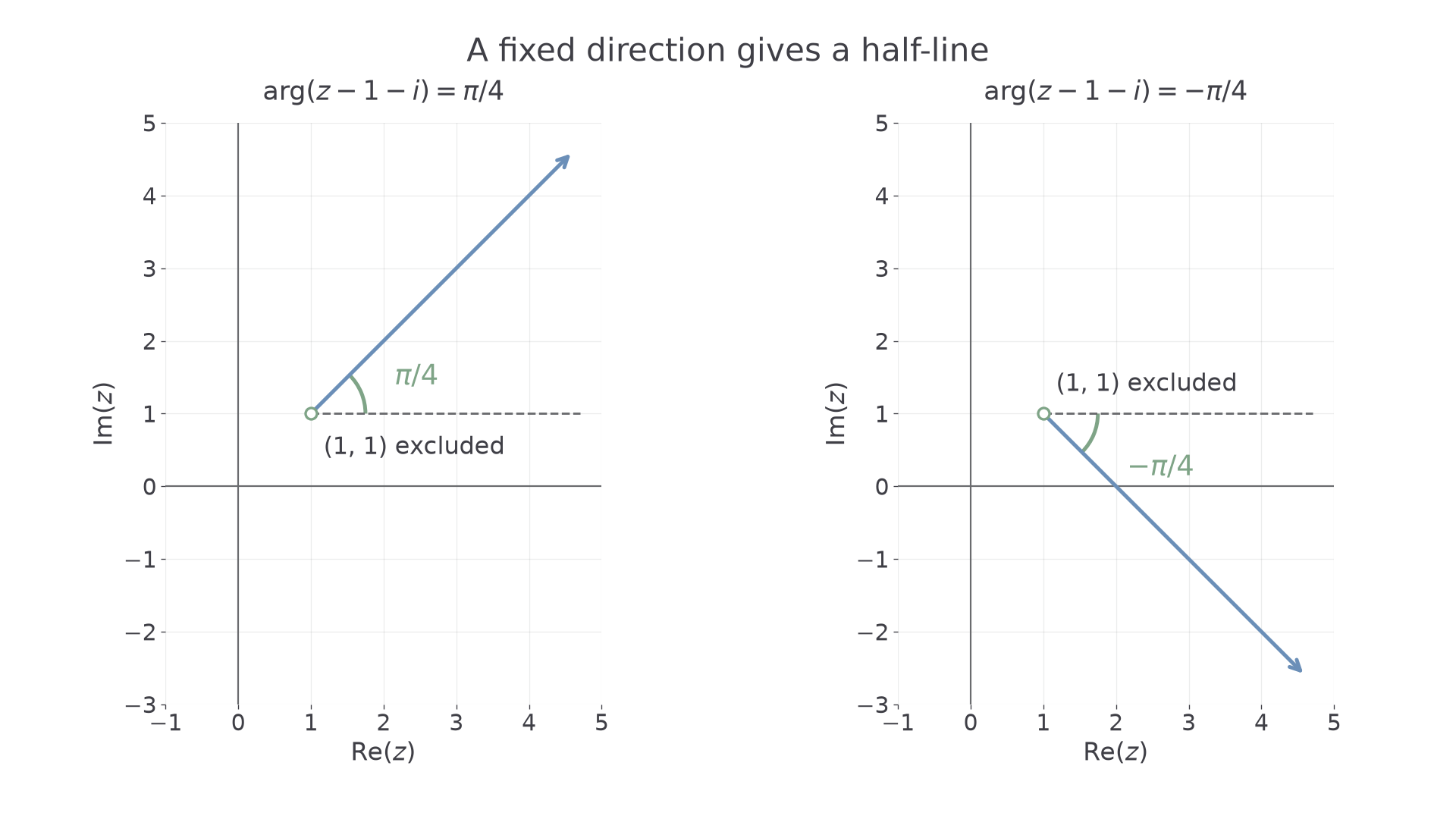
Answer. The half-line from upwards and right at angle , excluding ; equivalently , .
Check. At , the displacement is , with argument . At , it is , with argument , so that point is excluded.
Change only the angle to . The endpoint stays fixed and the ray now points downwards and right.
Worked example 4: a clockwise direction
Question. Describe using Cartesian coordinates.
Plan. Keep the endpoint and change the sign of the vertical component of the direction.
Why this step? The positive horizontal displacement keeps ; changing the angle's sign changes the vertical displacement, not the starting point.
Answer. , , with endpoint excluded.
Check. The point gives displacement , which has argument .
The endpoint is excluded in both pictures. A fixed direction makes no sense for a zero-length displacement.
[DIAGRAM: asset_name: Half-lines start at the subtracted point; asset_slug: b003_007_half_line_loci; caption: The endpoint stays at 1 plus i while changing the angle reverses the vertical direction; description: Two Argand panels show open endpoints at (1,1). One ray points upwards and right at pi over 4; the other downwards and right at minus pi over 4. Dashed horizontal reference rays begin at the endpoint, and angle arcs are drawn there rather than at the origin.]
Exam tip
For a half-line sketch, show the correct endpoint, the direction and the angle to a horizontal reference. A common error is starting at the negative of the required endpoint. Rewrite before drawing.
Move the endpoint for your turn, keeping the clockwise direction.
Watch out
Wrong: gives the whole line . The opposite ray has a different argument, and the endpoint has no argument. The correct locus is , .
Use both a line equation and a directional restriction for the next locus.
Equal distances give a perpendicular bisector
The condition says that is equally far from two fixed points. If , those points form a line segment, and its perpendicular bisector is exactly the set of equal-distance points.
There is a useful algebraic surprise here: both distances contain squares, but their equation becomes linear. The terms cancel, and so do the terms.
Equal-distance locus
For distinct fixed points and ,
The locus is the complete perpendicular bisector of the segment joining and . If , every point satisfies the equation instead.
Not in the formula booklet: learn it.
Squaring is safe here because both moduli are non-negative. It preserves equality and avoids carrying square roots through the calculation.
Worked example 5: a vertical perpendicular bisector
Question. Describe , giving its Cartesian equation.
Plan. Identify the fixed points and their midpoint, then confirm the line by equal squared distances.
Why this step? The two fixed points and are horizontally aligned, so their perpendicular bisector must be vertical.
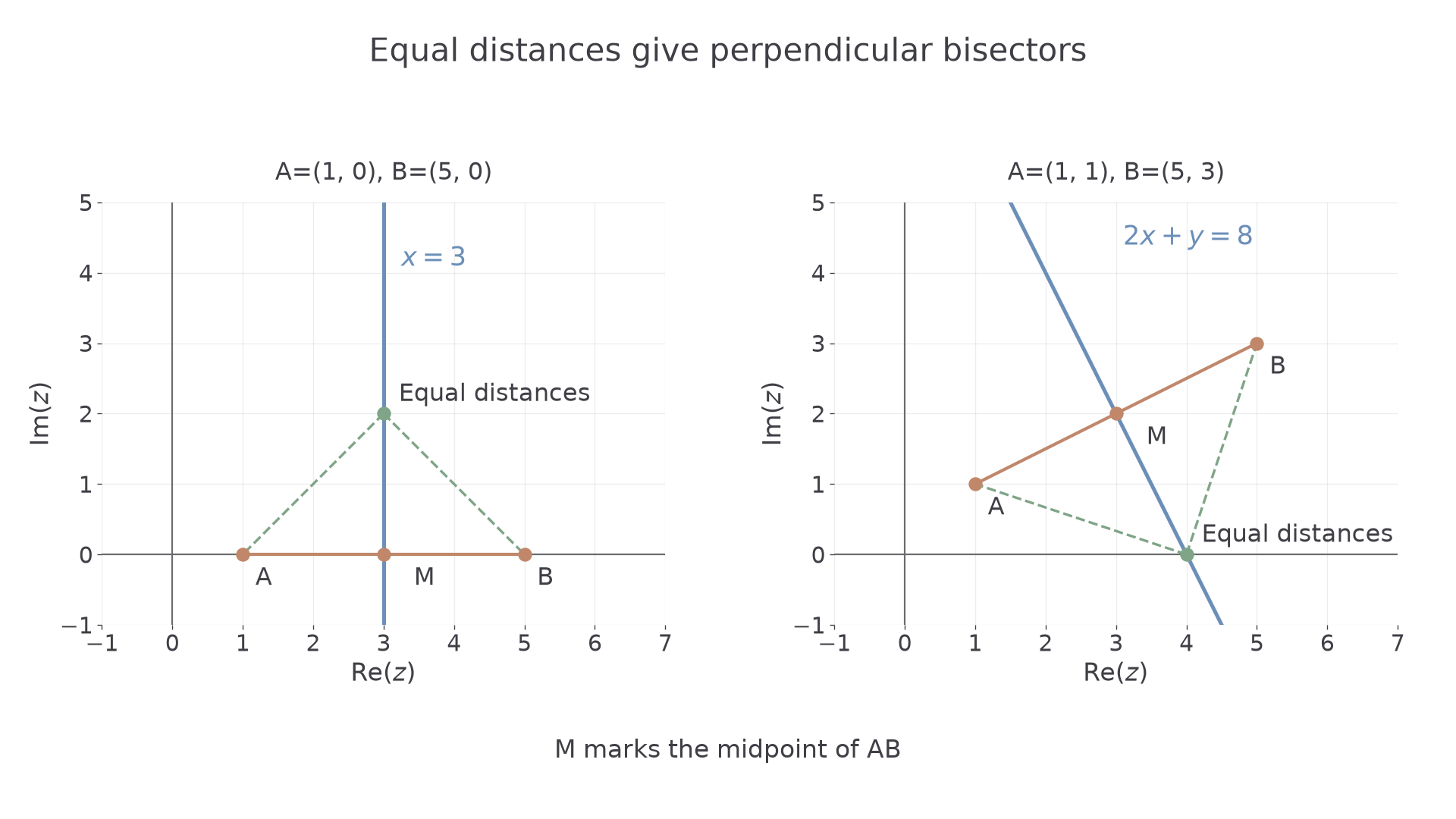
Answer. The complete line , the perpendicular bisector of the segment from to .
Check. Its point is distance from each fixed point.
Now change the fixed points so their joining segment is oblique. The equal-distance idea is unchanged; neither coordinate can be dropped.
Worked example 6: an oblique perpendicular bisector
Question. Find the Cartesian equation of , and describe the locus.
Plan. Square both distances, cancel the common terms and simplify to a line.
Why this step? The cancelled quadratic terms show why this is a line rather than a circle.
Answer. The line , the perpendicular bisector of the segment joining to .
Check. The midpoint satisfies . The segment has gradient , and the line has gradient , so they are perpendicular.
Mark the fixed points and midpoint when sketching. The midpoint is a reliable anchor for an oblique line.
[DIAGRAM: asset_name: Equal distances locate perpendicular bisectors; asset_slug: b003_007_bisector_loci; caption: The equal-distance locus passes through the midpoint and is perpendicular to the segment joining the fixed points; description: Two Argand panels show the segment from (1,0) to (5,0) with perpendicular bisector x equals 3, and the segment from (1,1) to (5,3) with bisector 2x plus y equals 8. Each midpoint is marked. A sample point on each bisector is joined to the two fixed points by equal-length dashed segments.]
Watch out
Wrong: the equal-distance locus is the line through the two fixed points. Right: it is perpendicular to that line and passes through its midpoint. Usually, the fixed points themselves are not on the locus.
Apply the same cancellation to a translated pair of points.
Quick Recap
- is distance from the fixed point ; is the direction from to .
- , for , is a circle centred at with radius .
- is a half-line in direction , with endpoint excluded.
- , for , is the complete perpendicular bisector of the segment joining and .
The opening equation describes every point on the circle with centre and radius .