Pj9, Pj10 - Using the Argand diagram
Read complex arithmetic as geometry. Pj9 connects a number and its conjugate to points on an Argand diagram; Pj10 shows how addition, subtraction, multiplication and division move those points.
Points and reflection in the real axis
How can multiplication turn into without changing its distance from the origin? On a diagram, this looks like a quarter turn. We will find the multiplier after learning how the diagram records a number.
You already know
For , and . A non-zero complex number has modulus-argument form ; multiplication adds directions and division subtracts them.
Use perpendicular axes with the same scale: the horizontal coordinate is the real part, and the vertical coordinate is the imaginary part. The imaginary part is the real number , so the vertical scale is labelled with real numbers.
Argand diagram
An Argand diagram represents by the point . The horizontal axis is the real axis and the vertical axis is the imaginary axis. The arrow from the origin to that point represents the same number as a position vector. For example, is at , not .
Changing to reflects the point in the real axis. Its distance from the origin stays the same.
[DIAGRAM: asset_name: Conjugation reflects in the real axis; asset_slug: b003_007_conjugate_reflection; caption: A number and its conjugate have equal real coordinates and opposite imaginary coordinates; description: Two equal-scale Argand panels show 2 plus 3i and 2 minus 3i on the right, and minus 2 plus 3i and minus 2 minus 3i on the left. Vertical dashed segments connect each pair across the real axis, with equal distances above and below it.]
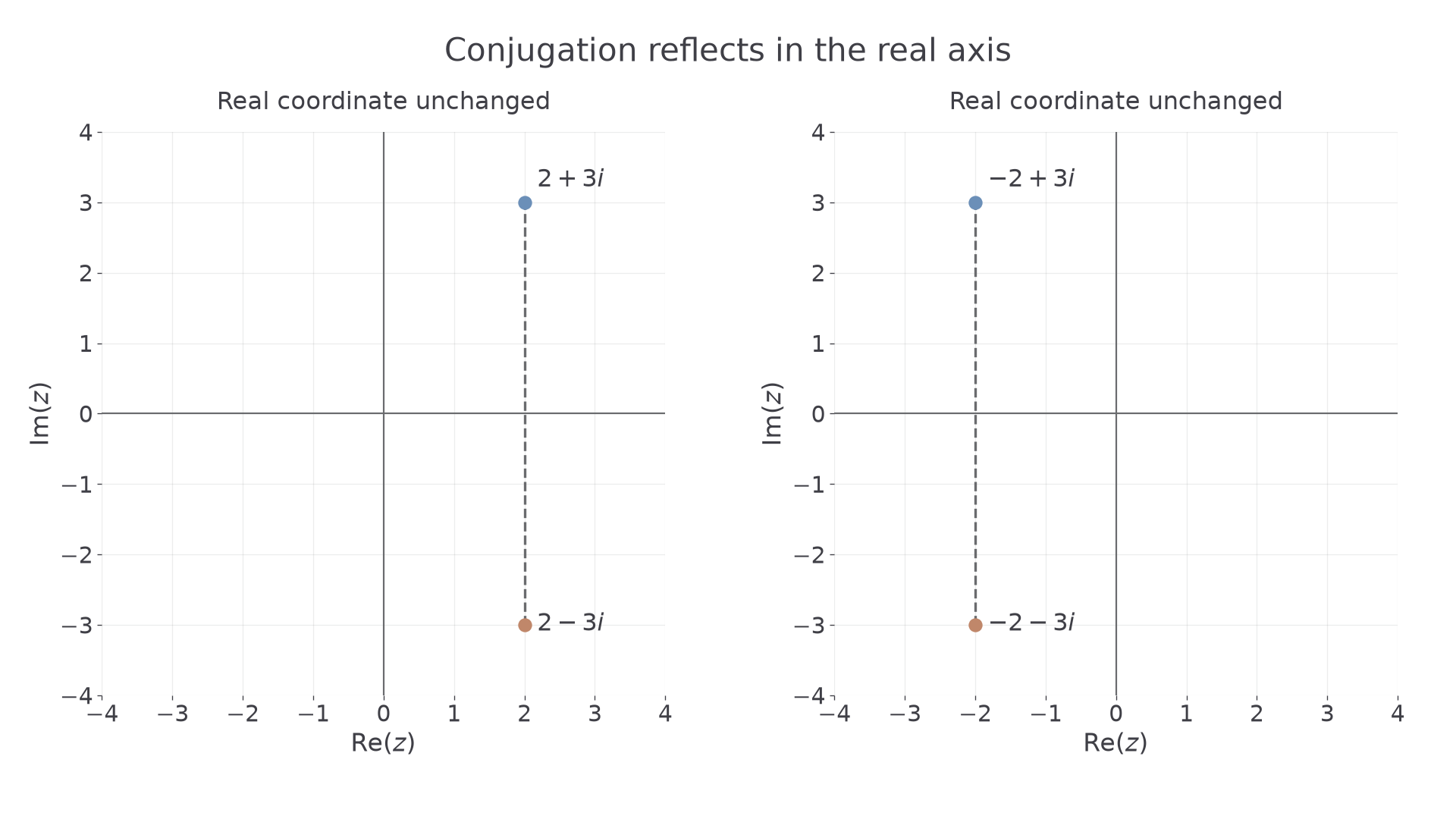
Worked example 1: locating a number and its conjugate
Question. State the coordinates of the points representing and , and describe the relation between them.
Plan. Read the real and imaginary coordinates, then reverse the sign of the imaginary coordinate.
Why this step? Conjugation changes the vertical coordinate only, so the mirror line is the real axis.
Answer. The points are and , reflections of each other in the real axis.
Check. The midpoint lies on the mirror line, and both points are units from it.
Change only the sign of the real part. Both points move to the left of the imaginary axis, but the mirror line is unchanged.
Worked example 2: a conjugate pair in the left half-plane
Question. State the coordinates of the points representing and , and describe the relation between them.
Plan. Keep the real coordinate , and change to for the conjugate.
Why this step? Reflection in the imaginary axis would change the real part, which is not what conjugation does.
Answer. The points are and , reflections in the real axis.
Check. Their midpoint is , still on the real axis.
For non-real , reflection reverses the sign of the principal argument. A real point is fixed by conjugation: in particular, a negative real point still has principal argument , rather than . The argument of remains undefined. These geometric facts are not in the formula booklet: learn them.
Watch out
Wrong: , so label the vertical coordinate . Right: , so the point is . The axis name tells you which coordinate is imaginary.
Use the same interpretation when the imaginary coordinate is already negative.
Addition and subtraction as vectors
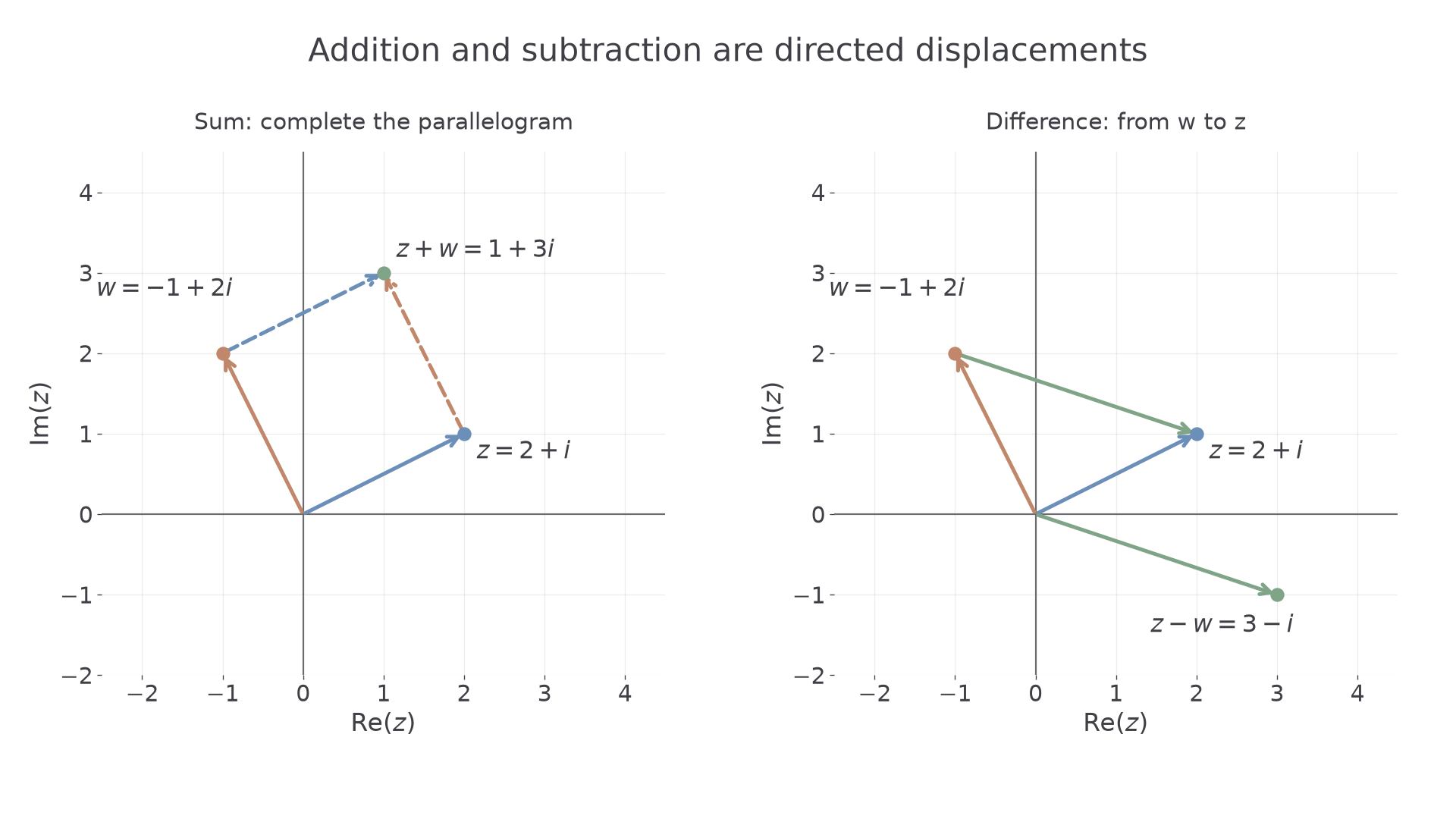
Adding to applies the same displacement as the arrow representing , starting at the point for . Copy the arrow without rotating it. You can instead draw the parallelogram whose two sides from the origin represent and ; its opposite vertex represents .
For subtraction, rearrange . The arrow from the point for to the point for represents . To plot as a point, copy that arrow so that its tail is at the origin.
Sum and difference on an Argand diagram
If represents and represents , then
For , , the corresponding points are and .
Not in the formula booklet: learn it.
The following diagrams use the same two starting numbers. Only the operation changes.
[DIAGRAM: asset_name: Sum and difference use directed displacements; asset_slug: b003_007_sum_difference; caption: Addition copies an arrow to the first point; subtraction uses the arrow from the second point to the first; description: Two Argand panels use z equals 2 plus i and w equals minus 1 plus 2i. The sum panel shows the parallelogram to 1 plus 3i. The difference panel shows the arrow from w to z and a parallel equal arrow from the origin to 3 minus i.]
Worked example 3: representing a sum
Question. Let and . Find the point representing , and explain its vector construction.
Plan. Add coordinates, then interpret the second number as a displacement from the first point.
Why this step? The arrow for moves one unit left and two up wherever its tail starts.
Answer. The sum is at . From , move one unit left and two up, or complete the parallelogram from the origin.
Check. Starting instead at and adding the displacement reaches the same point.
Change only addition to subtraction. Reversing an arrow now matters.
Worked example 4: representing a difference
Question. For the same and , find the point representing , and state which directed arrow between their points represents the difference.
Plan. Subtract both coordinates, and compare the displacement from to .
Why this step? The order means end at , starting from . Reversing that arrow gives the negative answer.
Answer. The point is . The arrow from to represents the same number.
Check. .
The length of the arrow from to is . This distance interpretation will turn complex equations into circles and lines in the next lesson; it is not in the formula booklet: learn it.
Watch out
Wrong: the arrow from to represents . Right: it represents . Subtract the coordinates of the starting point from those of the endpoint.
Keep the operation the same and change the starting numbers for your turn.
Multiplication rotates and scales
Multiplying by a fixed non-zero number multiplies every distance from the origin by and adds to every direction. Geometrically, it is a rotation about the origin combined with an enlargement centred at the origin, with positive scale factor .
This follows directly from the modulus-argument multiplication rule. It is not in the formula booklet: learn the interpretation. A multiplier of modulus gives a pure rotation; a positive real multiplier gives a pure enlargement. Multiplication by sends every point to the origin and has no rotation angle.
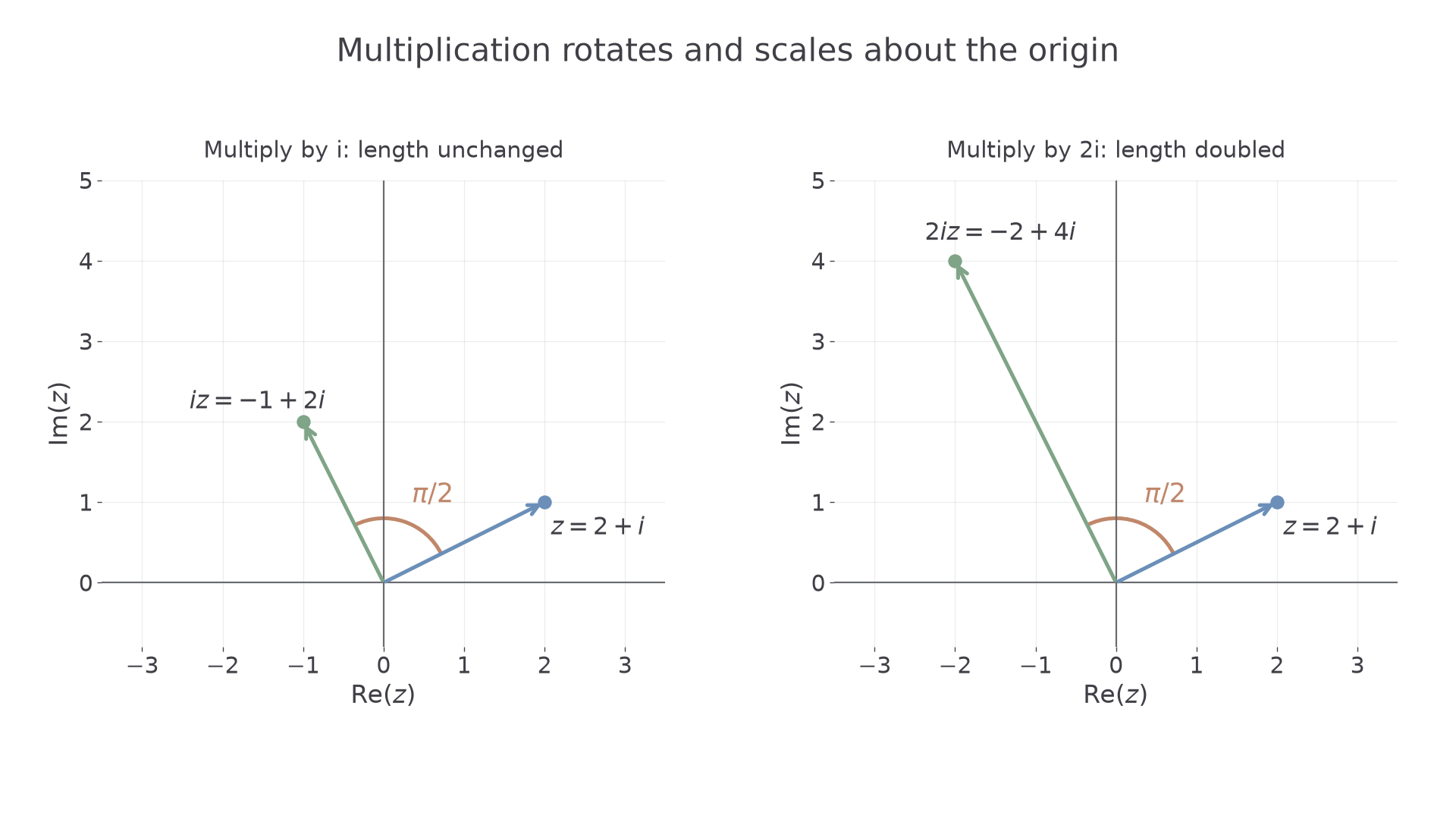
[DIAGRAM: asset_name: Multiplication by i and by 2i; asset_slug: b003_007_product_rotation; caption: Both multipliers rotate anticlockwise by a right angle; only 2i also doubles the length; description: Two Argand panels begin at z equals 2 plus i. Multiplication by i ends at minus 1 plus 2i with equal vector lengths. Multiplication by 2i ends at minus 2 plus 4i with twice the length. Both panels show a quarter-turn arc between the original and image rays.]
Worked example 5: a pure rotation
Question. Find when , and describe multiplication by geometrically.
Plan. Multiply in Cartesian form, then use the modulus and argument of the multiplier.
Why this step? It is the multiplier's argument that tells you the turn; the starting point can have any direction.
Answer. . Multiplication by is an anticlockwise rotation of about the origin.
Check. A quarter-turn anticlockwise sends coordinates to , so becomes . Both lengths are .
Change only the modulus of the multiplier, from to . Its direction stays the same, so only the enlargement is new.
Worked example 6: rotation with enlargement
Question. Find when , and describe multiplication by geometrically.
Plan. Multiply, then read the rotation and scale factor from .
Why this step? The turn and the enlargement are independent: a larger modulus does not make a larger rotation.
Answer. . The transformation is a rotation anticlockwise through and an enlargement of scale factor , both about the origin.
Check. The new point is twice the vector from the previous example.
Here is the answer to the opening question: multiply by . Do it twice and the number is negated, since ; do it four times and every point returns, since . Complex arithmetic has built a quarter-turn into multiplication.
Exam tip
A rotation description needs its angle, direction and centre. An enlargement needs its scale factor and centre. “Rotate by ” alone leaves the direction and centre unstated.
In the next question, keep the quarter-turn but change the scale factor again.
Watch out
Wrong: “Multiplication by rotates through .” The factor changes the modulus, not the angle. The correct description is a rotation anticlockwise through and an enlargement of scale factor , both about the origin.
Read the angle and scale factor separately from the next multiplier.
Division undoes the turn and the scale
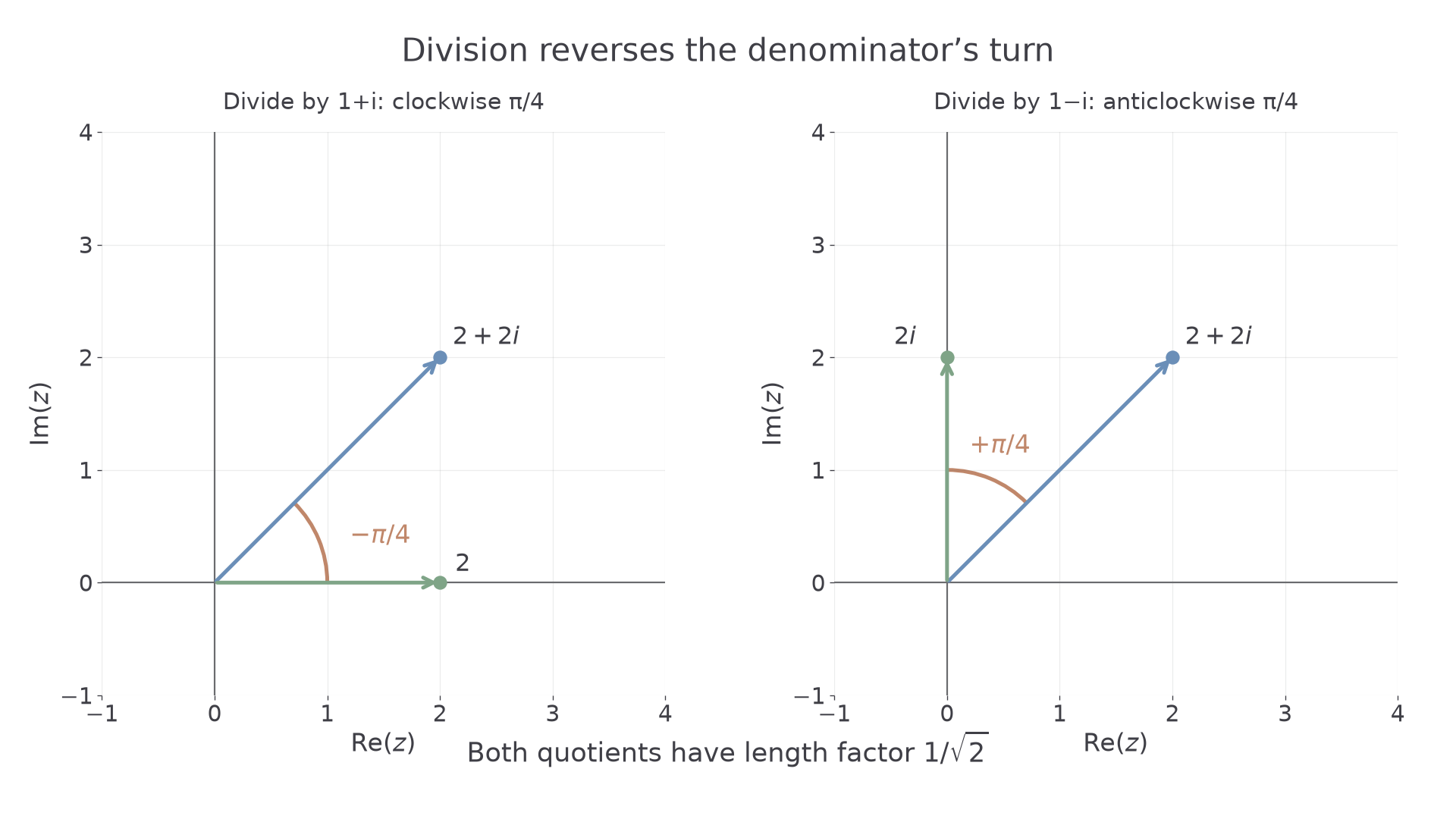
Dividing by a fixed non-zero scales distances from the origin by , and rotates through . The minus sign reverses the denominator's turn. This is the quotient rule from the previous lesson, interpreted geometrically; it is not in the formula booklet: learn it.
For example, dividing by a number of modulus halves lengths. Dividing by one of modulus doubles them. “Division makes things smaller” is not a reliable rule.
Worked example 7: dividing by a first-quadrant number
Question. Find , and describe the transformation .
Plan. Use a conjugate to calculate the quotient, then use and for its geometry.
Why this step? Division must undo multiplication by , so it reverses the turn and uses the reciprocal scale factor.
Answer. The quotient is . The transformation is a clockwise rotation through and an enlargement of scale factor , both about the origin.
Check. The original length becomes , and the original angle becomes .
Change only the sign of the denominator's imaginary part. Its length stays the same, but the direction of rotation reverses.
Worked example 8: dividing by a fourth-quadrant number
Question. Find , and describe the transformation .
Plan. Calculate with the conjugate, then subtract the negative argument of the denominator.
Why this step? Subtracting adds , so division rotates anticlockwise in this case.
Answer. The quotient is . The transformation is an anticlockwise rotation through and an enlargement of scale factor , both about the origin.
Check. Multiplying back gives .
You can draw the new point by turning the original ray and scaling its length, without constructing the conjugate fraction on the diagram.
[DIAGRAM: asset_name: Quotients reverse the denominator's angle; asset_slug: b003_007_quotient_rotation; caption: Dividing 2 plus 2i by 1 plus i turns clockwise; dividing it by 1 minus i turns anticlockwise; description: Two Argand panels begin at (2,2). A clockwise pi over 4 turn and length factor 1 over square root 2 ends at (2,0) in the first panel. An anticlockwise pi over 4 turn with the same length factor ends at (0,2) in the second.]
Watch out
Wrong: division by rotates clockwise through , because the denominator has a negative argument. Right: subtract that argument, so the rotation is anticlockwise through .
The same transformation now acts on a point in the second quadrant. Follow it through to the negative real axis.
Quick Recap
- Plot at ; conjugation reflects in the real axis.
- Addition uses a triangle or parallelogram of vectors. The arrow from to represents , with length .
- Multiplication by non-zero rotates by and scales lengths by , about the origin.
- Division by non-zero reverses that rotation and scales lengths by .
Multiplication by turns into : a quarter-turn anticlockwise changes the direction while preserving the length.