An inverse matrix reverses a transformation and recovers its original input. Pm11 explains what that means, Pm12 develops inverses of orders 2 and 3, and Pm13 uses them to find pre-images and solve matrix equations. Pm14 explains why undoing a product reverses the order of its factors.
What an inverse matrix undoes
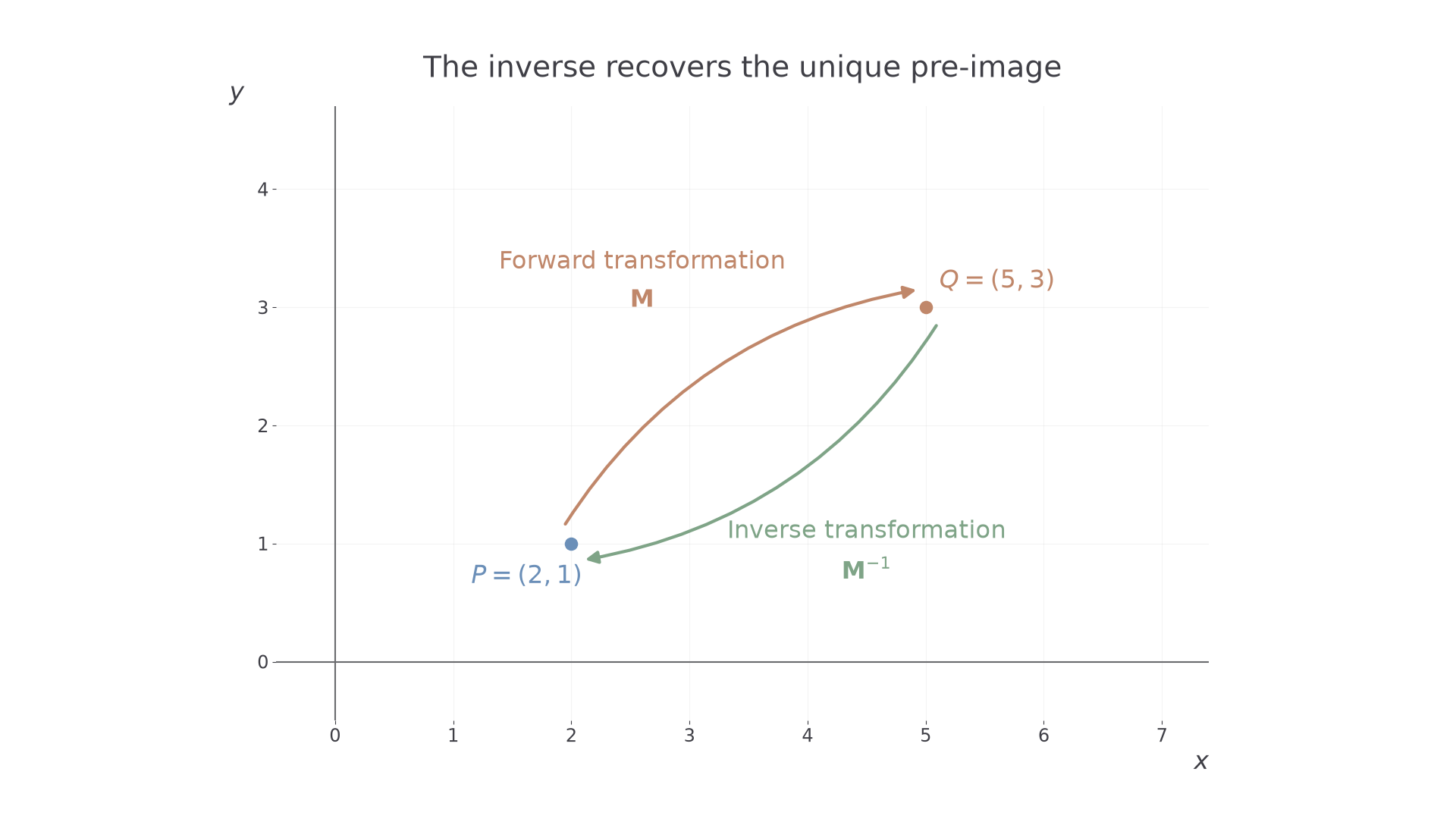
A transformation sends a point P to Q=(5,3) using M=(2111). Can you recover P directly, without solving a fresh pair of equations for every image point?
Multiplication gives M(21)=(53). The reverse journey must turn (53) back into (21). We want one matrix that makes that return journey work for every point, not just this one.
You already know
The identity matrix I leaves every vector unchanged. Matrix multiplication is associative, but its factors cannot usually be reordered. A square matrix has an inverse exactly when its determinant is non-zero.
For this example, R=(1−1−12) works:
RMMR=(1001)=I=(1001)=Iforward then reversereverse then forward
Because the result is the identity, the return journey works for every input vector.
[DIAGRAM: asset_name: Recovering a pre-image; asset_slug: inverse_preimage; caption: The inverse sends the image point Q back to its unique pre-image P; description: Equal-scale Cartesian axes show P at (2,1) in blue and Q at (5,3) in clay. A curved arrow from P to Q is labelled forward transformation M and a separate curved arrow from Q to P is labelled inverse transformation M inverse. In the accompanying text M has rows (2,1) and (1,1). The arrows represent the mappings, not paths travelled by the point.]
Here is the definition for a square matrix of any order. The identity must have that same order.
Inverse matrix and pre-image
The inverse of a square matrix M, written M−1, satisfies M−1M=MM−1=I. It represents the transformation that undoes M. A pre-image of a point is an original point that maps to it. For a non-singular linear transformation, every image point has exactly one pre-image.
A singular transformation has merged some distinct points. An inverse could not know which original point to recover, so no inverse matrix exists. The non-singular condition is essential, not a calculator inconvenience.
Key idea
An inverse reverses the whole mapping. It is not obtained by taking reciprocals of individual matrix entries.
There is an appealing boundary case: a reflection is its own inverse. For F=(0110), which reflects in y=x, F2=I, so F−1=F even though F=I. Undoing a reflection means performing it again.
Inverting a matrix of order 2
For a non-singular matrix of order 2, four rearranged entries and one scalar factor produce the inverse.
The rearrangement is not arbitrary. Multiplying by it gives
(acbd)(d−c−ba)=(ad−bc00ad−bc)=(ad−bc)I
The off-diagonal terms cancel. Dividing by ad−bc then leaves I, provided that determinant is not zero.
Inverse of a matrix of order 2
If A=(acbd) and ad−bc=0, then
A−1=ad−bc1(d−c−ba)
Swap the main-diagonal entries, change the signs of the other two entries, then divide the entire matrix by the determinant.
Not in the formula booklet: learn it.
Once the inverse is known, the pre-image calculation is another matrix multiplication: if q=Ap, then p=A−1q. The inverse acts on the image vector from the left.
Worked example 1: an inverse with integer entries
Question. Find the inverse of A=(3211). Hence find the pre-image of Q=(1,2).
Plan. Calculate the determinant, build the inverse and apply it to the image vector.
detAA−1p=3(1)−1(2)=1=11(1−2−13)=(1−2−13)(12)=(−14)check non-singularityswap and change signsundo the transformationrows by columns
Why this step? The given point is an image, so multiply by the inverse, not by the original matrix.
Answer.A−1=(1−2−13), and the pre-image is (−1,4).
Check.A(−14)=(−3+4−2+4)=(12), the required image.
Worked example 2 changes only the bottom-right entry from 1 to 2. The determinant is no longer 1, so the scalar factor must be retained.
Worked example 2: retaining the determinant factor
Question. Find the inverse of B=(3212). Hence find the pre-image of Q=(1,2).
Plan. Recalculate the determinant, divide every rearranged entry by it and apply the inverse.
detBB−1p=3(2)−1(2)=4=41(2−2−13)=41(2−2−13)(12)=41(04)=(01)new determinantinverse formulaapply the inversedivide both entries
Why this step? The determinant factor multiplies the entire matrix, including every entry of the final vector.
Answer.B−1=41(2−2−13), and the pre-image is (0,1).
Check.B(01)=(12). Also B(2−2−13)=4I, so division by 4 is needed.
The inverse formula has three operations; missing any one of them usually gives a plausible-looking wrong answer.
Watch out
Wrong: (3212)−1=(2−2−13). Right: include the factor 41. Without it, the product is 4I, not I.
The next check changes the top-left entry. Use the same image point but recalculate the determinant and inverse.
Inverses of order 3 and reciprocal determinants
A calculator can invert a numerical matrix of order 3; you still need to identify the correct operation, record the result clearly and check that it reverses the original matrix.
Enter the matrix with its stated row order and all negative signs. Check that its determinant is non-zero, then use the matrix inverse function. If the output is decimal but exact fractions are available, convert the entries before further work. An “inverse” obtained by raising individual entries to −1 is not a matrix inverse.
The determinant provides a compact check on an inverse. Since AA−1=I, the determinant product rule gives (detA)(detA−1)=1.
Determinant of an inverse
For a non-singular square matrix A of any order,
det(A−1)=detA1
The determinant of the inverse is the reciprocal of the determinant, not its negative. In the plane, a transformation and its inverse have reciprocal area scale factors.
Not in the formula booklet: learn it.
This is a necessary check, not a complete one: many matrices have the same determinant. Multiplying to obtain I checks the entries themselves.
Worked example 3: a calculator inverse of order 3
Question. Find the inverse of
A=101110011
and state det(A−1). Hence find the pre-image of (3,4,5).
Plan. Evaluate the determinant and inverse, then multiply the image vector by that inverse.
detAA−1det(A−1)p=2=2111−1−1111−11=21=213−4+53+4−5−3+4+5=213calculator determinantcalculator inversereciprocal determinantapply the inverse
Why this step? A three-dimensional image is still a column vector, and the inverse still acts from the left.
Answer. The inverse is the matrix displayed above, its determinant is 21, and the pre-image is (2,1,3).
Check.A213=2+11+32+3=345.
Worked example 4 changes only the bottom-left entry from 1 to 2. Both the inverse and the original point change, even though the image vector stays fixed.
Worked example 4: a changed entry in order 3
Question. Find the inverse of
B=102110011
and state det(B−1). Hence find the pre-image of (3,4,5).
Plan. Re-enter the changed matrix and apply the resulting inverse to the same image vector.
detBB−1det(B−1)p=3=3112−2−1121−11=31=313−4+56+4−5−6+8+5=343537calculator determinantcalculator inversereciprocal determinantrows by columns
Why this step? Keeping fractions exact makes the final forward check decisive rather than approximate.
Answer. The inverse is the matrix displayed above, its determinant is 31, and the pre-image is (34,35,37).
Check. The forward coordinates are 34+35=3, 35+37=4 and 2(34)+37=5, as required.
When the command allows calculator evaluation, there is no need to conceal its use behind invented hand working. If the question requests detailed reasoning or algebraic entries, however, you must show the required mathematical method.
Exam tip
Label every matrix: A, A−1 and a product are different objects. Write the matrix being inverted and the resulting inverse; unexplained lists of calculator entries do not communicate the method.
Change the bottom-left entry once more, and check the inverse against the identity.
Watch out
Wrong:det(B−1)=−3 because detB=3. Inversion takes a reciprocal, not a negative. The correct determinant is 1/3, so detBdet(B−1)=1.
Check both the matrix product and the reciprocal determinant below.
Solving matrix equations on the correct side
To remove a matrix factor, multiply by its inverse on the side where the two factors can meet.
For a number, the distinction between left and right multiplication disappears. For matrices it controls the answer. Starting with AX=B, multiplication on the left gives A−1(AX)=A−1B, so associativity produces IX. Multiplying on the right would leave AXA−1, with X in the way of cancellation.
Solving with an inverse
If A is non-singular and the products have compatible dimensions,
AX=BXA=B⟹X=A−1B⟹X=BA−1
For a transformation Ap=q, this gives the pre-image formula p=A−1q.
Not in the formula booklet: learn it.
The inverse has to sit next to the matrix it undoes. Write that multiplication before calculating entries; it makes the order unambiguous.
Worked example 5: the known factor is on the left
Question. Solve AX=B, where
A=(2111),B=(5310)
Plan. Multiply on the left by A−1, then evaluate the ordered product.
A−1X=(1−1−12)=A−1B=(1−1−12)(5310)=(5−3−5+61−0−1+0)=(211−1)detA=1cancel on the leftrows by columns
Why this step? Left multiplication places A−1 directly beside A; nothing has been commuted.
Answer.X=(211−1).
Check.AX=(5310)=B. Each column of X is also the pre-image of the corresponding column of B.
Worked example 6 changes only the side on which the known factor appears. The matrices A and B stay exactly the same, but the solution changes.
Worked example 6: the known factor is on the right
Question. Solve YA=B, using the same matrices A and B.
Plan. Multiply on the right by A−1, keeping the remaining factors in their original order.
YAA−1Y=BA−1=(5310)(1−1−12)=(5−13−0−5+2−3+0)=(43−3−3)multiply on the rightAA−1=Irows by columns
Why this step? Moving A−1 to the left of B would solve a different equation.
Answer.Y=(43−3−3).
Check.YA=(8−36−34−33−3)=(5310).
The first column of Worked example 5 answers the opening question: M−1(53)=(21), so P=(2,1). The same inverse recovers every other original point as well.
Watch out
Wrong: “Divide both sides by A.” Matrix division has no single meaning. Right: write exactly which side is multiplied by A−1, and keep that order through the calculation.
For the next equation, the unknown is again on the left. Use right multiplication, as in Worked example 6.
Undoing a product in reverse order
To undo two successive transformations, undo the last one first.
For column vectors, AB applies B first, then A. The inverse journey applies A−1 first, then B−1, so its matrix is B−1A−1. This reversal is forced by the order in which the transformations act.
Inverse of a product
For non-singular square matrices A and B of the same order,
(AB)−1=B−1A−1
Indeed,
(AB)(B−1A−1)=A(BB−1)A−1=AIA−1=I
The product in the other order is also I.
Not in the formula booklet: learn it.
A verification needs two genuinely calculated expressions: find (AB)−1, calculate B−1A−1 separately, then show they agree. Merely quoting the rule does not verify it for the given matrices.
Worked example 7: verifying the reversed order
Question. Verify the inverse product rule for
A=(1021),B=(01−10)
Plan. Calculate the inverse of the product and the reversed product of the inverses independently.
AB(AB)−1A−1B−1A−1=(21−10)=(0−112)=(10−21),B−1=(0−110)=(0−110)(10−21)=(0−112)multiply in the stated orderdet(AB)=1invert each factorsame matrix as above
Why this step? The separate calculations establish the equality for these matrices rather than using the equality to assume the answer.
Answer. Both expressions equal (0−112), so the rule is verified.
Check. Keeping the original factor order gives A−1B−1=(2−110), which is different.
Worked example 8 changes only the top-left entry of A from 1 to a non-zero parameter a. Keep its reciprocal exact throughout.
Worked example 8: verifying the rule with a parameter
Question. Verify the inverse product rule for C=(a021) and B=(01−10), where a=0.
Plan. Calculate the two sides separately, retaining the factor a1.
CB(CB)−1C−1B−1C−1=(21−a0)=a1(0−1a2)=a1(10−2a)=a1(0−110)(10−2a)=a1(0−1a2)multiplydet(CB)=ainvert the changed factormultiply the inverses
Why this step? The condition a=0 is needed for every division by a; at a=0, neither C nor its product has an inverse.
Answer.(CB)−1=B−1C−1, with both sides equal to a1(0−1a2).
Check. Multiplying (21−a0)a1(0−1a2) gives I. Taking a=1 also recovers Worked example 7.
Brackets are part of the mathematics: (AB)−1 inverts the whole product, whereas AB−1 inverts only its second factor.
Exam tip
When asked for the product rule for the inverse of AB, write that exact product in brackets and reverse the factors on the right. A correct rule for (BA)−1 answers a different question.
The final verification changes the shear entry from 2 to 3, while retaining a non-zero parameter.
Watch out
Wrong:(AB)−1=A−1B−1. This fails for the first pair: it gives (2−110). Undo the last transformation first; the correct inverse is B−1A−1=(0−112).
Write the reversed order before calculating the final verification.
Quick Recap
M−1M=MM−1=I; the inverse exists exactly when the determinant is non-zero.
For order 2, swap the main-diagonal entries, change the other two signs and divide the whole matrix by the determinant. For numerical order 3, use the calculator and check the result.
det(M−1)=1/detM. This checks a determinant, not every entry.
Cancel a known factor on its own side: AX=B gives X=A−1B, while XA=B gives X=BA−1.
(AB)−1=B−1A−1: undo the last transformation first.
The opening image Q=(5,3) has the unique pre-image P=(2,1), recovered by multiplying its column vector by M−1.
Learn faster with Nova
Ask for a simpler explanation, a quick recap, or help connecting the ideas in this lesson.