Mi16, Mi17 - Oblique impact between two bodies
Solve an oblique collision by applying momentum and restitution along the line of centres, while preserving each body's transverse velocity. Reconstruct the outgoing vectors and calculate energy loss using every component that contributes to speed.
Solve along the line of centres
If two spheres have coefficient of restitution zero, must they stick together? In a direct collision they share a final velocity. In an oblique collision, restitution controls only one component of their relative motion. We will use that distinction to settle the question.
You already know
For smooth impact, the impulse changes velocity only along its own line. Momentum conservation and Newton's experimental law determine the outgoing components along that line; the perpendicular components are unchanged individually.
Model the objects as uniform smooth spheres or discs, with no rotation before or after impact. Their shapes give a line of centres at contact, along which the equal and opposite impulses act. Two particles do not provide that preferred impulse direction and cannot model this oblique two-body collision.
Let point from 's centre towards 's at contact, and let be perpendicular to it. Subscripts and mean signed components in those directions. There is approach when .
Normal equations and transverse invariance
For masses , smooth contact and negligible external impulse,
Use and positive normal approach speed. Afterwards .
Not in the formula booklet: learn it.
The first line conserves momentum for the pair. The last line makes the stronger statement that each body's transverse momentum is separately unchanged, because neither receives a transverse impulse.
[DIAGRAM: asset_name: Normal and transverse components in a two-body impact; asset_slug: oblique_bodies_components; caption: The line of centres controls the impulse, while each transverse component survives unchanged; description: Before and after panels show two equal-radius discs A and B touching on a horizontal line of centres with A left of B. A has mass 2 kilograms and B 1 kilogram. Incoming velocity arrows are 4 right and 3 up for A, and 2 left and 1 up for B. Outgoing arrows are 1 right and 3 up for A, and 4 right and 1 up for B. Common rightwards normal and upwards transverse directions are labelled.]
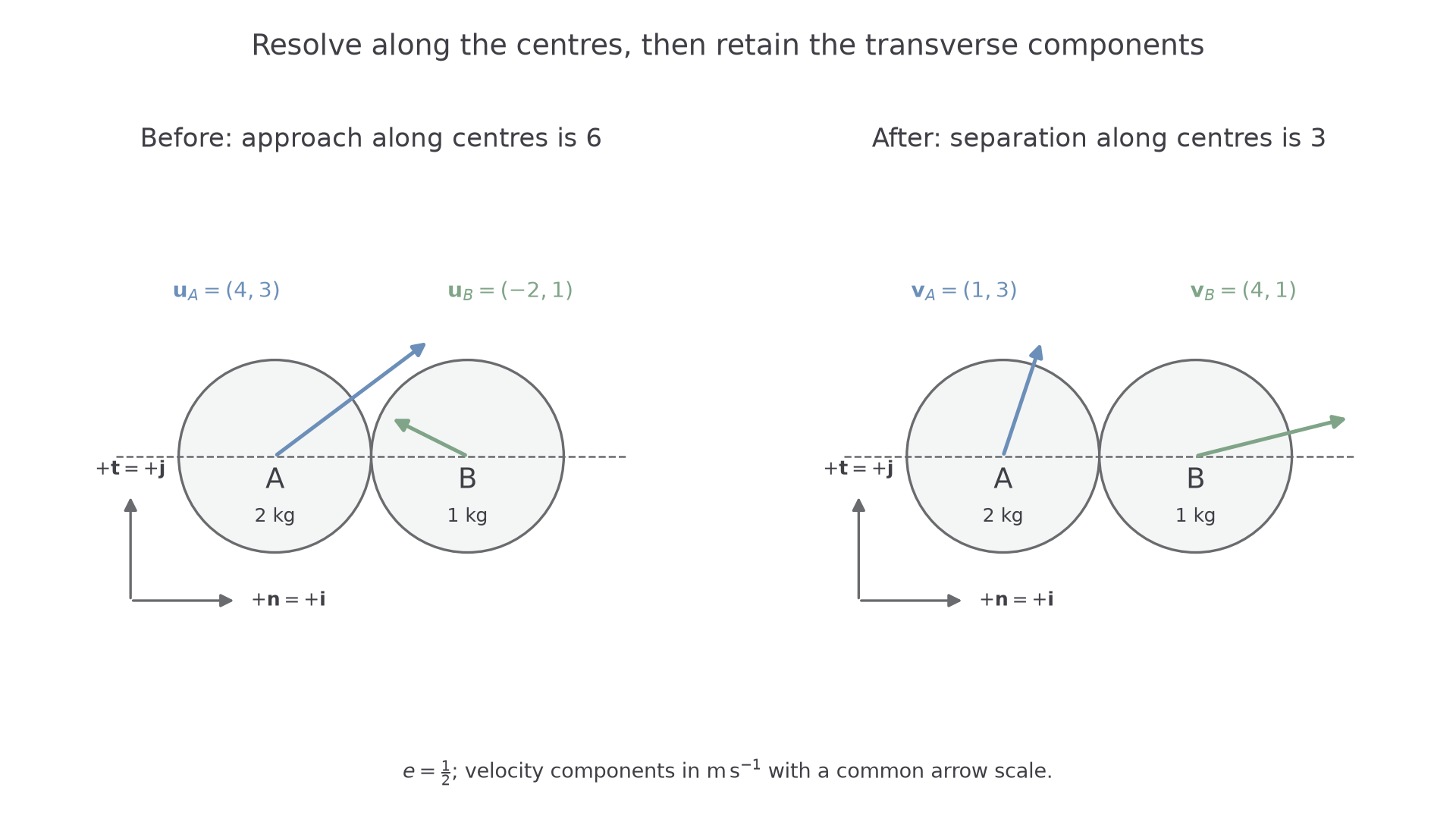
Worked example 1: centres on a coordinate axis
Question. Smooth uniform spheres and , of masses and , collide on a smooth horizontal table. At contact, lies due east of . Their incoming velocities are and , where is east and north. The coefficient of restitution is . Find their outgoing velocities.
Plan. Use east as the positive normal direction, solve the two eastward equations and retain each northward component.
Why this step? Restitution uses the signed normal components and , not the whole incoming speeds and .
Answer. and .
Check. The total momentum vector is before and after. Normal separation speed is half the approach speed .
Change only 's transverse incoming component from to . This alters the path of , but leaves both equations along the line of centres unchanged.
Worked example 2: a different sideways motion
Question. For the same masses, line of centres, 's incoming velocity and coefficient, let . Determine the outgoing velocities.
Plan. Solve the same normal equations, then carry through the new transverse component of .
Why this step? Smoothness removes the coupling between transverse motions; changing one transverse component cannot alter the impulse along the centres.
Answer. and .
Check. Total transverse momentum is before and after; the normal restitution ratio remains .
For the opening question, use the first incoming pair but set . Normal restitution gives , and momentum gives . The outgoing velocities are therefore and . Their normal components agree, but their full velocities do not: they need not stick together.
Watch out
Zero restitution means zero relative separation speed along the line of impulse. In an oblique collision, it does not require equal transverse velocities or coalescence.
Change a normal component in the next collision, so the simultaneous equations really do change.
Use an inclined line of centres
The line of centres need not lie along a given coordinate axis. Resolve into its direction first, solve there, then return to the original coordinates. Label each unknown as a component, rather than calling it a whole speed.
For an orthonormal pair , dot products give the signed components. Equivalently, use ordinary trigonometric resolution against the diagram.
Resolve and reconstruct
For perpendicular unit vectors and ,
Apply momentum and restitution to the normal components, and retain each body's transverse component.
Not in the formula booklet: learn it.
For a target initially at rest, its outgoing transverse component is zero. It therefore moves along the line of centres after impact. This gives a useful geometric clue when a question specifies the target's outgoing direction.
[DIAGRAM: asset_name: An inclined line of centres; asset_slug: oblique_inclined_centres; caption: Resolve the incoming horizontal velocity into directions along and perpendicular to the centres before applying the collision laws; description: Two equal smooth spheres touch with the line from A to B in direction n equal to three fifths i plus four fifths j. A horizontal incoming arrow of magnitude 5 is resolved exactly into 3 n and minus 4 t, where t equals minus four fifths i plus three fifths j. A separate after-impact panel for equal masses and e equal to one shows A moving in direction minus t and B in direction n, at right angles.]
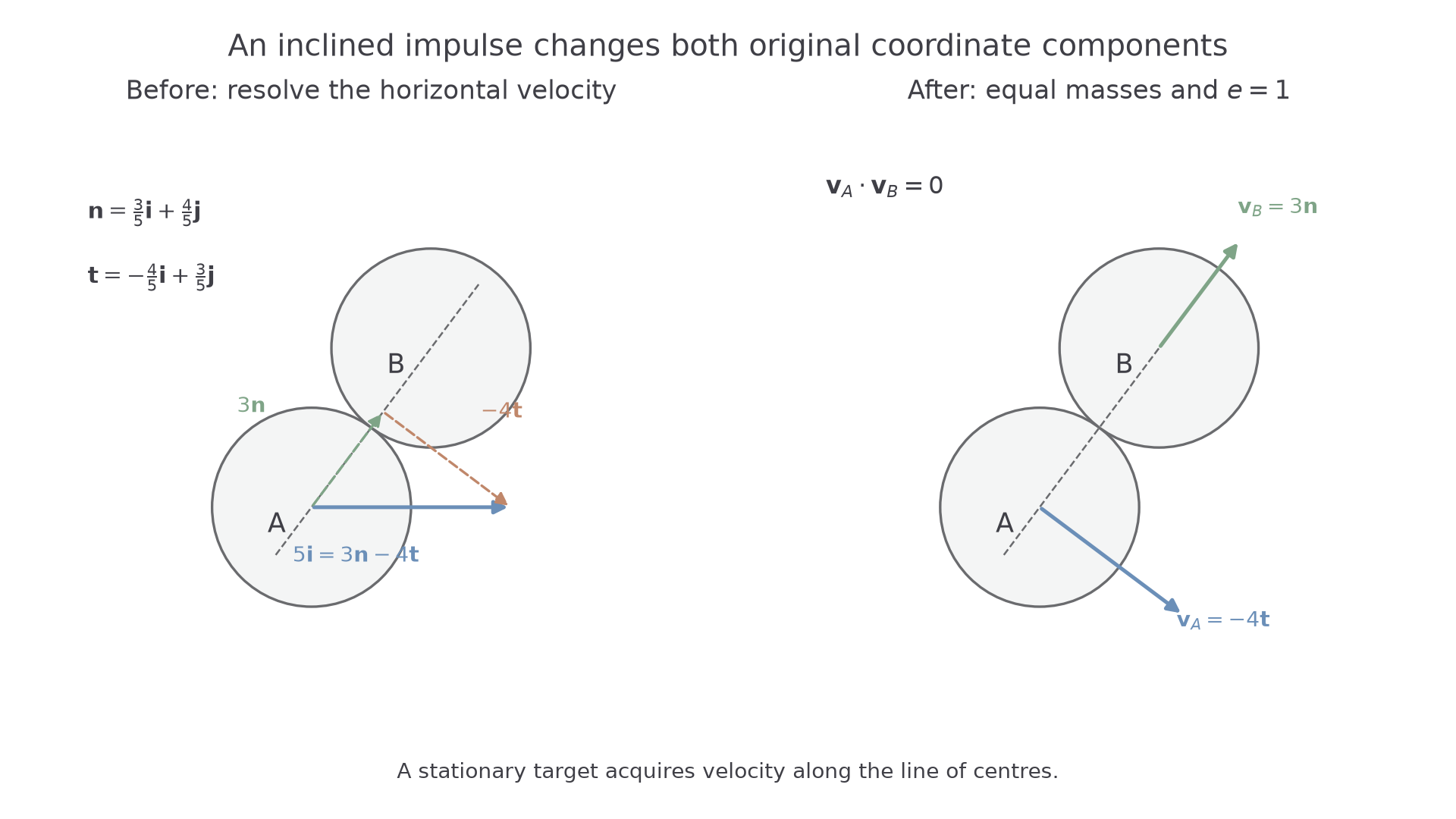
Worked example 3: reconstruct two velocity vectors
Question. Two smooth uniform spheres of equal mass collide on a smooth horizontal table. At contact, the unit vector from to is . Initially and is at rest. The coefficient of restitution is . Find both outgoing velocities and the deflection of .
Plan. Choose , resolve, solve the normal equations and reconstruct.
Why this step? Restitution changes components along an inclined line, so the original horizontal and vertical components both change when the velocity is reconstructed.
Answer. , . Sphere is deflected clockwise, to significant figures.
Check. The outgoing vectors add to , as equal-mass momentum requires. Their normal separation is , half the incoming normal approach.
Change only to . Equal masses and a stationary target now produce a striking geometric result.
Worked example 4: a right-angle departure
Question. For the same incoming velocities and line of centres, let the collision be perfectly elastic. Find both outgoing velocities and 's deflection, and show that the outgoing directions are perpendicular.
Plan. Resolve as before, set , then check the outgoing vectors' dot product.
Why this step? With equal masses, a stationary target and , the incoming sphere transfers its normal component to the target while retaining its perpendicular component.
Answer. , . The deflection is clockwise, and the two outgoing directions are at right angles.
Check. Their speeds are and , so their squared speeds sum to , consistent with no kinetic energy loss.
A vanishing component does not necessarily mean a vanishing velocity.
Watch out
Wrong: because in the elastic example. Smoothness preserves the non-zero transverse component. Correct: .
This right-angle result holds for this smooth equal-mass, perfectly elastic collision with one body initially at rest, provided both outgoing velocities are non-zero. It is not a rule for every pair of colliding balls.
Continue this lesson.
You’re previewing NovaLearn without an account. Create a free account to read the rest.
Create free account