Pv11, Pv12 - Intersecting, parallel or skew lines
Two lines in space can miss each other even when they are not parallel. Pv11 names the possible relationships; Pv12 gives you a reliable calculation to distinguish them and find an intersection when it exists. You will compare directions first, then require one pair of parameter values to satisfy all three coordinates.
Parallel directions and coincident lines
Two straight flight paths cross on a map. Must the aircraft paths actually meet?
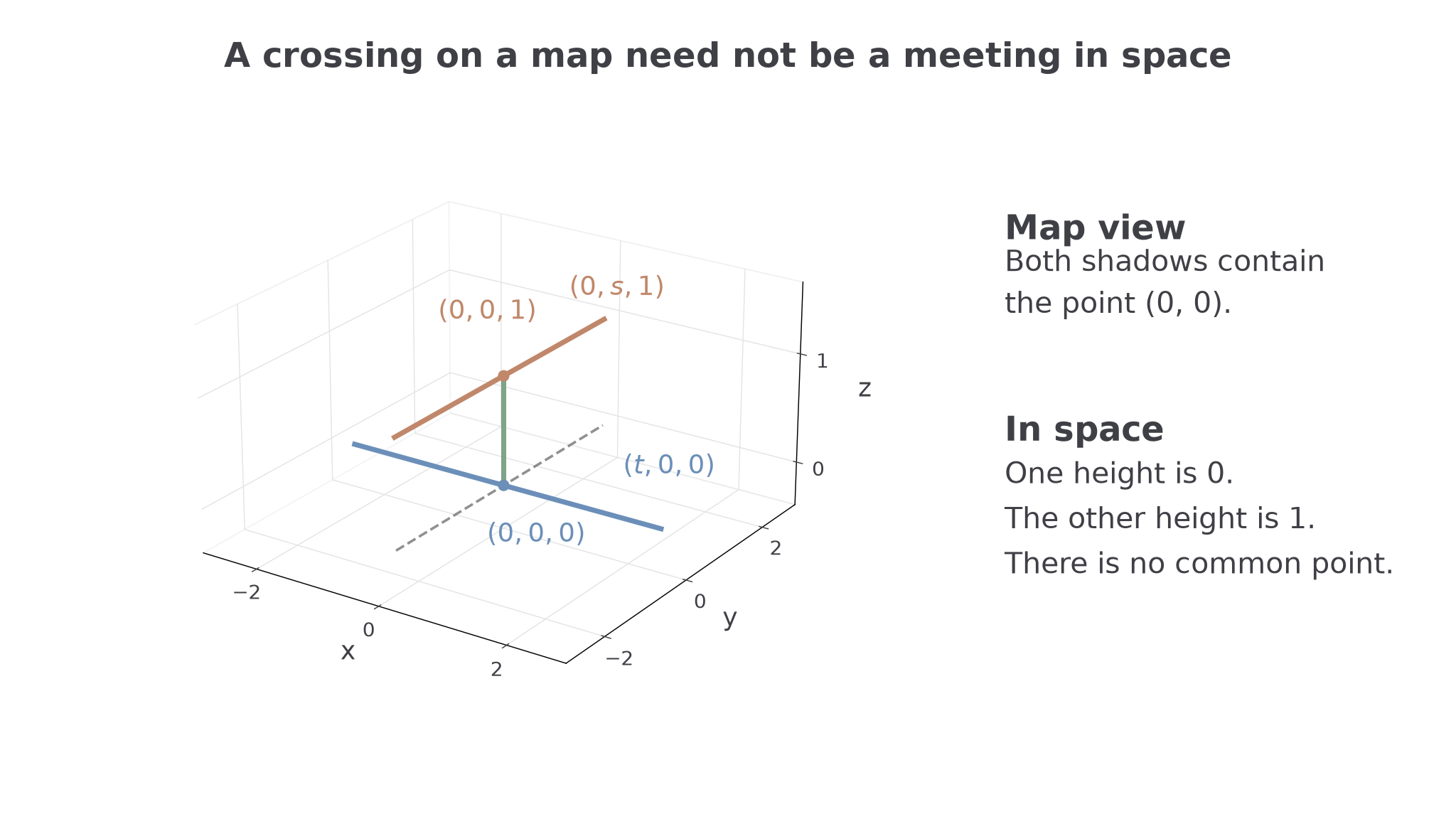
Not if they pass the crossing at different heights. For example, and project onto crossing coordinate axes on a horizontal map, but their heights are always and . They share no point. This is the extra possibility that makes three-dimensional geometry interesting.
You already know
A line has equation , with . Non-zero scalar multiples give the same parallel direction. A point belongs to a line only if one parameter value works in every coordinate.
First compare direction vectors. This separates the parallel-direction cases from the cases that need simultaneous equations.
Intersecting, parallel and skew lines
Two distinct lines intersect if they share a point. Distinct parallel lines have parallel direction vectors and no common point. Skew lines are neither parallel nor intersecting: they cannot lie in one plane. Two equations can also describe the same line; these are coincident lines, with every point in common.
In a single plane, two distinct non-parallel lines must meet. In space, “not parallel” leaves two possibilities: intersecting or skew. A drawing of projected lines cannot settle which one applies.
[DIAGRAM: asset_name: Crossing shadows, separated lines; asset_slug: b026_skew_projection; caption: These non-parallel lines have crossing shadows but no common point; description: A three-dimensional coordinate diagram shows a blue line through (t,0,0) in the plane z=0 and a clay line through (0,s,1) one unit above it. The clay line has a dashed shadow on z=0, crossing the blue line at the origin. A sage vertical segment from (0,0,0) to (0,0,1) marks the different heights. The points at the apparent crossing are labelled with their full coordinates.]
When the directions are parallel, test one point from the second equation in the first. If it lies on the first line, the lines coincide; otherwise they are distinct and parallel. This criterion follows from the line equation and is not separately printed in the formula booklet.
Worked example 1: distinct parallel lines
Question. Determine the relationship between
Plan. Compare the directions, then test the displayed point of in .
Why this step? Parallel directions alone do not distinguish two separate lines from two equations of the same line. One point test supplies the missing information.
Answer. The directions are parallel and is not on , so the lines are distinct and parallel.
Check. The displacement between the displayed points is , which is not a scalar multiple of .
The next example changes only the displayed point of the second line. Its direction remains the same, but the new point lies on the first line.
Worked example 2: two equations of one line
Question. Determine the relationship between above and
Plan. Establish parallel directions and verify all three coordinates of the new point with one value of .
Why this step? The common direction through a shared point fixes one geometric line. The parameter relation confirms that every real value in either equation is represented by the other.
Answer. The lines coincide. There is no single point of intersection; every point on either line is common.
Check. At , gives ; gives the same point on .
Do not use a zero scalar product as a parallel test. A zero scalar product means perpendicular directions; parallel non-zero directions are scalar multiples, including negative multiples.
Watch out
Wrong: “The direction vectors are unequal, so the lines are not parallel.” Right: compare scalar multiples. The vectors and are unequal but parallel.
This check changes the directions and the chosen point. Decide whether the equations describe separate parallel lines or one line.
One parameter pair for all coordinates
For non-parallel lines, equate their coordinates using a separate parameter for each line, then test whether the resulting parameter pair works everywhere.
Two suitable coordinate equations usually determine a candidate pair. Substitute it into the third equation before claiming an intersection. If your first two equations do not determine a unique pair, use another pair; do not divide by zero or assume that an undetermined parameter means the lines coincide.
Worked example 3: a genuine intersection
Question. Determine whether the following lines intersect, and find the coordinates of the intersection if they do:
Plan. Solve the - and -equations, check , then substitute into either line.
The directions are not scalar multiples. Equating coordinates gives
Why this step? Agreement in two coordinates proves only that the projected lines cross. The third equation decides whether their heights agree too.
Answer. The lines intersect at .
Check. The first equation gives ; the second gives .
The next example changes only the second line's starting height, from to . Its map projection is unchanged, so the same parameter pair will emerge from and ; the height check now does the decisive work.
Worked example 4: the projected crossing is not enough
Question. Determine whether in Worked example 3 and
are intersecting, parallel or skew.
Plan. Check the directions, solve the first two coordinate equations, then test their unique candidate in the third.
Why this step? Any common point would have to satisfy the first two equations, hence use this unique pair. Since that pair fails the third equation, no common point exists.
Answer. The lines are non-parallel and do not intersect, so they are skew.
Check. The apparent crossing consists of two different points, and , exactly one unit apart vertically.
This parameter-consistency method is not a separate formula in the booklet. The booklet's Cartesian line form can be converted to components first: name each line's common ratio with its own parameter, then use the same method.
Watch out
Wrong: impose because both symbols describe movement along a line. Right: solve for them independently. In Worked example 3 the common point uses and ; the parameters have different origins and step lengths.
When coordinates are requested, end with . A parameter value locates a point within an equation, but it is not itself the point's coordinates. The flight-path puzzle is settled in the same way: a map crossing is insufficient unless the height coordinates agree.
Quick Recap
- Compare direction vectors first: scalar multiples mean parallel directions.
- With parallel directions, a shared point means coincident lines; otherwise they are distinct and parallel.
- For non-parallel lines, solve coordinate equations using independent parameters and check the remaining equation.
- A consistent pair gives an intersection; an inconsistent system means skew lines.
Crossing on a map does not guarantee meeting in space: the flight paths must share all three coordinates, including height.