MG6–MG8 - Centres of mass of solids of revolution
MG6–MG7 use volumes of thin discs to locate the centre of mass of a uniform solid of revolution, about either coordinate axis. MG8 then combines such solids, including bodies with cavities, by replacing each part with its mass at its own centre.
Weight each disc by its volume
Why is a uniform solid cone's centre of mass only one-quarter of its height above the base, rather than halfway up? The narrow tip contains much less material than the broad base. Calculus turns that observation into an exact weighted average.
You already know
For common uniform density, masses are proportional to volumes and for separate parts. Rotating a region about the -axis gives disc volumes , so .
Imagine replacing each thin disc by its mass at its centre on the axis. A disc of radius has four times the volume of a disc of radius with the same thickness: this is why the radius itself is the wrong weight. A disc near coordinate , of thickness , has volume , mass , and mass moment about the plane . Add those moments by integration and divide by total mass.
[DIAGRAM: asset_name: Disc volumes weight the axial centre; asset_slug: h645_b076_discs; caption: The axial first moment weights each disc volume by its coordinate x; description: An axial section of a solid generated by y equals square root x between zero and four shows a vertical slice at x with radius y and thickness dx. A side panel gives dV equals pi y squared dx and its first volume moment x dV. The axial centre is marked at x equals eight thirds, closer to the wider end than the midpoint.]
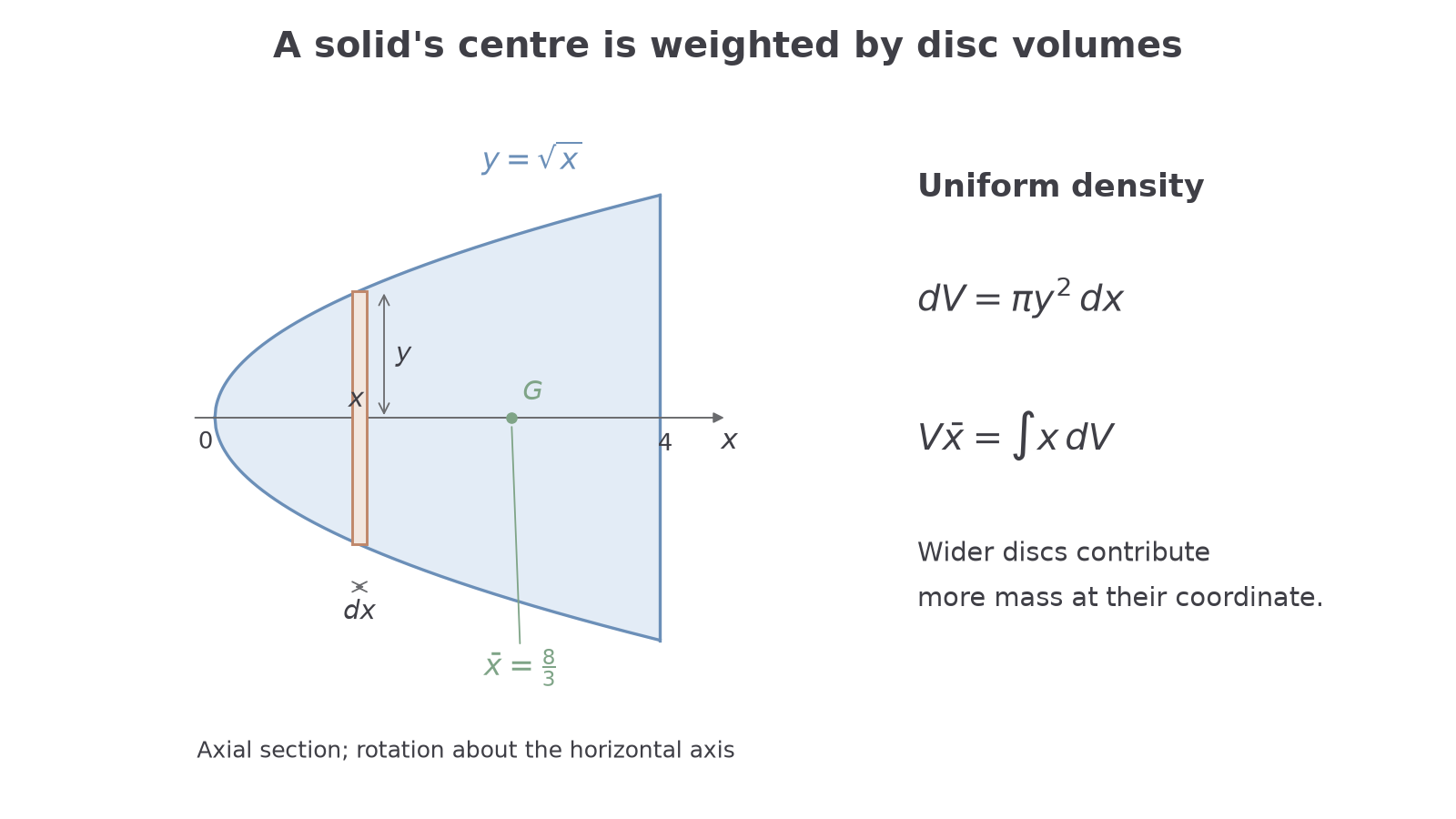
Centre of mass about the x-axis
For a solid of common uniform density generated by rotation about the -axis,
Hence
provided . Rotational symmetry makes the other two centre coordinates zero. The density cancels because it is constant throughout.
Not in the formula booklet: learn it.
The first volume moment is not a torque: its units are length to the fourth power. Multiplying by density and gravitational acceleration would turn it into a weight moment; those common factors cancel in the centre calculation.
Worked example 1: a solid wider towards one end
Question. The region , , is rotated about the -axis to form a uniform solid. Find its volume and axial centre of mass.
Plan. Use in the volume and first-volume-moment integrals.
Why this step? A disc's weight is proportional to its area , not to its radius . Using would describe the original lamina instead.
Answer. cubic units, with centre .
Check. : the centre lies inside the axial interval and beyond its midpoint towards the wider end.
Change only the profile to , keeping the same axis and interval. Disc areas now grow as , weighting the far end more strongly.
Worked example 2: a more rapidly widening profile
Question. Find the volume and centre of the uniform solid generated by , , about the -axis.
Plan. Replace by in both integrals.
Why this step? Changing the profile changes both the total volume and its moment. Updating only the numerator would average with the wrong mass.
Answer. , with centre .
Check. , so the more strongly widening profile has moved the centre further towards .
If the question asks for detailed reasoning, show the integrals and their evaluation. Otherwise, correctly specified integrals may be evaluated with the calculator; retain exact values when an exact centre is requested.
Watch out
Wrong: find by averaging the interval endpoints.
Right: average coordinates with disc-volume weights. The midpoint is the answer only when the mass distribution has the appropriate symmetry.
Use a new power and interval in the same method.
Change the axis and allow a central hole
For rotation about the -axis, use horizontal discs: the coordinate being averaged is , the radius is the horizontal distance , and the slice thickness is . Symmetry fixes the other centre coordinates on that axis.
If a cross-section is an annulus, subtract the inner disc area before forming either integral. The hole removes mass as well as its moment.
Horizontal discs and annuli
For rotation about the -axis, with outer and inner radii ,
Set for a solid disc. The radii must describe the actual non-overlapping cross-section of the solid.
Not in the formula booklet: learn it.
The method is unchanged: total volume below, first volume moment above. Keeping the integration variable aligned with the axis prevents an accidental swap of radius and coordinate.
Worked example 3: horizontal discs
Question. The region , , is rotated about the -axis. Find the volume and centre of the resulting uniform solid.
Plan. Use squared radius , then average the coordinate .
Why this step? The radius is , while the averaged position is . Interchanging those roles gives neither the volume nor the centre.
Answer. , with centre .
Check. , consistent with the increasing cross-sectional area.
Change only the inner boundary from the axis to . The same outer surface now surrounds a cylindrical hole.
Worked example 4: annular slices
Question. Find the volume and centre when the region is , , rotated about the -axis.
Plan. Use cross-sectional area in both integrals.
Why this step? A hole is not represented by subtracting radii: circular areas depend on squared radii.
Answer. , with centre .
Check. The removed cylinder has volume and centre at . It was below the original centre , so removing it moves the remainder's centre upwards, as .
Subtract disc areas, rather than squaring the gap between their radii.
Watch out
Wrong: for an annular slice. This is the area of a disc whose radius is the gap, not the remaining ring. Correct: in the second example.
You could reach the same result by treating the hole as a removed uniform solid. Annular integration and subtraction of known component moments are compatible descriptions of the same material.
Exam tip
Use a single consistent volume unit in both equations. A factor may be cancelled from the ratio, but it must cancel from both numerator and denominator.
Increase only the hole radius for the next check.
Derive the hemisphere and cone centres
Two familiar solids now become short applications of disc weighting. Set the origin on the flat base plane so that each answer is a distance from that plane along the symmetry axis.
For a hemisphere of radius , the axial section satisfies , with . For a cone of base radius and height , the straight profile is , with .
Worked example 5: a uniform solid hemisphere
Question. Derive the centre of mass of a uniform solid hemisphere of radius , measured from its flat face.
Plan. Integrate disc volumes and their axial moments, using .
Why this step? The flat-face origin fixes which distance is being calculated. A distance from the curved pole would instead be .
Answer. The centre is from the flat face along the axis.
Check. It lies between the face and the half-height point, where the largest discs concentrate the mass.
Continue this lesson.
You’re previewing NovaLearn without an account. Create a free account to read the rest.
Create free account