Pc2, Pc3 - Volumes of revolution and mean values
Pc2 builds volumes of revolution from thin cylinders, for rotation about either coordinate axis. Pc3 uses a definite integral to find a function's mean value, connecting the area under a changing height to an equivalent constant height.
Thin discs about the x-axis
Two rectangles each have area . One has height and width ; the other has height and width . If each is rotated about its bottom edge on the -axis, do they make equal volumes? Their areas agree, but the taller rectangle places more material further from the axis.
You already know
A cylinder of radius and height has volume . A definite integral is a limit of sums of thin strips, with accumulating height times width.
For a region between , the -axis and , take a vertical strip of width . On rotation about the -axis it becomes approximately a thin cylinder, or disc, with radius . Its volume is approximately .
[DIAGRAM: asset_name: Vertical strips become discs; asset_slug: h645_b038_discs; caption: Squaring the radius turns an area strip into a volume slice; description: A coordinate graph shows a region beneath y equals square root x between zero and four, with a thin vertical strip at x equals two. The strip is labelled radius y and thickness delta x. A side panel shows a circular cross-section with radius y and states disc volume approximately pi y squared delta x and the limiting integral pi integral y squared dx.]
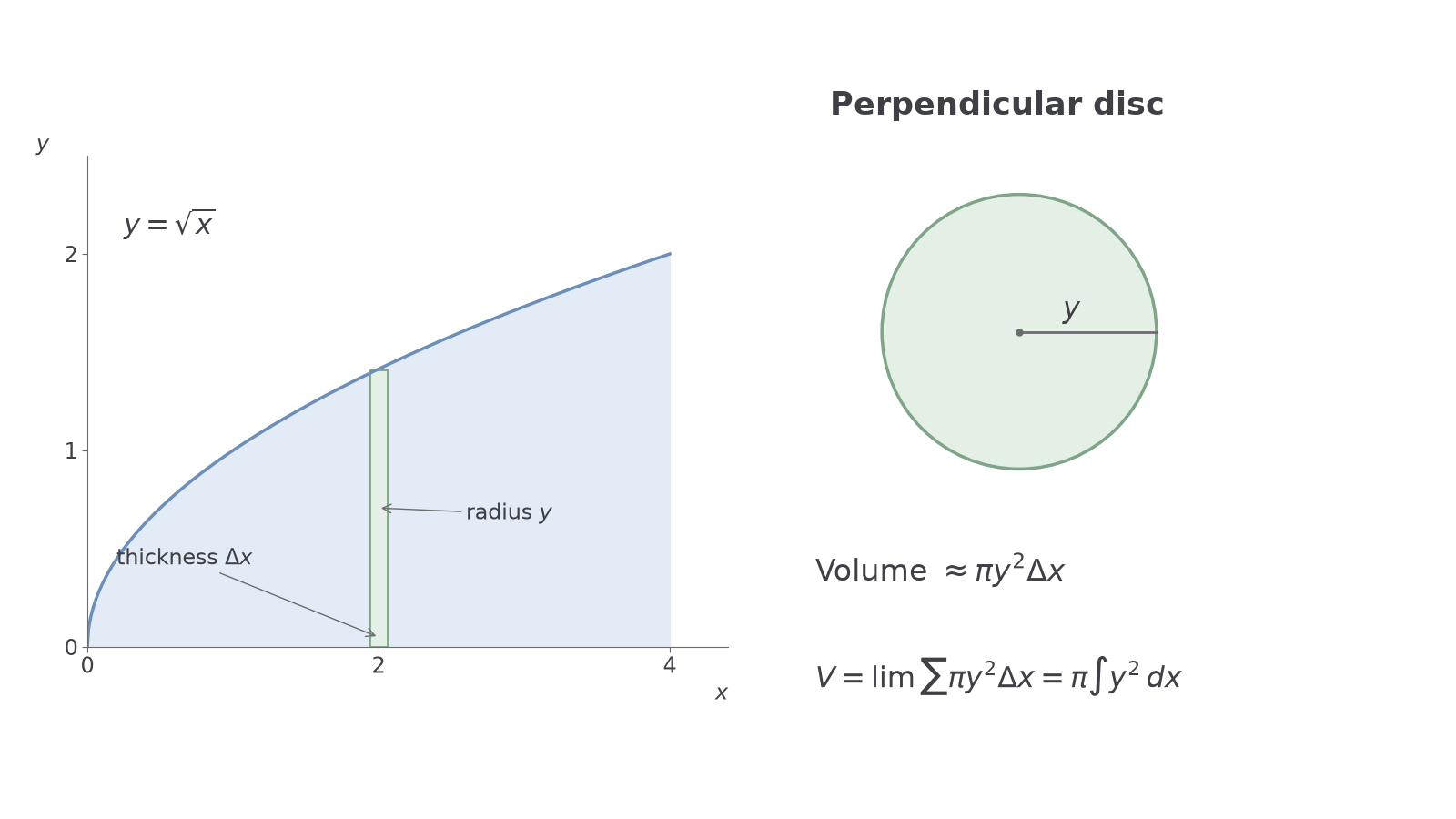
Adding the cylinder volumes, then letting the maximum strip width tend to zero, gives
This derivation explains the square and the variable of integration: radius squared comes from the circular cross-section, and measures thickness along the rotation axis.
Volume about the x-axis
For a bounded region whose cross-section perpendicular to the -axis is a disc of radius ,
If the cross-section has outer radius and inner radius , with ,
This subtracts the inner cylinders from the outer ones.
Not in the formula booklet: learn it.
A hole changes the cross-section from a disc into an annulus. Subtract squared radii, rather than squaring their difference.
Worked example 1: a solid with no hole
Question. The region under , above the -axis and between and , is rotated through radians about the -axis. Find its volume.
Plan. Use radius , square it, and integrate the circular cross-sectional area.
Why this step? Integrating would find the original plane area. The rotated cross-section has area .
Answer. cubic units.
Check. The solid fits inside a cylinder of radius and length , whose volume is ; is smaller.
Keep the curve and the interval, but change the region to the area above the curve and below . Rotation now leaves a hole of radius .
Worked example 2: a solid with a hole
Question. The region between , , and is rotated about the -axis. Find its volume.
Plan. Subtract the inner squared radius from the outer squared radius .
Why this step? The empty middle is itself the solid from Worked example 1, so its volume must be subtracted, not its radius.
Answer. cubic units.
Check. The outer cylinder has volume . Subtracting the previous gives .
If a region crosses the axis, identify the actual distance to the furthest boundary. A curve below the axis still has a positive radius; squaring the signed ordinate handles a disc, but two overlapping discs must not be counted twice.
Watch out
Wrong: annular area .
Right: annular area . The gap's thickness is not the radius of a new disc.
The same cross-sectional method now uses a smaller outer radius.
Horizontal discs about the y-axis
For rotation about the -axis, turn the slicing direction through a right angle. A horizontal strip of thickness makes a disc whose radius is the horizontal distance . Its approximate volume is .
Therefore the cylinder sum tends to . If the curve is supplied as , rearrange it to express the relevant horizontal boundary in terms of , and use -limits.
Volume about the y-axis
For a region whose perpendicular cross-sections are discs of radius ,
For annular cross-sections with horizontal radii ,
Both follow as limits of sums of cylinders of thickness .
Not in the formula booklet: learn it.
Use the boundary's distance from the new axis. Keeping after changing the rotation axis describes a different solid.
Worked example 3: rearranging the curve
Question. The region bounded by , the -axis and , with , is rotated about the -axis. Find its volume.
Plan. At each height , the radius is ; integrate horizontal disc areas from to .
Why this step? The radius is horizontal now. The curve supplies directly, so there is no need to square .
Answer. cubic units.
Check. The solid has height and maximum radius , so its volume is below the enclosing cylinder's .
Keep the curve and heights, but move to the region between the curve and . This introduces an inner radius without changing the integration variable.
Worked example 4: a hole about the y-axis
Question. The region between , with , and is rotated about the -axis. Find its volume.
Plan. Use outer radius and inner radius in a horizontal annulus.
Why this step? An inner radius comes from the curve , even though the original equation was written with as the subject.
Answer. cubic units.
Check. The radius-, height- cylinder has volume . Removing the solid from the previous example leaves .
The matching values in the two pairs of examples have a geometric reason: interchanging horizontal and vertical coordinates interchanges the axes and produces congruent solids. The integral changes its letter, while the cross-sectional areas have the same shape.
Exam tip
Before integrating, write the radius, the thickness variable and the limits for that variable. The volume formula must include ; integrating the squared radius alone gives only a volume divided by .
This curve rearranges directly into a horizontal squared radius.
Watch out
Wrong: the annular area is . Squaring the difference of radii does not subtract the hole’s area. The correct cross-section is , integrated with respect to .
Identify each disc area separately before taking their difference.
A mean value is an equivalent constant height
The mean value of a function is the constant height that gives the same signed area over the same interval. If that height is , the rectangle's signed area is , so it must equal .
[DIAGRAM: asset_name: A mean height with equal area; asset_slug: h645_b038_mean; caption: The curve x squared on zero to three has the same area as a rectangle of height three; description: A graph shows y equals x squared from zero to three with its area shaded pale blue. A dashed horizontal line at y equals three marks the mean height, with a pale sage rectangle of width three and height three shown in an adjacent matching panel. Both areas are labelled nine.]
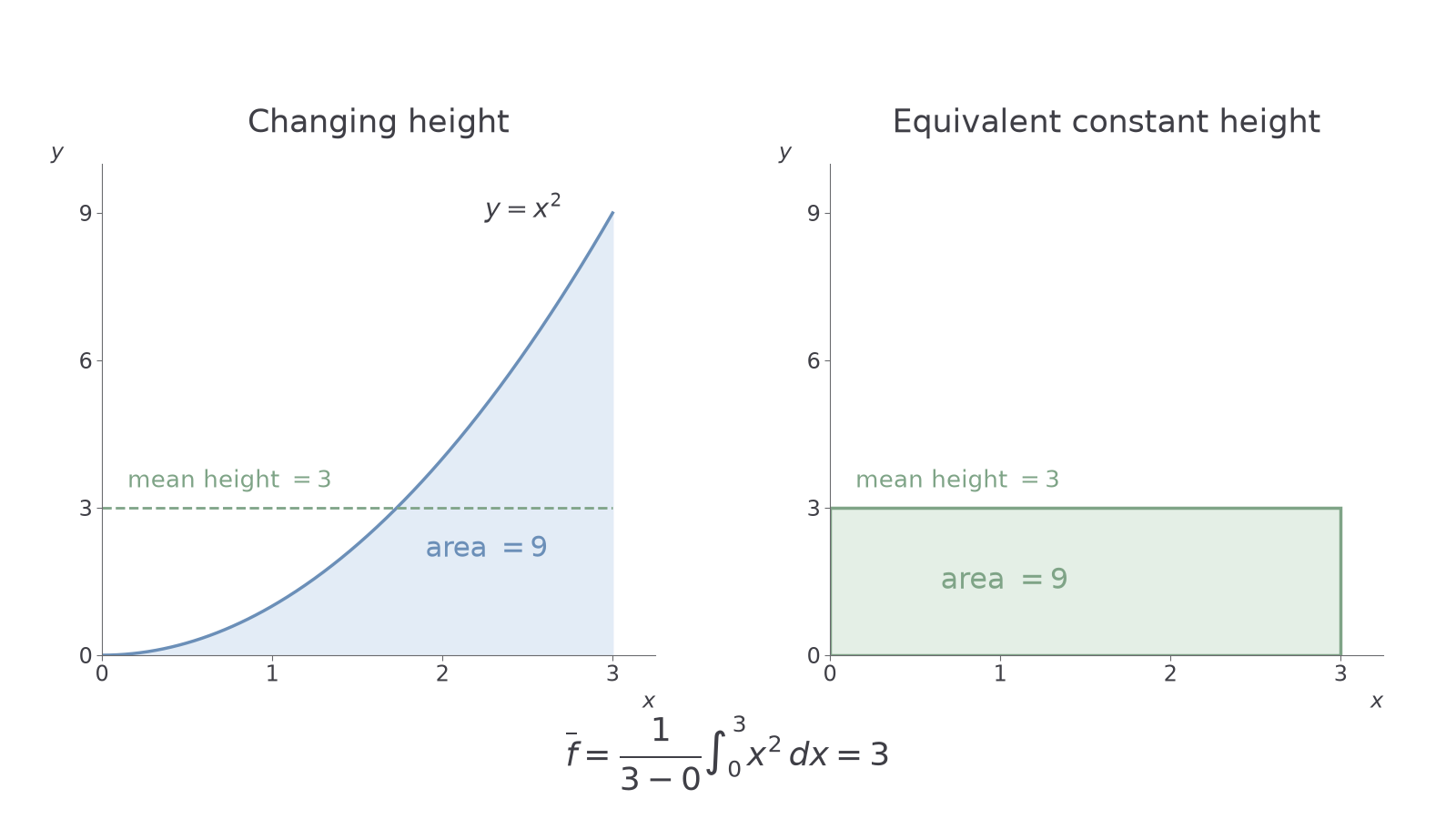
Mean value of a function
For an integrable function on , with , its mean value is
This is a mean of the function's values over the interval, not just the mean of its two endpoint values.
In the formula booklet.
For a continuous function, the mean lies between its minimum and maximum values. Positive and negative signed contributions may cancel: a function can have mean zero without being zero throughout the interval.
Worked example 5: a changing height
Question. Find the mean value of on .
Plan. Integrate the function, then divide by the interval width .
Why this step? The integral is , but that is an area. Dividing by width converts it into an average height.
Answer. The mean value is .
Check. A rectangle of width and height has area , matching the curve's integral. Also , the function's range here.
Change only the left endpoint to . The width doubles, but so does the integral because is even.
Worked example 6: an interval crossing zero
Question. Find the mean value of on .
Plan. Use interval width , evaluate the integral and divide.
Why this step? A symmetric interval does not make an even function's integral zero. Both halves contribute positively.
Answer. The mean value remains .
Check. The mean of on this interval is , while the mean of is . Averaging first and then squaring gives a different answer.
That distinction explains a useful fact about a sinusoidal signal. Over , has mean , but has mean . Equal positive and negative swings cancel in the first mean, while squaring preserves both. The identities and the mean-value formula are in the booklet; the conclusion follows by integration.
Watch out
Wrong: mean value of on is .
Right: it is , from the integral divided by the width. Averaging endpoints is exact for a straight-line function, but not for every curve.
The opening rectangles also settle the volume question: their volumes are and . Equal plane areas need not produce equal volumes because the disc area depends on radius squared.
Quick Recap
- Thin cylinders give about the -axis and about the -axis.
- For a hole, subtract the inner squared radius from the outer squared radius.
- Choose limits for the variable measuring thickness along the rotation axis.
- A function's mean is its signed integral divided by the interval width; it need not equal an endpoint average or the function of an average input.
The two area- rectangles make volumes and : equal areas can give different volumes of revolution.