Xa3–Xa6 - Cyclic groups, subgroups and Lagrange's theorem
Some finite groups can be reached by repeatedly using just one element. Xa3 and Xa4 distinguish a generator's cycle from the order of the whole group; Xa5 tests subgroups, and Xa6 uses Lagrange's theorem to restrict their sizes and the orders of elements.
Find cycles, element orders and generators
On a dial with eight positions, a jump of three visits every position, but a jump of four visits only two. How can the larger jump produce the smaller collection? The answer is the first return to the identity, not the size of the number written on the jump.
You already know
A group has closure, associativity, identity and inverses. Under addition modulo , reduce results to , with identity zero. Under multiplication or composition, repeated use is written as powers. Set membership and containment use different notation.
For a multiplicative group, define , , , and so on. Associativity makes repeated products unambiguous; these powers use the group's operation, not necessarily ordinary numerical multiplication.
Orders and a finite cyclic group
The order of a finite group is , its number of elements.
The order of an element is the least positive integer such that , if one exists. If no such exists, has infinite order. The identity has order .
A finite group is cyclic if one element , called a generator, produces every element by repeated use. Write . If , a generator has order , and .
In additive notation, replace by “ added to itself times gives zero”. An element's order counts operations until that first return; it is not its value. These definitions are not printed in the formula booklet.
[DIAGRAM: asset_name: Jumps of three and four modulo eight; asset_slug: h645_b141_cycles; caption: The first return to zero determines the cycle length, and only the eight-step cycle generates the whole group; description: Two circular diagrams have eight equally spaced labelled vertices zero through seven. The left arrows follow 0,3,6,1,4,7,2,5,0 under adding three modulo eight. The right highlights only 0 to 4 to 0 under adding four. Start vertex zero is clay; visited vertices are blue and unused vertices grey.]
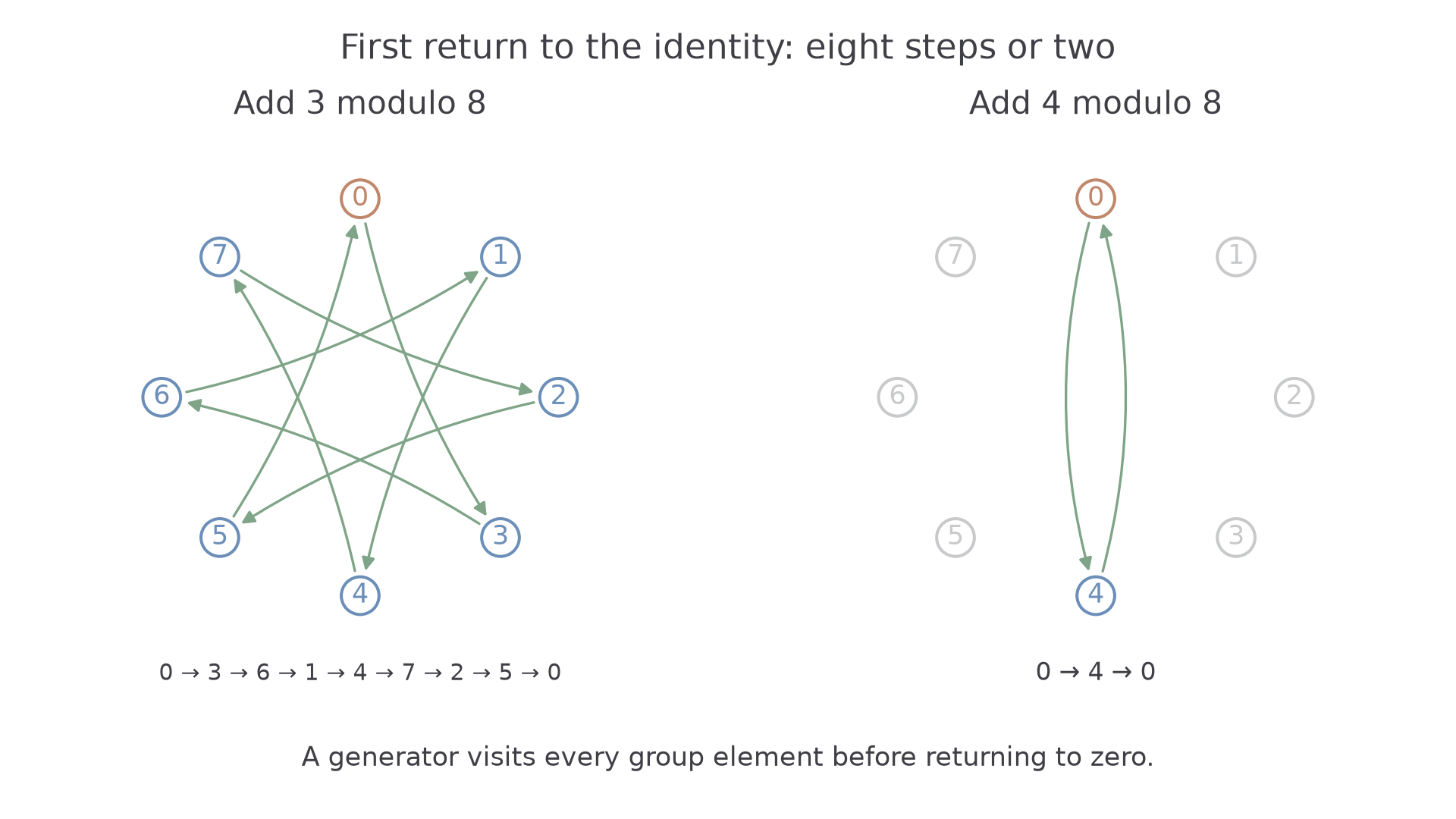
Worked example 1: a generator of an eight-element group
Question. In , find the order of and show that it generates .
Plan. List successive repeated sums modulo , stopping at the first return to zero.
| Number of copies of | ||||||||
|---|---|---|---|---|---|---|---|---|
| Result modulo |
Why this step? Returning to zero alone is insufficient for a generator; the least return must occur after visiting all eight elements.
Answer. The order of is , and is a generator of this cyclic group.
Check. The eight listed values are distinct and exhaust .
Change only the chosen element from to , leaving the group and operation unchanged.
Worked example 2: a shorter cycle
Question. Find the order of , its generated set, and decide whether it generates .
Plan. Stop when repeated addition first gives zero; do not continue counting repetitions as new elements.
Why this step? The group has eight elements, but a particular element may run round a smaller cycle inside it.
Answer. The order of is ; it generates , not all of .
Check. Every repeated sum of is either or , so it cannot reach .
Repeating this test for every element gives orders for , respectively. Thus all generators here are , not all non-identity elements. A cyclic group is abelian, since .
An element can have infinite order in an infinite group. In , the element has infinite order because for every positive integer . In , has infinite order because for every positive . These examples concern element orders; our cyclic-group work concerns finite groups.
Watch out
Wrong: in addition modulo eight, because .
Why: being non-identity does not make an element a generator; the cycle reaches only two elements.
Right: . A generator must reach all eight elements before its first identity return.
Count the complete first-return cycle for the new element below, rather than judging its order from its numerical label.
Test a subset under the same operation
A subgroup is a subset that is itself a group using the original operation. Associativity is inherited from the parent group, so do not re-prove it. Check that the identity is present, products stay inside the subset, and inverses stay inside it.
A subgroup test
For a subset of a group , it is enough to show
Associativity is inherited from . The operation on must be the restriction of the operation on .
Not in the formula booklet: learn it.
Use all required checks. A subset of the right size, or one that contains the identity, need not be a subgroup.
Worked example 3: even residues
Question. Show that is a subgroup of . Classify it as proper or not, and non-trivial or not.
Plan. Verify closure by the restricted table, identify inverses and use inherited associativity.
Why this step? Entries remaining in prove closure for all pairs, rather than for just one sample sum.
Answer. It is a subgroup. It is proper because , and non-trivial because .
Check. It is exactly the set generated by in the preceding check.
Change only the subset by deleting , while keeping the operation .
Worked example 4: identity is not enough
Question. Determine whether is a subgroup of the same group.
Plan. Look for a product or inverse that leaves the proposed subset.
Why this step? Keeping zero does not keep every other group property; one failed axiom is decisive.
Answer. is not a subgroup.
Check. The operation was not changed to addition modulo : that would define a different problem rather than test this subset.
A proper subgroup means any subgroup other than itself. A non-trivial subgroup means any subgroup other than . For a group with more than one element, is proper but trivial; is non-trivial but not proper. The terms “proper, non-trivial” together exclude both extremes. These definitions are not printed in the formula booklet.
Watch out
Wrong: is a subgroup, for under .
Why: identity membership does not establish closure; .
Right: check identity, closure and all inverses under the original operation; inherit only associativity.
Once those tests establish a subgroup, compare it separately with the whole group and the identity-only subgroup to classify it.
Continue this lesson.
You’re previewing NovaLearn without an account. Create a free account to read the rest.
Create free account