Mr1–Mr3 - Angular speed, forces and acceleration
A body can keep the same speed while accelerating throughout its motion. Mr1 gives the language of a circle; Mr2 and Mr3 connect its inward acceleration to the actual forces. You will convert between angular and tangential speed, calculate radial acceleration and build equations of motion.
One revolution, two ways to describe speed
A bead moves round a circle of radius , completing revolutions per minute. Is its speed ? The number counts turns, so it needs both a time conversion and a link to distance.
In one turn the bead travels metres while its radius turns through radians. Angular motion measures the turning; tangential motion measures the movement along the circle.
You already know
For an angle in radians, arc length is . A dot means differentiation with respect to time: . One complete revolution is radians.
Keep the radius fixed when differentiating the arc length. The direction of the velocity is tangent to the circle, perpendicular to the radius at the particle.
Radial, tangential and angular velocity
A radial direction lies along a radius; specify towards or away from the centre. A tangential direction is perpendicular to that radius in the plane of the circle.
The angular velocity is the rate , also written , at which the angular position changes. Its sign depends on the chosen positive sense of rotation. Angular speed is . Here angular velocity is treated as a signed scalar.
Choose the direction of travel as positive when using speed. The same angular speed gives a greater tangential speed on a larger circle.
Speed round a fixed circle
For a fixed radius , with measured in radians,
Here is signed tangential velocity in the chosen positive sense. For magnitudes, use speed .
In the formula booklet.
At constant angular speed, the period is the time for one revolution. Since , . This period relation is not in the formula booklet: learn it. Use seconds before calculating quantities in SI units.
Worked example 1: turns per minute to speed
Question. A bead moves uniformly round a circle of radius , completing revolutions per minute. Find its angular speed, tangential speed and period.
Plan. Convert turns per minute to radians per second, then use the radius and the time for one turn.
Why this step? A revolution is an angle, not a distance. The radius enters only when angular speed becomes tangential speed.
Answer. , and .
Check. In seconds the bead travels metres, exactly the circumference.
Change only the rotation rate to revolutions per minute. The radius stays fixed, so tangential and angular speeds increase by the same factor.
Worked example 2: a faster rotation
Question. Find the angular speed, tangential speed and period for the same bead and circle at revolutions per minute.
Plan. Make the same unit conversion using the new number of turns.
Why this step? The speed is times the previous speed, but the period is divided by : each turn takes less time.
Answer. , and .
Check. , still one circumference.
A negative reverses the direction of travel, while the speed remains positive. Use the sign only when a direction of rotation has been defined.
Watch out
Wrong: substitute directly into when the rate is revolutions per minute. Right: first use in radians per second.
Try a new rotation rate while keeping the same circle.
Constant speed still needs inward acceleration
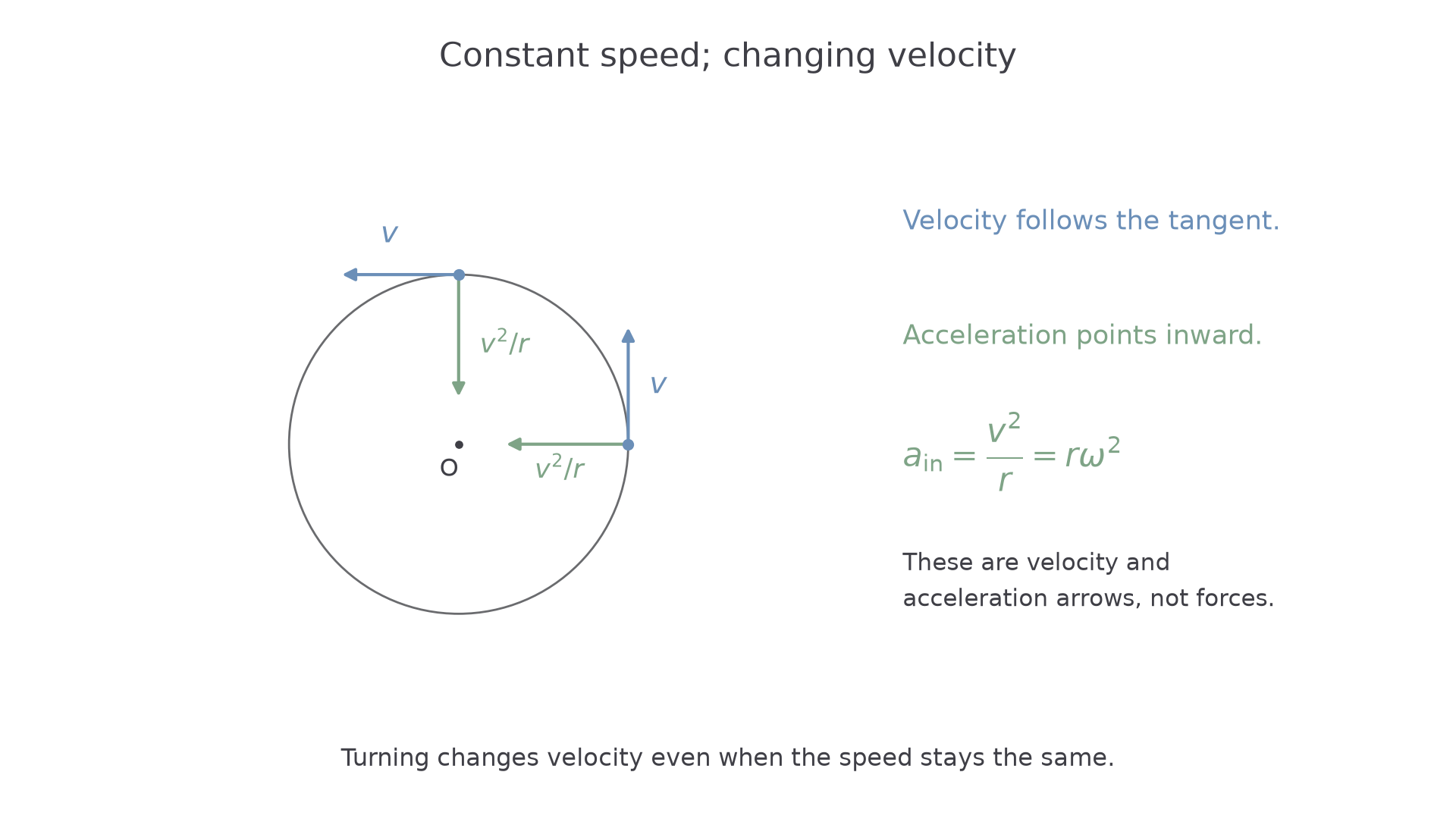
A car travelling at constant speed round a circular bend changes its velocity because its direction changes. Its acceleration is not zero.
For two nearby positions on a circle, the velocity arrows turn through the same small angle as the radii. The triangle of velocity changes gives . Dividing by and taking the limit gives , directed towards the centre. At constant speed there is no tangential component.
[DIAGRAM: asset_name: Tangential velocity and inward acceleration; asset_slug: h645_b071_radial; caption: Velocity is tangent to the path; at constant speed the acceleration points towards the centre; description: A circular path has two marked positions. Blue velocity arrows are tangent, and sage acceleration arrows point inward. A separate right-hand panel states that equal speed does not mean equal velocity, and that the inward acceleration has magnitude v squared divided by r. No force arrows are included.]
Radial acceleration
For motion on a circle of fixed radius ,
This is the component of acceleration towards the centre. For uniform speed it is the whole acceleration; if the speed varies, a tangential component may also be present.
In the formula booklet.
The square makes the inward acceleration independent of the sense of rotation. Doubling the speed quadruples it. This is why a modest increase in speed can make a bend much harder to negotiate.
Continue this lesson.
You’re previewing NovaLearn without an account. Create a free account to read the rest.
Create free account