Mr4 - Horizontal circles at constant speed
Mr4 brings circular acceleration into familiar force models: a car on a flat bend, a conical pendulum and a banked track. You will use zero vertical acceleration alongside a non-zero horizontal radial acceleration, choose the correct circle radius and test whether friction or contact can sustain the motion.
A level circle needs horizontal grip
Can an car take a level circular bend of radius at , if the coefficient of friction is ? The car is neither rising nor falling, but it is accelerating. One force equation will not describe both directions.
Model the car as a particle, with no aerodynamic forces and with horizontal tyre friction providing the inward resultant. At constant speed there is no tangential acceleration. In this ideal model the friction is sideways, opposing the tendency to slide outwards; it need not oppose the forward velocity.
You already know
For a circle, . Newton's law uses the actual inward force components. At a rough contact, static friction satisfies , with equality only at limiting grip. Use .
Vertical balance gives the normal force. The radial equation gives the friction actually required. Compare that value with the available maximum only after finding it.
A level circular track
For a particle of mass travelling uniformly on a level circle of radius , with friction as the only horizontal force,
The motion is possible within this friction model if
The limiting speed is .
Not in the formula booklet: learn it.
Mass cancels from the limiting-speed condition. Doubling the car's modelled mass doubles both required sideways force and available grip, so it leaves the predicted limiting speed unchanged.
Worked example 1: enough friction
Question. An car travels at on a level circular track of radius . The coefficient of friction is . Determine whether the motion is possible.
Plan. Find the required inward friction and compare it with .
Why this step? Using immediately would describe impending sliding, which has not been stated.
Answer. The motion is possible in this model. The friction is towards the centre.
Check. The minimum coefficient needed is , below .
Change only the speed to . The available grip is unchanged, but the required force grows as the square of speed.
Worked example 2: the model cannot sustain the turn
Question. Determine whether the same car can follow the same circle at .
Plan. Recalculate the radial force and compare it with the same maximum friction.
Why this step? Newton's law calculates what maintaining the specified circle would require. The contact inequality decides whether the surface can supply it.
Answer. The car cannot maintain this circular path at under the stated model.
Check. The limiting speed is to significant figures, between the two trial speeds.
Once grip is lost, the original circular-motion equations no longer determine the path. They diagnose failure of the proposed motion, rather than calculating the later skid.
Watch out
Wrong: friction always has magnitude . Right: find the friction needed and test . Equality is the limiting case.
The next speed lies between the two worked examples.
The circle radius is not the string length
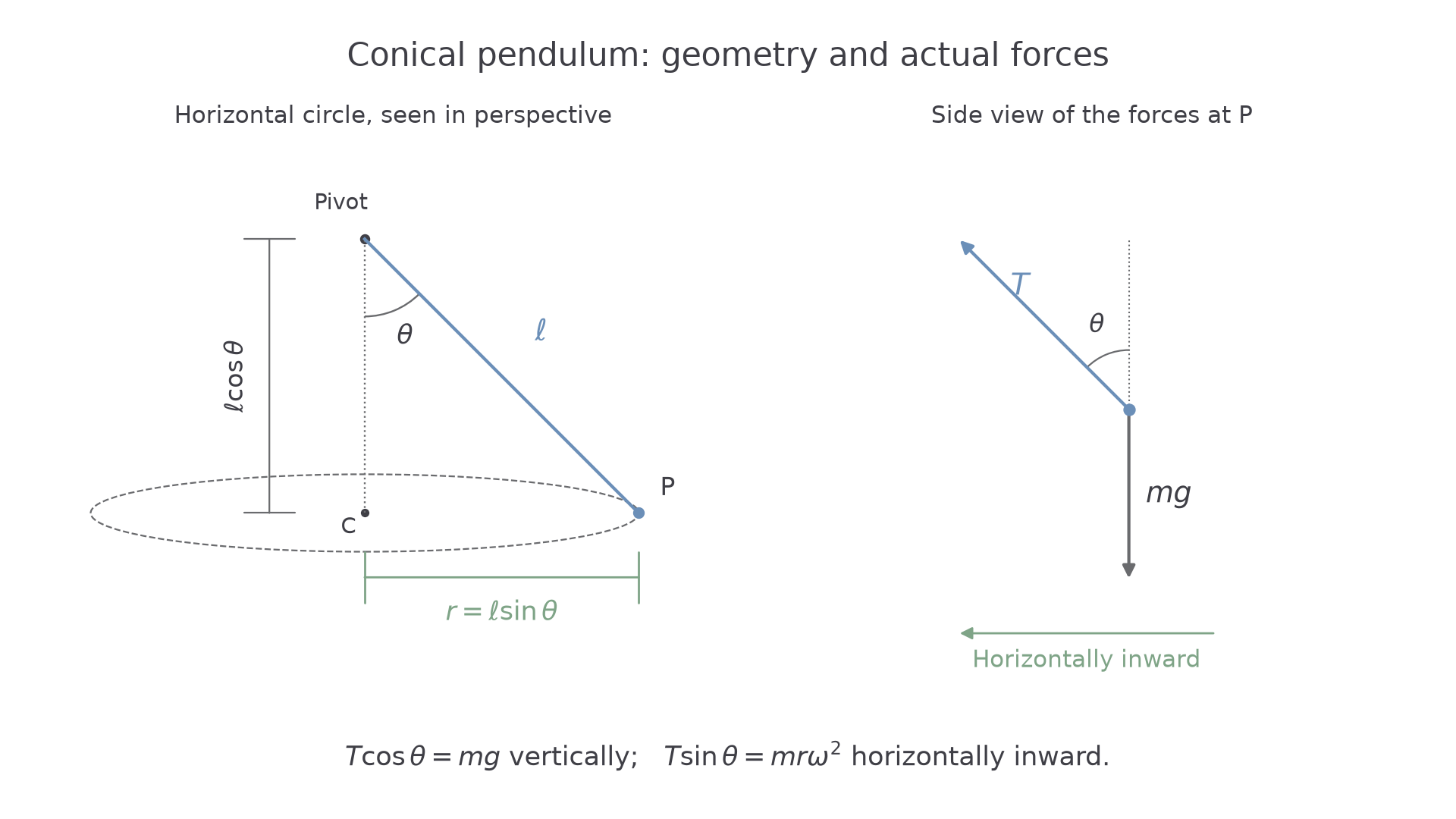
In a conical pendulum, a particle attached to a fixed point by a light inextensible string travels uniformly in a horizontal circle. The string sweeps out a cone. Its length is a sloping distance; the circle's radius is the horizontal projection.
Let the string have length and make an angle , where , with the downward vertical. The circle radius is . Tension supplies both an upward component to balance weight and a horizontal component to turn the particle.
[DIAGRAM: asset_name: Conical pendulum geometry and actual forces; asset_slug: h645_b072_conical; caption: The horizontal circle has radius ell sin theta; tension's vertical and horizontal components have different jobs; description: A fixed pivot is above the centre of a horizontal circle. A sloping string of length ell makes angle theta with the downward vertical, ending at a particle. The horizontal radius is labelled r equals ell sin theta and the vertical depth ell cos theta. A separate force panel shows tension along the string towards the pivot, weight vertically down, and the inward horizontal direction.]
Conical pendulum equations
For a particle of mass on a taut light string of length , rotating uniformly at angle to the vertical,
Eliminating , for ,
The speed is , and the period is .
Not in the formula booklet: learn it.
The angular-speed equation follows by dividing the horizontal equation by the vertical equation, then substituting . It is specific to this one-string force model. If a second string or surface acts, return to the actual forces.
Worked example 3: a conical pendulum at a given angle
Question. A particle is attached to a light string of length . It rotates uniformly with the string at to the downward vertical. Find the tension, circle radius, angular speed and period.
Plan. Use vertical balance for tension and the horizontal geometry for the circular motion.
Why this step? The particle circles the vertical axis, not the pivot. Substituting as the horizontal radius would give the wrong radial equation.
Answer. , , , , to significant figures where needed.
Check. , while gives the same inward force.
Change only the angle to . The string length and particle mass remain the same.
Worked example 4: a narrower cone
Question. Find the tension, radius, angular speed and period for the same pendulum when the string is at to the vertical.
Plan. Recalculate both string projections before applying the same force equations.
Why this step? Changing the angle changes the circle radius as well as the force components. Keeping the old radius would mix two different geometries.
Answer. , , , , to significant figures.
Check. At , the tension's horizontal and vertical components are equal. The inward force is therefore , agreeing with .
Continue this lesson.
You’re previewing NovaLearn without an account. Create a free account to read the rest.
Create free account