Pj1, Pj2 - Complex number terms and quadratic roots
Some quadratic equations have no real roots, yet they still have roots. In this lesson you meet the imaginary unit and the language of complex numbers: real and imaginary parts, the conjugate, the modulus and the argument, and the real and imaginary axes. You then solve any quadratic equation with real coefficients and check your answers, exactly as Core Pure questions expect.
Square roots of negative numbers
Can you split 10 into two numbers whose product is 40?
Try a few pairs. 2 and 8 give 16, 4 and 6 give 24, and 5 and 5 give 25. Moving the two numbers apart only makes the product smaller, so with real numbers 25 is the best you can do. The algebra agrees. If the numbers are and , then
No real number squares to , so there is no real solution. Gerolamo Cardano posed exactly this problem in his book Ars Magna in 1545. He wrote the answers as and , checked that their product really is 40, and then dismissed the calculation as clever but useless. By the end of this lesson you will see that these are two perfectly good numbers, and you will find them in a few lines.
The first step is to give a square root of a name.
Imaginary unit
The imaginary unit is a number with . For any positive real number , . For example, and . Not an example: is not , because .
Check the first example: . Also , so has two square roots, and , just as has and . The symbol means , and the two square roots together are . With available, the equation is no longer a dead end; the last section of this lesson finishes Cardano's problem.
Key idea
Write every square root of a negative number as a real multiple of straight away, and replace by whenever it appears.
Powers of i
Because , every power of simplifies:
Once you reach , the pattern starts again.
[DIAGRAM: asset_name: Powers of i; asset_slug: i_power_cycle; caption: Multiplying by i four times brings you back to 1; description: Four boxes in a loop show 1 on the right, i at the top, minus 1 on the left and minus i at the bottom, each labelled with the power of i it equals. Anticlockwise arrows marked times i join them, so four steps return to 1 and a power of i depends only on the remainder when the index is divided by 4.]
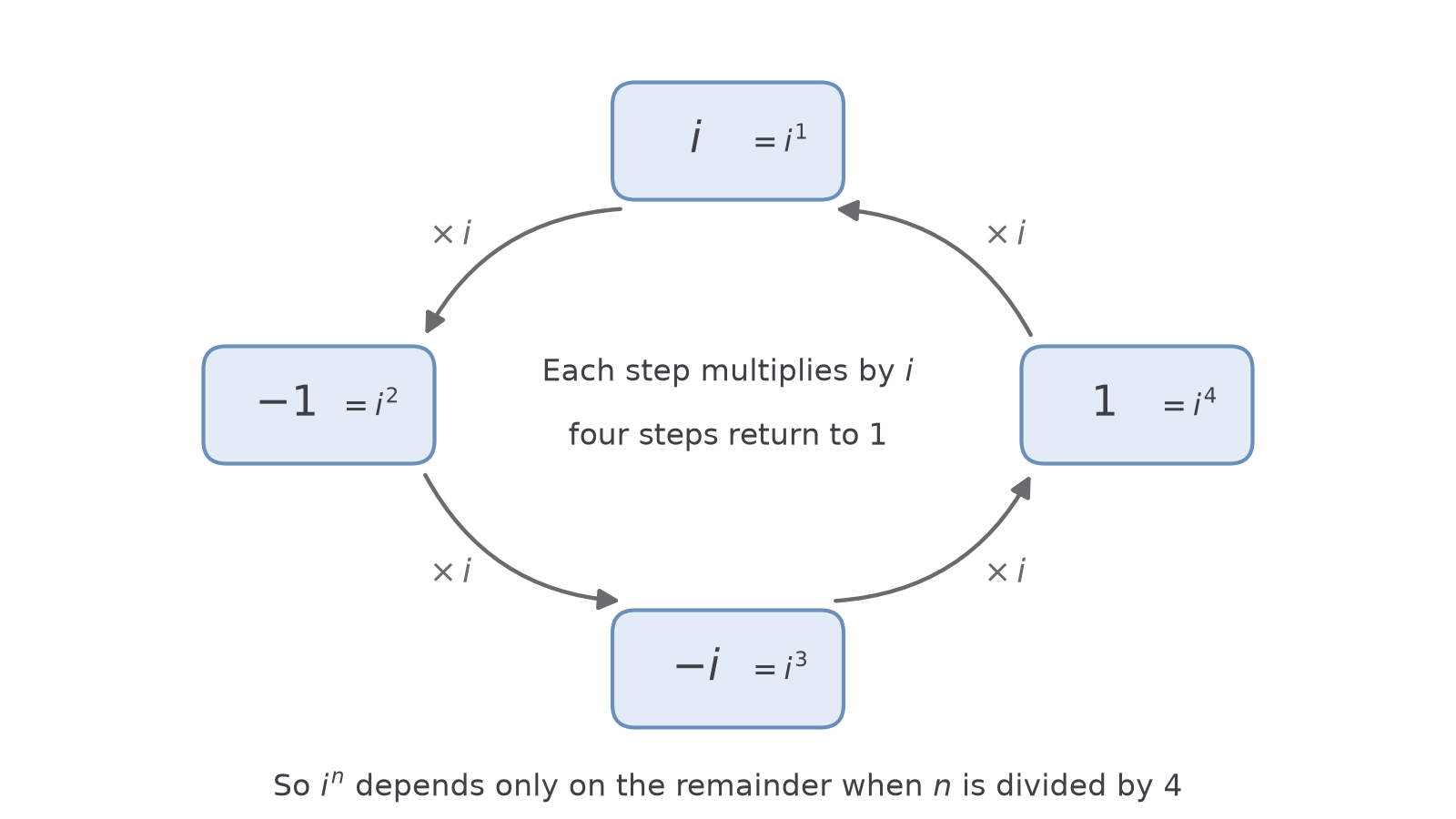
Powers of i
For any whole number :
You can always rebuild it from .
Not in the formula booklet: learn it.
For example, , so .
Watch out
The rule is true only when and are not negative.
Wrong:
Right:
Change each root into a multiple of first, then multiply.
The language of complex numbers
A complex number is a real number plus a real multiple of ; this section names its parts and pictures it as a point.
Cardano's numbers already have this shape: is the real number 5 plus lots of .
Complex number
A complex number is a number of the form , where and are real. The real part of is and the imaginary part is . For example, and . Not an example: is not , because the imaginary part is a real number.
The fourth row matters. A real number such as is a complex number whose imaginary part is 0, so every real number is also a complex number. A number such as , whose real part is 0, is called purely imaginary. The set of all complex numbers is written , and it contains the set of real numbers .
[DIAGRAM: asset_name: Real numbers inside the complex numbers; asset_slug: complex_number_sets; caption: Every real number is a complex number with imaginary part 0; description: A large lavender region labelled C, all complex numbers x plus yi with x and y real, contains a smaller green region labelled R, real numbers with imaginary part 0, holding minus 8, three quarters, root 2 and pi. Outside R but inside C are 4 minus 7i, 5i, 5 plus i root 15 and minus 1 minus i, each with its real and imaginary parts written beneath it.]
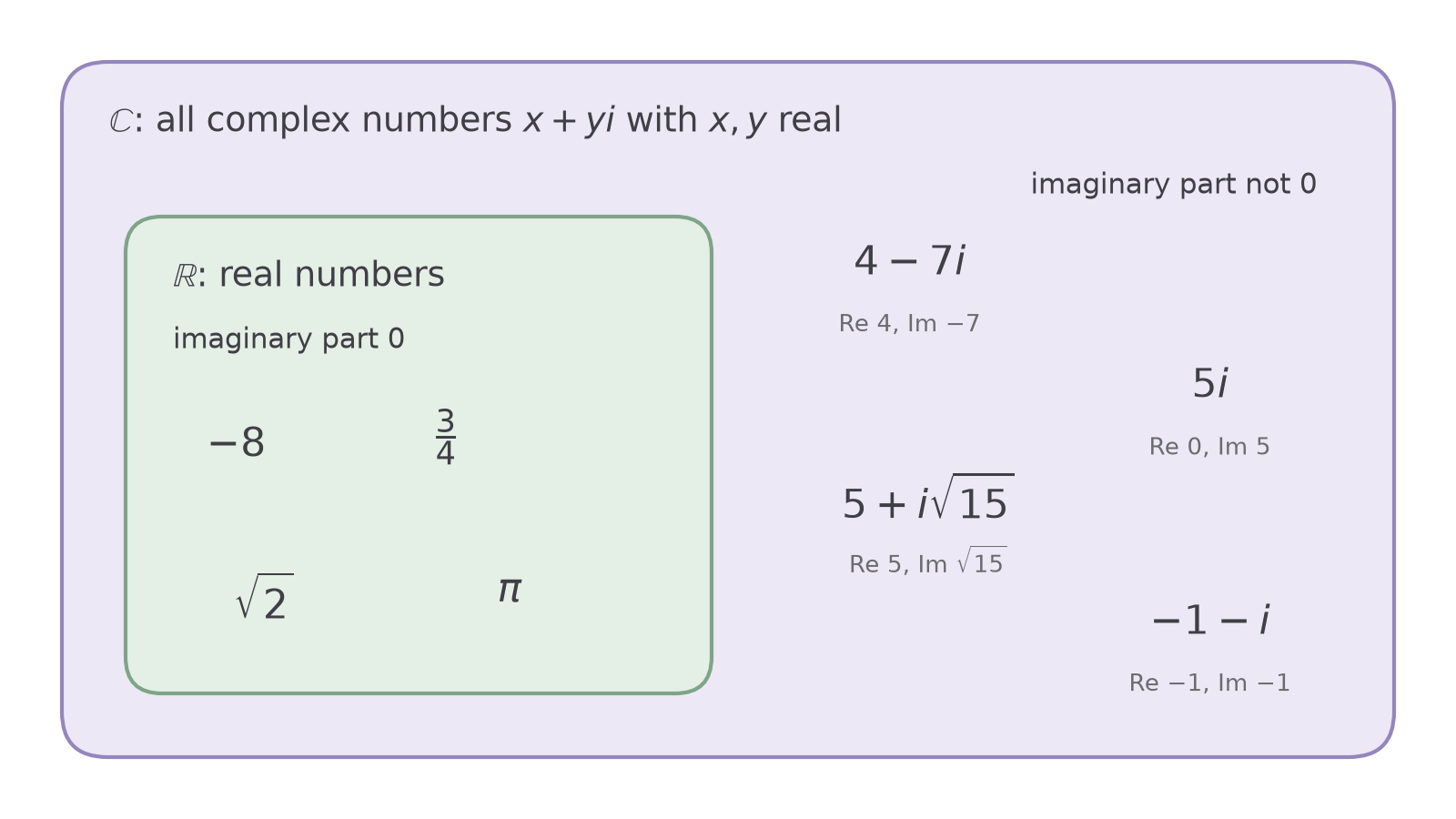
You can read off the parts only when the number is written as one real number plus one real multiple of . For example, is not yet in that form:
so its real part is 2 and its imaginary part is 6.
Two points of notation. Exam papers write the same number as , or ; all three mean the same thing. When the imaginary part is a surd, write or , never , so that the is clearly outside the root.
Key idea
and are both real numbers, and you read them only after writing as a single real number plus a single real multiple of .
Complex numbers as points
Because is fixed by the two real numbers and , you can plot it as the point . The horizontal axis is the real axis, labelled Re, and the vertical axis is the imaginary axis, labelled Im. This picture is called an Argand diagram, after Jean-Robert Argand, who published it in 1806. Real numbers lie on the real axis and purely imaginary numbers lie on the imaginary axis.
[DIAGRAM: asset_name: A complex number as a point; asset_slug: argand_modulus_argument; caption: The complex number 3 plus 4i drawn as a point, with its modulus and argument; description: An Argand diagram with the horizontal real axis labelled Re and the vertical imaginary axis labelled Im. The point z equals 3 plus 4i is marked, with dashed lines showing Re(z) equals 3 across and Im(z) equals 4 up. A blue line from the origin O to z is labelled modulus of z equals 5, and a green arc at O from the positive real axis to that line is labelled arg z. A side panel says that the modulus is the distance from O, the square root of 3 squared plus 4 squared, and that the argument is the angle from the positive real axis, with tan of arg z equal to four thirds, so arg z is about 0.927 radians, and that arguments lie between minus pi and pi.]
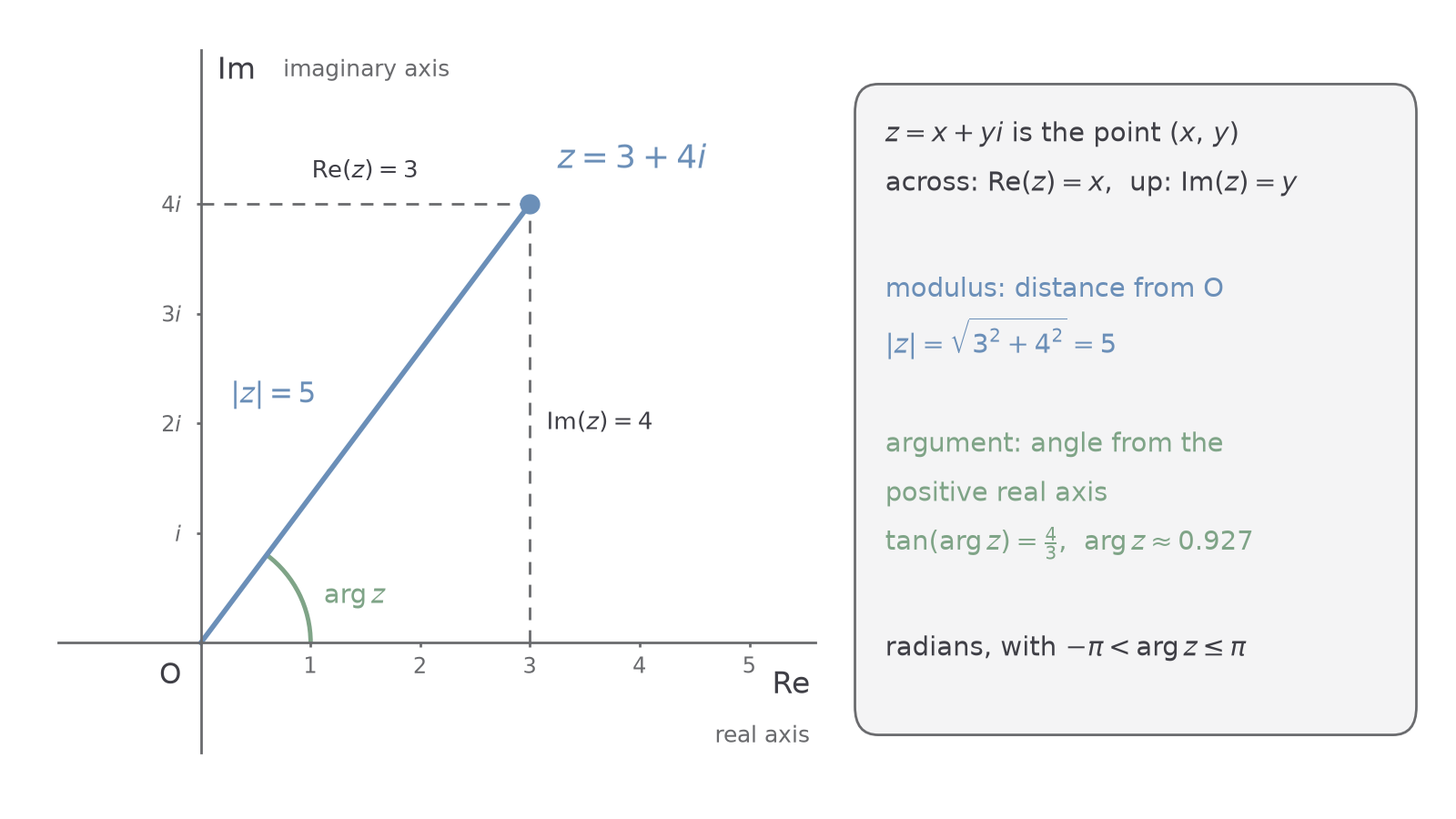
Two more words describe where the point is: how far it is from the origin , and in which direction.
Modulus
The modulus of , written , is the distance from the origin to the point : . For example, and . Not an example: is not ; the imaginary part is squared, so .
The modulus is Pythagoras' theorem on the right-angled triangle in the diagram, so it is always real and never negative. For a real number it is the absolute value you already know: .
Argument
The argument of , written , is the angle between the positive real axis and the line from to , measured anticlockwise; an angle measured clockwise is negative. Arguments are in radians, and the principal argument satisfies . For example, , and . Not an example: is not , which lies outside the principal range.
For , which lies in the first quadrant, , so . In the other quadrants this shortcut needs care, and the number 0 has no argument at all. The lesson on modulus-argument form gives the full method.
The complex conjugate
Every complex number has a partner, its conjugate, with the same real part and the opposite imaginary part, and together the pair has a real sum and a real product.
Start with and change the sign of its imaginary part to get . Then
Both answers are real. In the sum the imaginary parts cancel. In the product the two cross terms cancel, and becomes .
Complex conjugate
The complex conjugate of is : the real part stays the same and the imaginary part changes sign. For example, , and . Not an example: the conjugate of is not or .
On an Argand diagram, is the reflection of in the real axis, so and are the same distance from the origin: .
The same cancelling happens for every complex number. With :
Sum and product of conjugates
For with and real:
Not in the formula booklet: learn it.
The number is a sum of squares of two real numbers, so is real and never negative, and it is zero only when . It is also the square of the modulus: , the squared distance from the origin to .
This is the complex version of a trick you already use with surds: and multiply to the rational number 1. In the next lesson the same trick is the key to dividing by a complex number.
Key idea
A complex number times its conjugate is the real number , which is never negative, and a complex number plus its conjugate is the real number .
Quadratic equations with real coefficients
Every quadratic equation with real coefficients has two roots among the complex numbers, and when the discriminant is negative they form a conjugate pair and .
You already know
has roots . The discriminant is positive for two real roots, zero for one repeated root and negative when there are no real roots.
With , a negative discriminant is no longer a dead end. If , then is positive and . The in the formula then produces two roots with the same real part and opposite imaginary parts.
Roots when the discriminant is negative
If , where , and are real and , then
The two roots are complex conjugates of each other.
Not in the formula booklet: learn it.
To check a root, substitute it. You need only two moves: square the root by expanding the bracket with , then collect the real terms and the terms in .
Worked example 1: completing the square
Question. Solve .
Plan. Complete the square, take both square roots using , then check one root by substituting it.
Why this step? Completing the square leaves a square equal to a negative number, which now has the two square roots and .
Answer. or
Check. For : , so
The graph shows where these roots come from. Completing the square gives , so the parabola has its vertex at and never meets the -axis. The line of symmetry gives the real part of each root, and the imaginary parts, , are the square roots of the vertex height 9. This picture works whenever the coefficient of is 1.
[DIAGRAM: asset_name: A parabola with complex roots; asset_slug: parabola_complex_roots; caption: A parabola that never meets the x-axis still has two complex roots; description: Graph of y equals x squared plus 4x plus 13 with vertex at (minus 2, 9) above the x-axis. A dashed vertical line x equals minus 2 marks the axis of symmetry and a double arrow marks the vertex height 9. A side panel explains that the axis of symmetry gives the real part minus 2 and that 9 equals 3 squared gives the imaginary parts plus or minus 3, so the roots are minus 2 plus or minus 3i.]
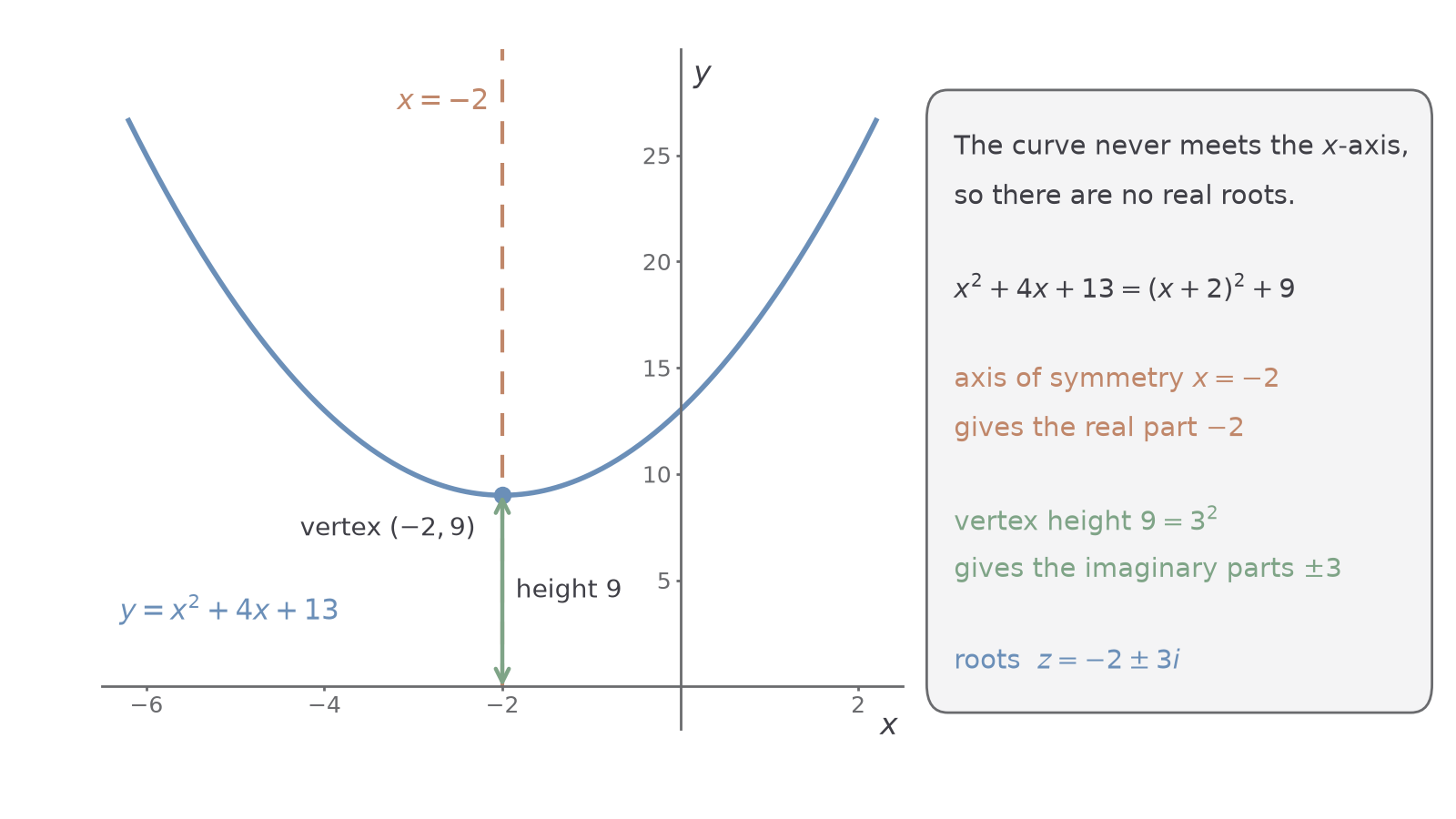
Worked example 2 changes one feature: the coefficient of is not 1. The formula is quicker than completing the square here, and both terms on the top must be divided by .
Worked example 2: a leading coefficient that is not 1
Question. Solve , giving your answers in the form .
Plan. Find the discriminant, use the quadratic formula with , then simplify each part.
Why this step? The fraction line covers the whole numerator, so 6 and are each divided by 4.
Answer. or
Check. For : , so
Watch out
Divide every term of the numerator by , not just the real part.
Wrong:
Right:
Substituting a root back in catches this error at once.
Exam questions also decide how much working you must show, and a calculator can solve quadratics in seconds, so the method has to be visible.
Exam tip
When a question says “Determine” or asks for detailed reasoning, show the discriminant or the completed square before the roots. Roots copied from a calculator's equation solver, with no method, earn no marks. Give both roots, each with simplified real and imaginary parts; counts as both.
Back to Cardano
Now the opening question has an answer. Two numbers and are the roots of , which expands to . With sum 10 and product 40 this is , the equation from the first section. Its discriminant is , so
The conjugate pair results from earlier confirm the answer:
Cardano's “impossible” numbers are ordinary complex numbers. They cannot be found among the real numbers, but they behave exactly as the problem requires.
Quick Recap
- , so for , and the powers of repeat every four.
- A complex number is with and real; and are both real numbers.
- On an Argand diagram is the point : is its distance from the origin and is its angle from the positive real axis, with .
- The conjugate gives and .
- A quadratic with real coefficients and a negative discriminant has a conjugate pair of roots .
Cardano's two numbers with sum 10 and product 40 are and .