Pv16, Pv17 - Point-to-line and point-to-plane distances
Distance to a line or plane means the shortest distance, measured along a perpendicular connector. Pv16 covers a point and a line in two or three dimensions; Pv17 covers a point and a plane. You will use the supplied formulae where they apply and find a perpendicular foot when a three-dimensional line needs a geometric method.
Distance to a line in two dimensions
The point is units from the origin. Is that its distance from the line ?
No: the origin is not even on that line. Even a point that is on the line need not be the nearest point. The shortest connector meets the line at right angles; any sideways movement along the line adds an extra component to the journey.
Shortest distance and perpendicular foot
The distance from a point to a line or plane is the length of the shortest segment joining them. Its endpoint on the target is the perpendicular foot. A point already on the target has distance zero.
For a two-dimensional line written with zero on the right, the booklet supplies a direct formula. Keep its constant term and its sign.
Point-to-line distance in two dimensions
For and the line , where and are not both zero,
In the formula booklet.
The absolute value makes the distance non-negative. A negative numerator before the absolute value tells you which side the chosen normal points towards; it does not mean a negative length.
Worked example 1: retaining the line's constant
Question. Find the shortest distance from to .
Plan. Substitute the point into the supplied formula, including the constant .
Why this step? The constant locates the line. Omitting it would calculate distance to the different line .
Answer. units.
Check. The point lies on the line, and its displacement to is , parallel to the normal , with length .
The next example changes only the sign of the complete line equation. The line is identical, so the distance must remain identical.
Worked example 2: the normal points the other way
Question. Find the shortest distance from to .
Plan. Use the signed coefficients as given, then take the absolute numerator.
Why this step? Reversing a normal changes the numerator's sign but cannot move the line. The absolute value makes the formula independent of that choice.
Answer. units.
Check. Multiplying the equation by gives the line in Worked example 1.
In fact, multiplying the entire line equation by any non-zero scalar leaves the distance unchanged: both the absolute numerator and the denominator are multiplied by that scalar's absolute value. An equation can change dramatically on the page while describing exactly the same geometry.
Watch out
Wrong: for , use in the zero-right-side formula. Right: rearrange to , so .
The opening distance is , measured to the line rather than to the origin. Apply the same formula to new coefficients here.
Finding the nearest point on a three-dimensional line
In three dimensions, put the unknown foot on the line and require the connector from that foot to the given point to be perpendicular to the line's direction.
You already know
For a line , a possible foot has position . Perpendicular non-zero vectors have scalar product zero, so the foot satisfies .
The right triangle explains the minimisation: moving away from along the line adds a non-zero sideways leg, so the new connector is longer. The scalar-product condition locates the foot; it also works when the given point lies on the line, giving a zero distance.
[DIAGRAM: asset_name: The shortest connector meets the line at right angles; asset_slug: b028_perpendicular_foot; caption: The perpendicular connector is shorter than any connector with extra movement along the line; description: A view in the plane containing a point and a line shows blue line AH, clay point P above it, and sage segment HP at right angles to the line. An oblique grey segment AP is longer. Labels use A=(1,0,0), H=(2,2,2), P=(4,1,2); AH has length 3 and HP has length root 5. A right-angle marker sits at H. The view is a cross-section of the three-dimensional geometry, not an x-y coordinate plot.]
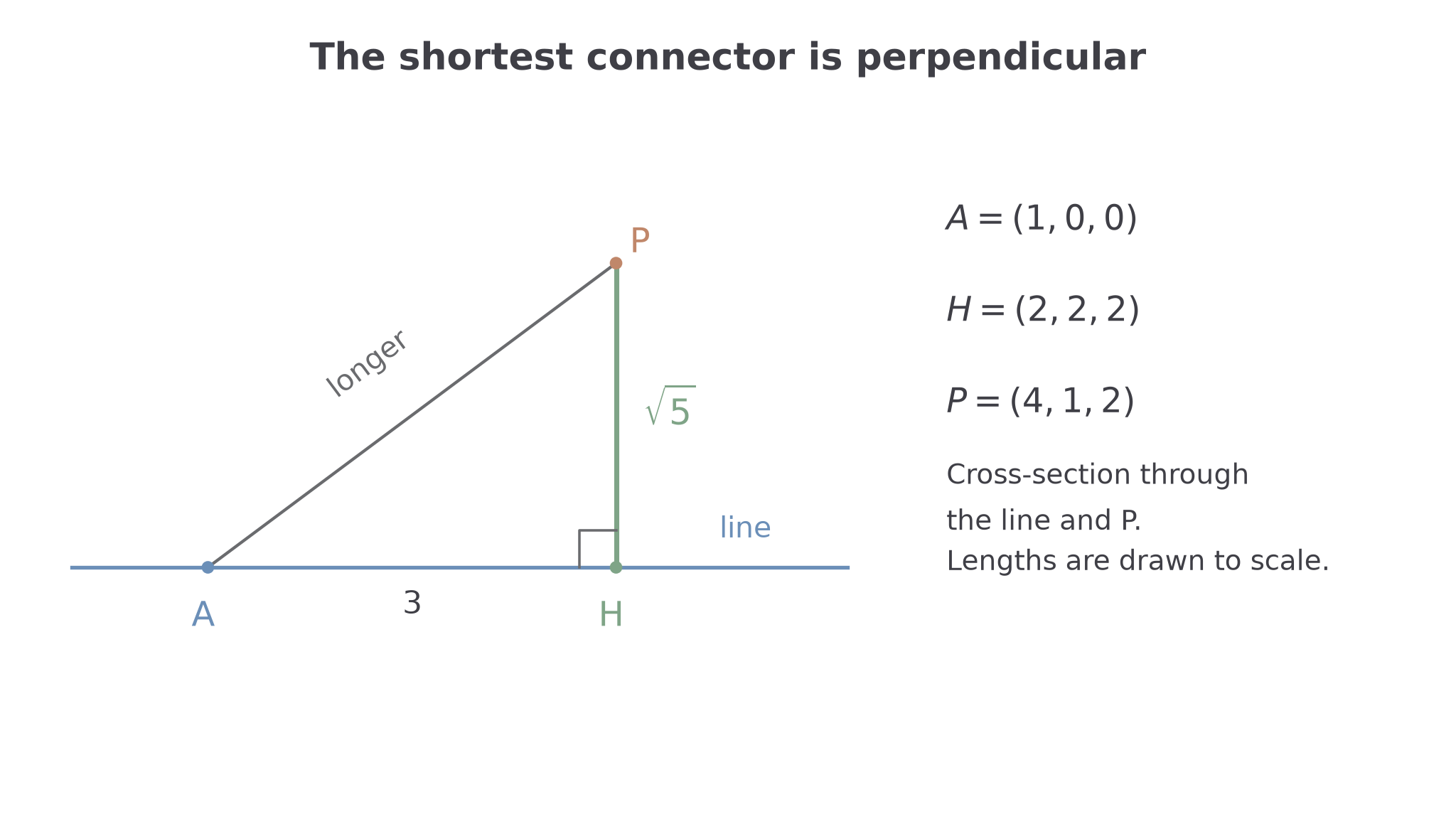
This perpendicular-foot method is not a separate formula in the booklet. It uses the line equation and scalar product you already know; no three-dimensional distance formula has to be memorised to use it.
Worked example 3: locating the perpendicular foot
Question. Find the shortest distance from to .
Plan. Write the coordinates of a point on the line, solve , then find .
Why this step? An arbitrary point on the line gives some connector. The zero scalar product selects the perpendicular one, so its length is the shortest distance.
Answer. units.
Check. , and belongs to the line at .
The next example moves the given point by one copy of the line direction, from to . Its nearest foot moves by the same amount, leaving the perpendicular gap unchanged.
Worked example 4: moving alongside the line
Question. Find the shortest distance from to the line in Worked example 3.
Plan. Apply the perpendicular condition with the new point and compare the resulting connector.
Why this step? Movement parallel to the line changes the along-line component, not the perpendicular component. The calculation shows that the foot's parameter increases by .
Answer. units.
Check. , exactly the displacement between the two feet.
Keep a connector and a direction separate: the condition uses their scalar product, while the final distance uses the connector's magnitude.
Watch out
Wrong: set to find the nearest point. That demands that lies on the line. Right: set ; the shortest connector usually has a non-zero length.
Use the perpendicular condition again in this matched problem.
Using a vector product for a point and a line
When only the distance is needed, the vector product gives the perpendicular gap without finding the foot's coordinates.
Let be any point on the line, the given point, and a non-zero line direction. The vectors and form a parallelogram whose height above the line is the required distance. You already know that its area is the magnitude of their vector product. Dividing that area by its base length leaves the height.
Point-to-line distance in three dimensions
For a line through in non-zero direction , and point ,
The order of the vector product changes its direction but not its magnitude. The result is zero when lies on the line.
Not in the formula booklet: learn it.
This is an alternative to finding a perpendicular foot. The booklet supplies the vector-product formula; the point-to-line ratio itself is not printed there. Choose the foot method when the nearest point is also requested.
Worked example 5: distance without the foot
Question. Find the shortest distance from to .
Plan. Use the origin as , calculate , and divide its magnitude by .
Why this step? The vector product removes the along-line component geometrically. Dividing by the direction's length prevents the arbitrary size of that direction vector from changing the distance.
Answer. units.
Check. The foot is : the connector is perpendicular to and has length .
The next example changes only the size of the direction vector, doubling it. It describes the same line, so the numerator and denominator must scale together.
Worked example 6: the direction need not be a unit vector
Question. Find the shortest distance from to .
Plan. Retain the doubled direction in both parts of the ratio.
Why this step? A direction vector fixes orientation, not a physical unit of length. Any non-zero scalar multiple must give the same geometric distance.
Answer. units.
Check. The parameter relation identifies this as the previous line, with foot now at .
State the vector product you use. A list of unexplained calculator components does not show which connector and direction went into the method.
Watch out
Wrong: the distance is . That is an area. Right: divide by , unless a unit direction was deliberately chosen.
The direction in the following problem has a zero component; the component formula for a vector product handles it normally.
Distance perpendicular to a plane
For a point and a plane, the shortest connector follows a normal to the surface, rather than any convenient line through the point.
The supplied formula is the three-coordinate counterpart of the two-dimensional line formula. Again, rearrange the plane so that its right side is zero before reading the constant term.
Point-to-plane distance
For and the plane , with non-zero normal,
In the formula booklet.
The denominator is the normal's magnitude. If the point satisfies the plane equation, the numerator is zero, exactly as the geometry requires. You are expected to understand this perpendicular distance, rather than prove the supplied formula.
Worked example 7: a supplied plane-distance formula
Question. Calculate the shortest distance from to .
Plan. Use the zero-right-side form and substitute the point.
Why this step? The plane's offset contributes . The numerator measures departure from this particular plane, not from the parallel plane through the origin.
Answer. units.
Check. lies on the plane, and is normal to it with length .
The next example reverses only the plane equation. The normal and signed numerator reverse, while the surface and distance stay fixed.
Worked example 8: a negative signed numerator
Question. Calculate the shortest distance from to .
Plan. Write , then keep the absolute value around the full numerator.
Why this step? Absolute value applies after adding every signed term. Taking separate absolute values inside the sum would destroy the plane equation.
Answer. units.
Check. Multiplying the plane equation by recovers Worked example 7, so the geometry is unchanged.
The opening point-to-line distance and this point-to-plane distance share one principle: use a perpendicular connector. An oblique connector reaches the target, but its extra sideways component makes it longer.
Watch out
Wrong: divide the numerator by . Right: divide by its square root, the normal's length. For normal , the denominator is , not .
This final plane has a negative middle coefficient. Keep it in brackets when finding the normal's magnitude.
Quick Recap
- Shortest distances use perpendicular connectors; a point already on the target has distance zero.
- For a two-dimensional line, use the supplied formula after writing the equation with zero on the right.
- For a three-dimensional line, find a perpendicular foot or divide a connector's vector-product magnitude by the direction length.
- For a plane, use the supplied formula with the complete signed constant and the normal's magnitude.
The opening point is units from the line ; distance to the origin answers a different question.