8.06b - Arc lengths and surface areas
Measure the length of a curve by adding tiny sloping lengths, then rotate those lengths to build a surface. You will choose and evaluate arc-length and surface-area integrals for cartesian and parametric curves, including rotation about either coordinate axis.
Arc length from a cartesian equation
A sphere of radius fits exactly inside a cylinder of radius and height . Which has the larger area: the sphere's surface or the cylinder's curved surface?
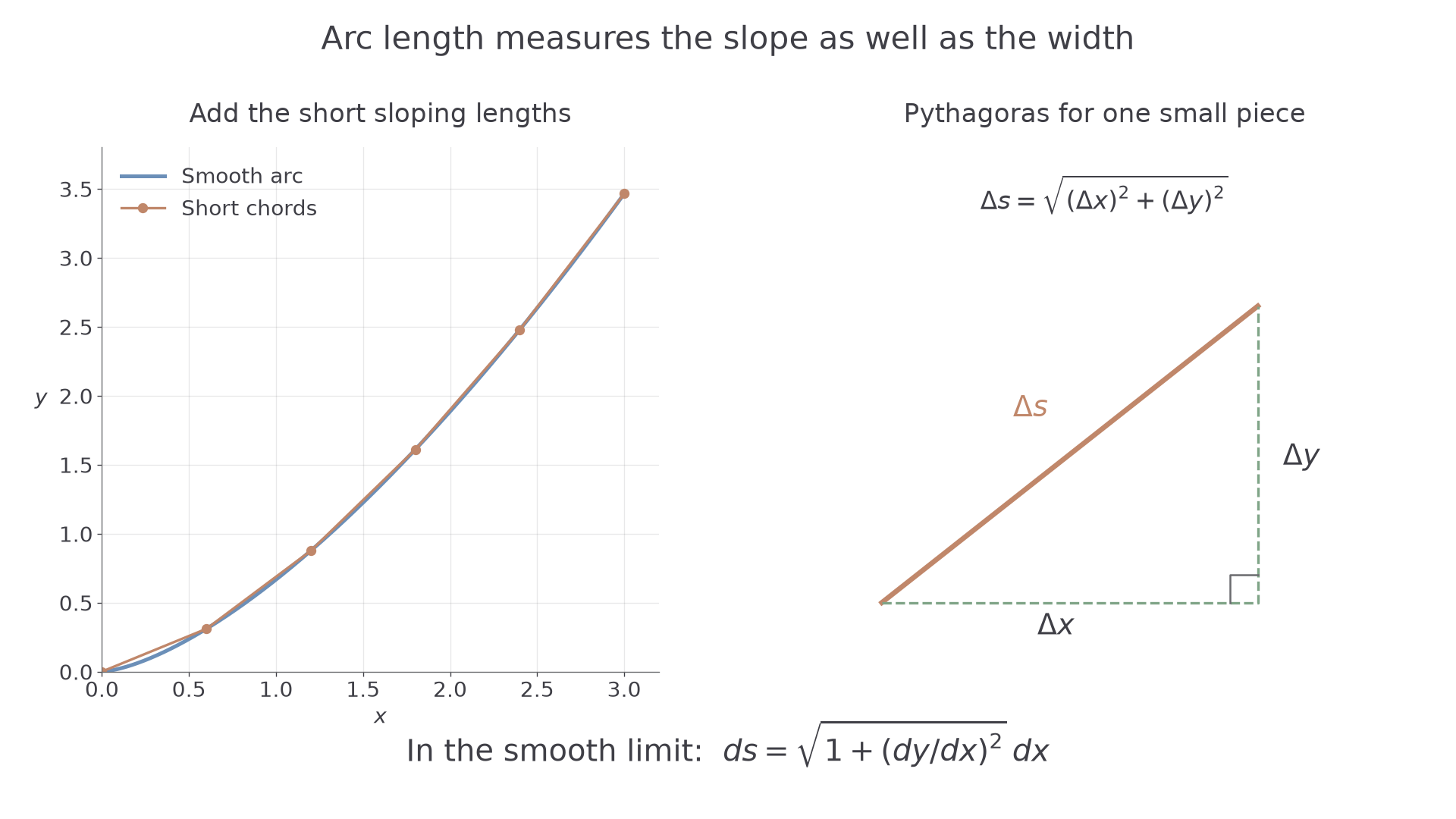
Volume formulae will not settle that question: a curved surface is made from sloping lengths, rather than circular discs. Begin with the length of the curve that will generate it. A straight segment with horizontal change and vertical change has length , not or . The same Pythagoras idea applies to very small pieces of a smooth curve.
[DIAGRAM: asset_name: A curve is approximated by short sloping segments; asset_slug: h245_8_06_arc_element; caption: Arc length adds sloping lengths, with both horizontal and vertical changes contributing; description: Left panel shows a smooth rising curve approximated by five chords. Right panel enlarges one short chord and its right-angled triangle, labelled delta x, delta y and delta s. Beneath it, the limiting expression is ds equals square root of one plus derivative squared times dx.]
You already know
Differentiate cartesian and parametric equations using the chain rule, and evaluate definite integrals with matching limits. The earlier inverse-function integrals also give ways to integrate square-root expressions. A curve's length is measured in units, while its surface area is measured in square units.
For a small horizontal change , the chord has length . Factoring out , adding the chords and taking a smooth-curve limit replaces their slope by . The local length element is . This also explains the square on the derivative: a downward slope contributes just as much length as its upward reflection.
Cartesian arc length
For a continuously differentiable curve on , with ,
In the formula booklet.
If the equation is naturally , interchange the roles of the coordinates: , for . This equivalent form follows from the same Pythagoras argument; the booklet prints the version. Use the form with the simpler derivative, and split into pieces if one equation cannot describe the entire arc.
Worked example 1: a convenient cartesian derivative
Question. Determine the exact length of the arc , for .
Plan. Differentiate, simplify the squared derivative inside the root, then integrate with respect to .
Why this step? Simplifying before integrating turns the length integral into a single power of a linear function.
Answer. The arc length is units.
Check. The endpoints are and , whose straight-line separation is . The arc length is slightly larger, as it must be.
Change only the roles of and . Reflecting in preserves length, but changes the convenient integration variable.
Worked example 2: integrating with respect to y
Question. Determine the exact length of , for .
Plan. Differentiate with respect to and use increasing -limits.
Why this step? Solving for would introduce fractional powers in . The given form already has a derivative whose square is simple.
Answer. The arc length is units.
Check. This arc is the reflection of the previous one, so equal lengths provide a geometric check independent of the integration.
Arc length is not the signed change in either coordinate.
Watch out
Wrong: , which gives the net vertical change. Right: use . Even a horizontal segment, whose derivative is zero, has positive length .
Keep the same reflected curve and change its endpoint.
Arc length from parametric equations
A parameter can describe an arc even when its horizontal or vertical direction reverses, so calculate the small length from both parametric derivatives together.
If and , a small positive parameter change gives coordinate changes approximately and . Their sloping length is approximately . Neither derivative has to be positive.
Parametric arc length
For a smooth curve traced once as increases from to , with ,
Piecewise smooth arcs can be split and their lengths added. Isolated zero-speed endpoints are allowed when the integral exists.
In the formula booklet.
The quantity under the integral is the rate at which length is traced. Factor it before taking the square root: an apparent quartic may be a perfect square.
Worked example 3: a perfect square after differentiation
Question. A curve is given by , . Determine the exact length of the arc for .
Plan. Differentiate both coordinates, simplify the sum of squares, and integrate the positive square root.
Why this step? The factorisation removes the square root exactly. Expanding it and attempting a general square-root integral would hide the simple form.
Answer. The length is units.
Check. The endpoint distance is , less than , and the tracing rate is between and on a parameter interval of width .
Change only the lower parameter limit to . The vertical coordinate now decreases and then increases, but both halves of the arc still contribute positive length.
Worked example 4: a coordinate reverses direction
Question. For the same curve, determine the exact length of the arc for .
Plan. Keep the positive tracing rate and integrate over the new interval.
Why this step? The curve goes from through to . Its net vertical change is zero, but the downward and upward pieces each have positive length.
Answer. The length is units.
Check. The two halves are reflections in the -axis, so the result is twice the preceding length.
A reversal of a coordinate is harmless; retracing the same arc changes what the integral counts. For example, , , , traverses the segment from to and back. Its tracing integral is , but the segment itself has length . Choose an interval that traces the required arc once.
Watch out
Wrong: , or without checking its sign. Right: simplify the sum first, and use . Split the interval wherever the sign changes.
The same polynomial curve remains straightforward beyond , where its horizontal coordinate starts increasing again.
Cartesian surfaces about the x-axis
Rotating a short sloping segment produces a thin conical band, so its curved area depends on the sloping length rather than the horizontal width.
A conical frustum has curved area , where is its sloping length. For a very thin band the two radii approach the same radius , giving . This local circumference-times-length relation, derived here and not separately printed in the booklet, explains every surface formula in the lesson.
[DIAGRAM: asset_name: Sloping bands and their distances from the axis; asset_slug: h245_8_06_surface_bands; caption: Each curved band contributes circumference times sloping length, and its radius is perpendicular to the rotation axis; description: Left panel shows y equals x plus one from x zero to two, a highlighted short segment, its vertical radius y to the x-axis, and a schematic conical band labelled 2 pi y ds. Right panel shows the reflected branches x equals plus or minus square root of 2y, with horizontal distances to the y-axis both labelled absolute x.]
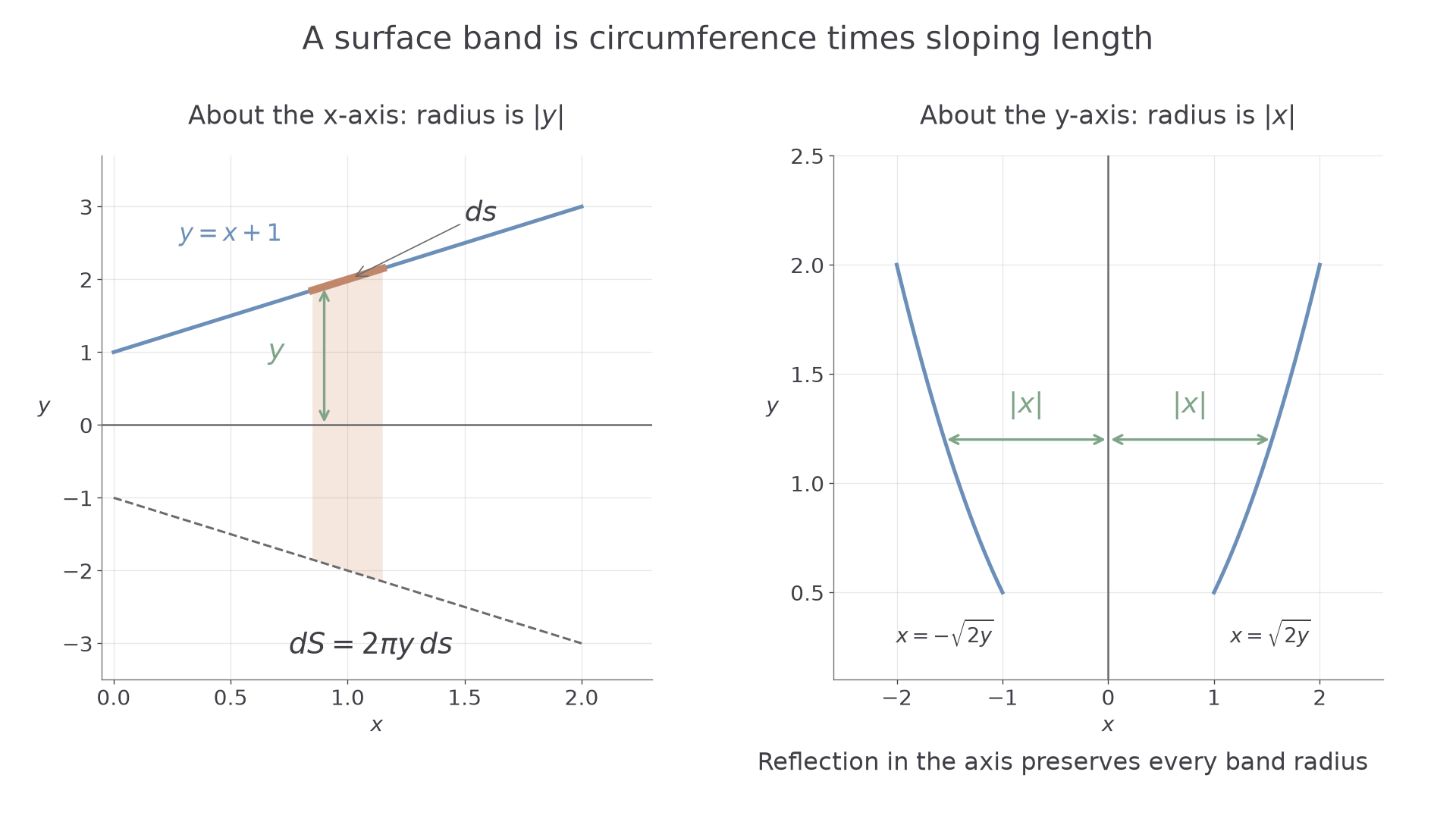
The frustum formula is assumed geometry and is not printed in the booklet. In the limit, the surface of a smooth curve is found by integrating these bands. For rotation about the -axis, the radius is .
Surface area about the x-axis
For a curve , , traced once and generating no repeated surface patches,
This is the curved surface generated by the arc. Flat end discs are not included. The booklet prints this formula with as the non-negative radius; use if the curve is below the axis, splitting at crossings if needed.
In the formula booklet.
A straight generating line provides a useful check because its surface is a cone or a frustum.
Worked example 5: a cone's curved surface
Question. The segment , for , is rotated through radians about the -axis. Determine the exact area of the generated surface.
Plan. Use radius and sloping-length factor , then integrate.
Why this step? Rotating the curve gives the cone's curved side. The integral uses the circumference , not the disc area .
Answer. The surface area is square units.
Check. The cone has radius and slant height ; its curved area is .
Change only the vertical position of the line, from to . The sloping length stays the same, but every circumference is larger.
Worked example 6: shifting the curve away from the axis
Question. The segment , for , is rotated through radians about the -axis. Determine the exact area of the generated surface.
Plan. Replace the radius by , keeping the same sloping-length factor.
Why this step? A vertical translation leaves the slope unchanged but changes the distance from the rotation axis. Arc length alone cannot determine the surface area.
Answer. The surface area is square units.
Check. The frustum has endpoint radii and , and slant height . Thus .
If the question asks for the total boundary area of the closed frustum, add its two flat discs: here their total area is . The phrase “surface generated by the curve” asks for the curved area alone.
Watch out
Wrong: , which is a volume, or , which omits the slope. Right: . Circumference has units of length and supplies another length, giving square units.
Shift the line one unit farther from the same axis.
Cartesian surfaces about the y-axis
For rotation about the -axis, the radius is the horizontal distance , and the booklet's cartesian form uses as the integration variable.
The same argument applies. Expressing the curve as makes its sloping-length element . Both the radius and the derivative must be functions of .
Surface area about the y-axis
For a curve , , traced once and generating no repeated surface patches,
The booklet prints as the non-negative radius. Use for a branch to the left of the axis. This is curved surface area only.
In the formula booklet.
Alternatively, if gives a simpler calculation, keep and integrate using -limits. That equivalent choice follows from the same length element; it is not a separate printed cartesian formula. The axis chooses the radius, while your representation chooses the integration variable.
Continue this lesson.
You’re previewing NovaLearn without an account. Create a free account to read the rest.
Create free account