4.02o, 4.02p - Drawing loci and regions
Translate complex equations and inequalities into circles, straight lines, half-lines and regions on an Argand diagram. Use set notation to state exactly which points belong, including boundaries, and combine conditions by taking their intersection.
Circles and distance regions
Which complex numbers are within distance of , on or to the right of the line , and on or above the line ? The answer is a curved region, but three short conditions will describe it exactly. This lesson builds the pieces and puts them together at the end.
You already know
If points , represent , , then represents the arrow from to , and is its length. An Argand diagram uses coordinates .
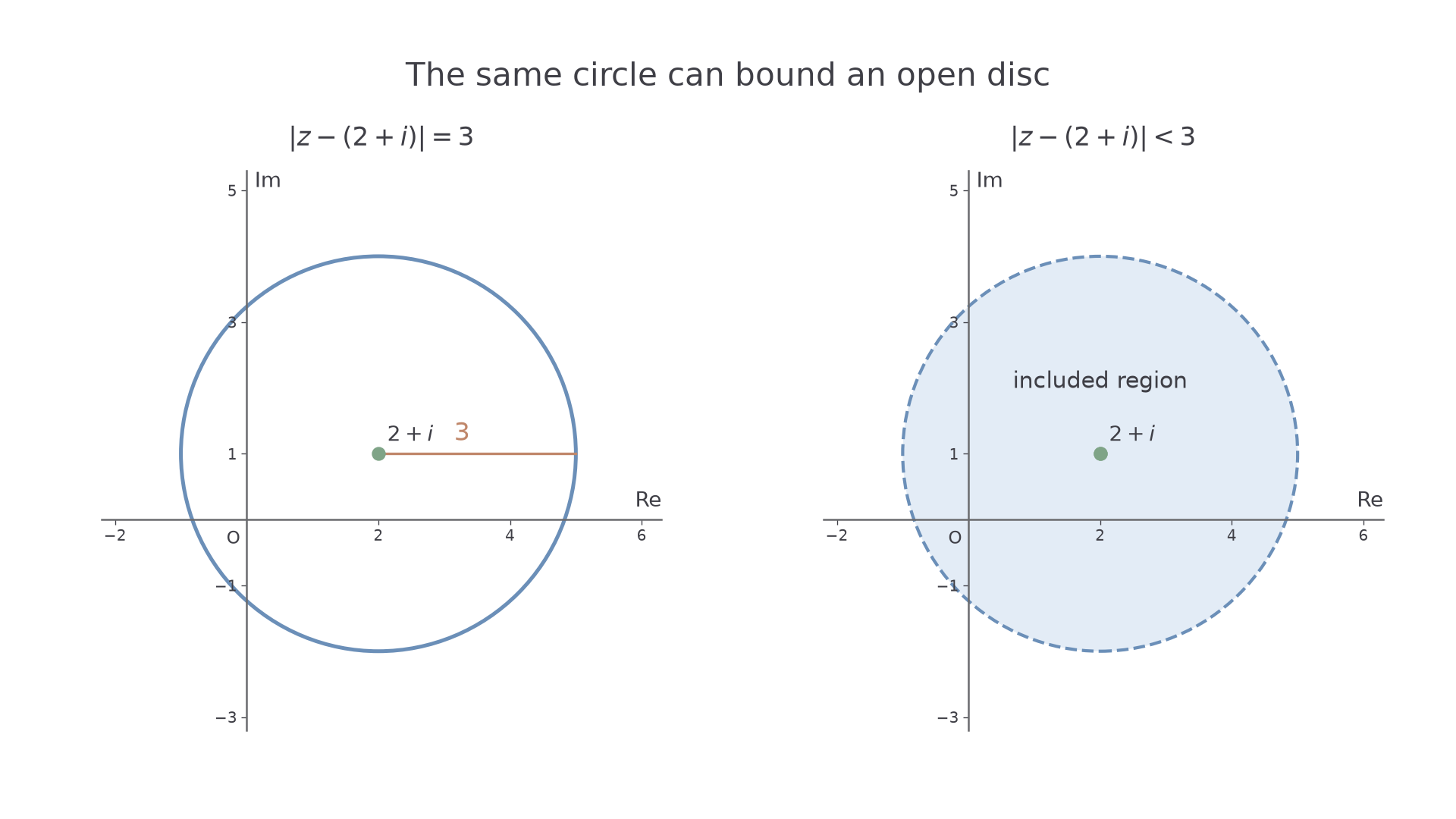
For example, fixes the distance of from , not from . The points form a circle centred at with radius .
[DIAGRAM: asset_name: A circle and its interior in the complex plane; asset_slug: h245_4_02_circle_region; caption: Subtracting the centre makes the modulus a distance from that centre; description: Two equal-scale Argand panels show centre 2 + i and radius 3. The left shows the solid circle for modulus of z - (2 + i) equal to 3. The right shows the same circle dashed, with its interior pale blue and labelled included region for modulus less than 3. A sample radius from the centre to the circle is labelled 3.]
Locus
A locus is the set of all points satisfying a stated condition. For example, , with , is a circle. The inequality describes its interior, excluding the circumference.
The complex expression also gives the familiar cartesian equation.
Circle locus
For , , and :
The complex circle form is supplied; its geometric meaning and cartesian translation must be known.
In the formula booklet.
Replacing equality by an inequality selects one side of the circumference: a smaller distance is inside and a larger distance is outside.
Worked example 1: a circle equation
Question. Describe the locus and give its cartesian equation.
Plan. Identify the reference point and square the distance expression.
Why this step? The number being subtracted names the centre: , not .
Answer. The circle with centre , radius , and cartesian equation .
Check. satisfies the condition since .
Change only equality to a strict inequality. The same circumference becomes an excluded boundary.
Worked example 2: an open disc
Question. Describe , state how its boundary is drawn, and determine whether belongs.
Plan. Use the circle as a boundary and compare the point's distance with the radius.
Why this step? Comparing squared distances avoids an unnecessary square root, provided the radius is non-negative.
Answer. The interior of the circle centred at , radius , with a dashed circumference. The point belongs.
Check. The centre has distance , so it must lie in the included region.
Use a solid boundary for or , and a dashed boundary for or . For , the locus is the single point ; a negative radius gives no points. Outside a circle, , the included region is unbounded.
Watch out
Wrong: has centre . Right: write , so its centre is .
Clearly label the included region. OCR assumes no universal convention for whether shading means included or excluded.
Coordinate lines and equal distances
Fixing a real coordinate gives a vertical line; fixing an imaginary coordinate gives a horizontal line. Equating two distances gives another kind of straight line: a perpendicular bisector.
For , means , while means . Their inequality versions select half-planes: is strictly to the right, and is on or below the horizontal line. These coordinate-line interpretations are not in the formula booklet: learn them.
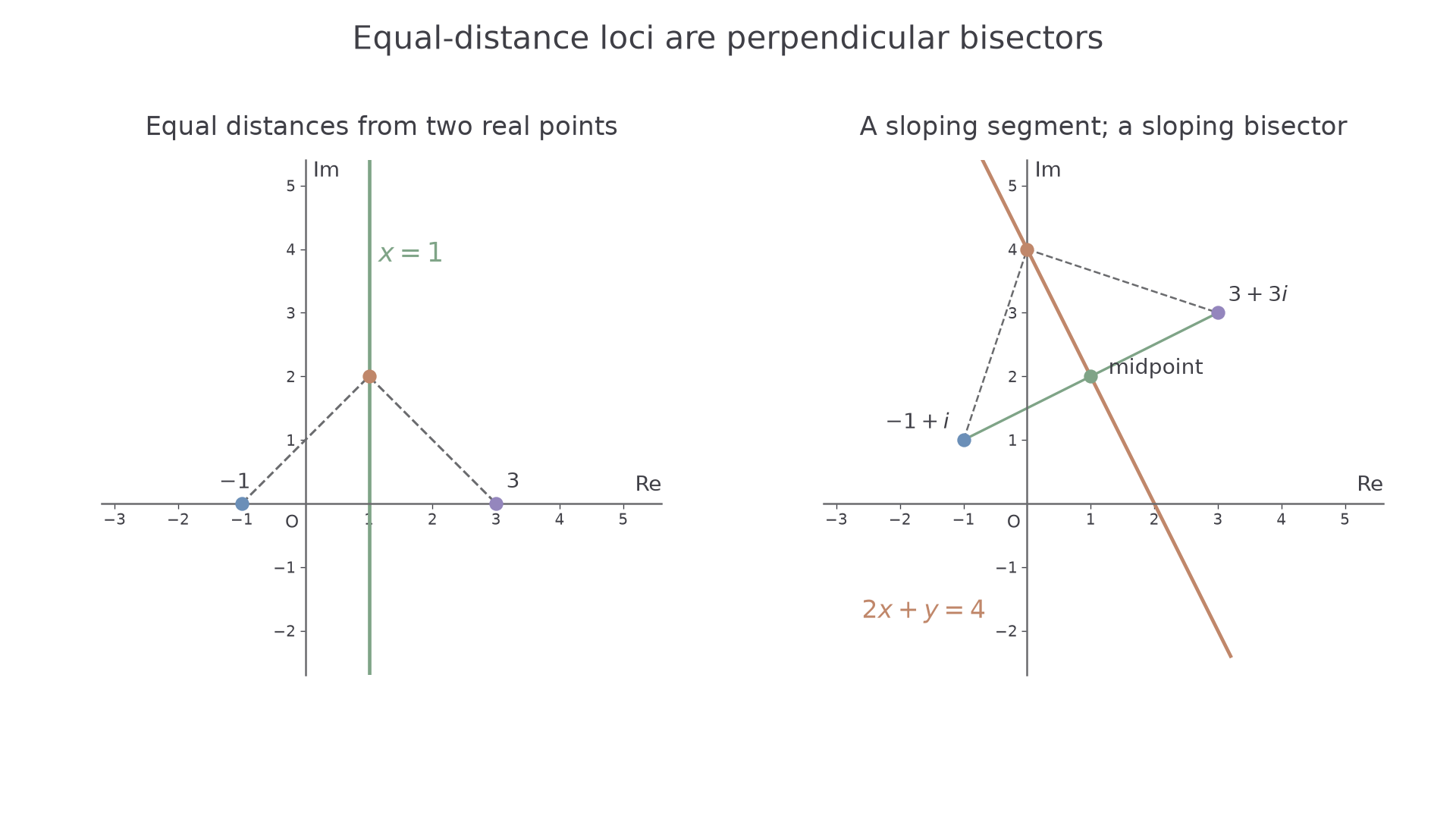
Now consider . The point is equally distant from and . Every point on the vertical line through their midpoint has that property, and no other point does.
[DIAGRAM: asset_name: Equal distances give a perpendicular bisector; asset_slug: h245_4_02_perpendicular_bisector; caption: Squaring equal distances produces the perpendicular bisector of the reference points; description: Two equal-scale Argand panels. The first shows reference points -1 and 3 and their solid perpendicular bisector x = 1. The second shows -1 + i and 3 + 3i joined by a sage segment, midpoint 1 + 2i, and solid line 2x + y = 4 perpendicular to the segment. One point on each bisector has equal-distance segments to the two references.]
Equal-distance locus
For distinct fixed complex numbers , :
is the perpendicular bisector of the segment joining and . The complex line form is supplied; its perpendicular-bisector interpretation must be known.
In the formula booklet.
To obtain the cartesian equation, square both distances and expand. The and terms cancel because both sides are distances from the same variable point.
Worked example 3: horizontal reference points
Question. Determine the cartesian equation and describe the locus .
Plan. Write , square both sides, and simplify.
Why this step? Squaring is reversible here because both moduli are non-negative.
Answer. , the perpendicular bisector of the segment from to .
Check. Every point has squared distance from each reference point.
Change the reference segment from horizontal to sloping. The bisector is still a line, but now both coordinates occur in its equation.
Worked example 4: sloping reference points
Question. Determine the locus . Also describe the region where the left-hand distance is smaller.
Plan. Expand the two squared distances, then keep the same inequality direction for the region.
For a smaller left-hand distance the same expansion gives , hence .
Why this step? The algebra selects the correct side of the bisector; “inside the line” would have no geometric meaning.
Answer. The locus is , the perpendicular bisector. The nearer-to- region is the open half-plane , with dashed boundary.
Check. At , , and the left distance is zero, so that is the correct side.
If , the equal-distance condition holds everywhere, so there is no unique perpendicular bisector. The distinct-point condition matters.
Watch out
Wrong: treating as a horizontal line because it is a “real” equation. Right: it fixes , so the line is vertical. fixes , giving a horizontal line.
A test point makes a quick check on any half-plane inequality.
Half-lines and angular regions
The argument of gives the direction of the arrow starting at , so fixing that argument gives a half-line from , not a full line through it.
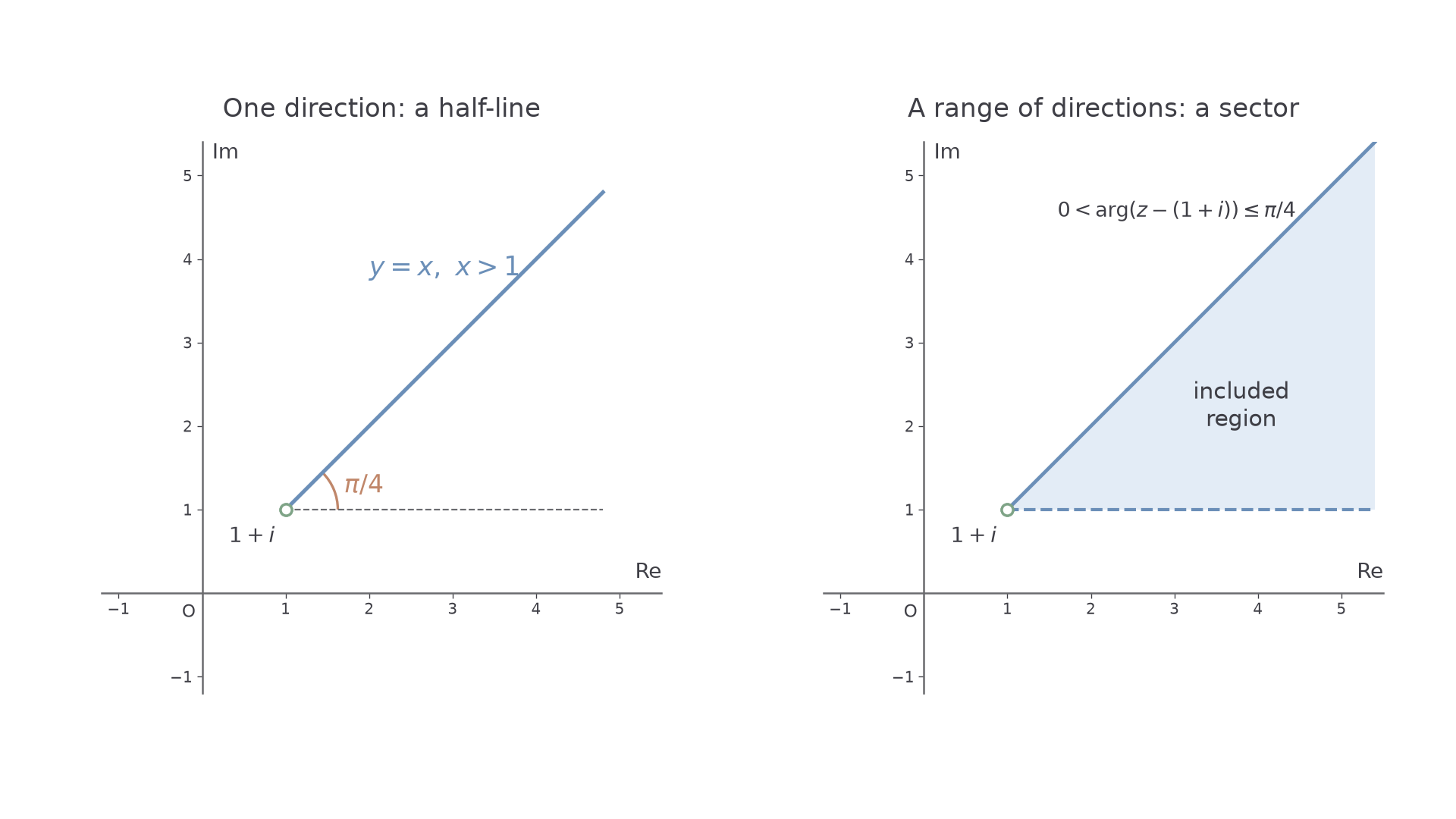
For example, says: start at , then travel in direction . Points behind the start have a direction differing by , so they do not satisfy the equation. The starting point itself is excluded because is undefined.
[DIAGRAM: asset_name: A half-line and an angular region; asset_slug: h245_4_02_argument_regions; caption: Argument conditions measure directions from the shifted starting point; description: Two equal-scale Argand panels use starting point 1 + i, shown as an open circle. The left shows the ray y = x with x greater than 1 in blue, direction pi/4 measured from a horizontal guide. The right shades and labels the sector above the excluded dashed horizontal ray y = 1 and at or below the solid pi/4 ray, representing 0 less than arg(z - (1 + i)) less than or equal to pi/4.]
Half-line locus
For a fixed complex number and real angle :
is the half-line starting at in direction , with excluded. The equation assumes the chosen argument interval contains .
In the formula booklet.
An inequality between arguments selects a range of directions. Specify the principal interval before comparing them; this lesson uses . In that interval, for example, selects only angles between and , not angles just above .
Worked example 5: the correct half of a line
Question. Describe and give cartesian conditions for its points.
Plan. Shift the origin to , use gradient , and restrict the forward direction.
Why this step? The line equation alone also includes points below and left of , whose argument is , not .
Answer. The half-line from at angle anticlockwise from the positive real direction, excluding ; equivalently , .
Check. At , the difference is , of argument . At , it is , which fails.
Change the equality to an angular interval. The single direction becomes a sector, and each endpoint tells you whether its boundary ray is included.
Worked example 6: a sector with mixed boundaries
Question. Describe , using principal arguments in .
Plan. Put , locate the two boundary directions, then check their inequality signs.
Why this step? Both rays start at ; measuring their angles from would translate the whole answer incorrectly.
Answer. The region above the horizontal ray to the right from , and on or below the ray. Draw the horizontal ray dashed and the diagonal ray solid; exclude the starting point.
Check. gives difference , with argument between and , while has a larger argument and is outside.
A solid boundary ray can still have an open endpoint: the ray's points satisfy equality, but its starting point has no argument.
Watch out
Wrong: using the whole line for . Right: retain only , and mark the starting point open. A tangent equation by itself loses a half-turn distinction.
Use a point relative to the shifted origin to check the direction.
Sets and intersections of regions
Set notation states which complex numbers belong to a locus. The colon means “such that”; a list of conditions separated by “and” requires every condition at once.
Set-builder notation
The notation means the set of complex numbers satisfying the condition. Equivalently, write . The intersection consists of points belonging to both and .
For example, , for , is
where . Notice that squaring the distance also squares the radius. The set-notation translation is not in the formula booklet: learn it.
[DIAGRAM: asset_name: The intersection of three complex regions; asset_slug: h245_4_02_region_intersection; caption: A point belongs only when all three conditions hold; description: Equal-scale Argand diagram shows circle centre 1 + i radius 2, vertical line x = 2 and horizontal line y = 1, all solid. The part inside the circle, right of x = 2 and above y = 1 is filled pale blue and labelled included region. Points 2 + 2i and 3 + 2i are marked, the first inside and the second outside the circle. The circle-line intersection at (2, 1 + root 3) is labelled.]
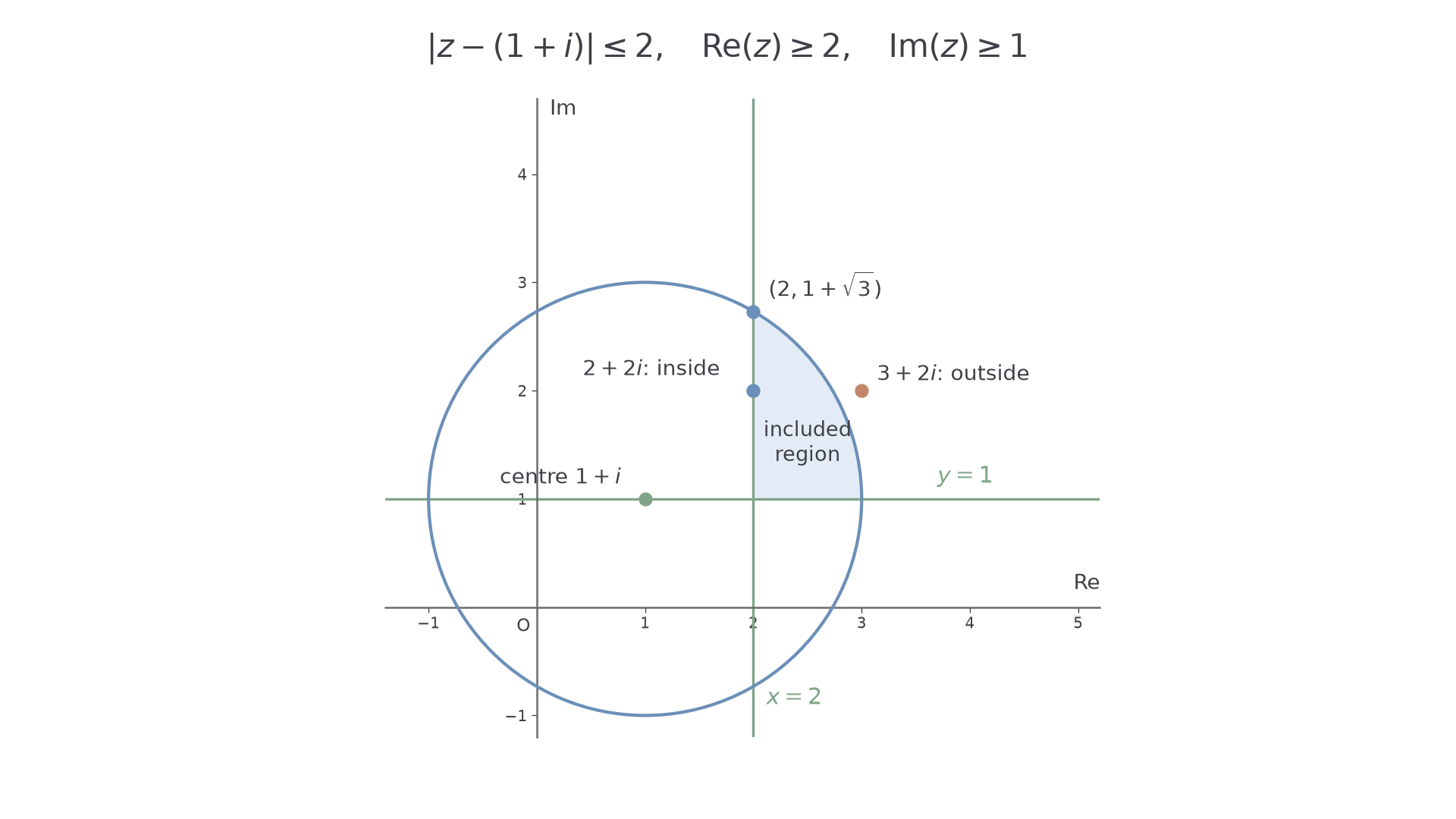
When sketching an intersection, draw each boundary accurately enough to locate their meeting points, then identify the region satisfying every condition. A test point can check membership, but it does not replace describing the full set.
Worked example 7: the opening region in set notation
Question. Write in complex and cartesian set notation the points within distance of , with real part at least and imaginary part at least . Include points at distance exactly .
Plan. Translate each phrase into one inequality and combine them using “and”.
Why this step? “And” takes the overlap. Taking “or” would include points that satisfy just one condition, such as points arbitrarily far to the right.
Answer.
Every boundary piece of the resulting region is included and solid. Its top-left meeting point has , so , giving in the required upper region.
Check. has squared distance , real part , and imaginary part , so it belongs. For , the squared distance is , so it does not.
Change only the distance inequality to strict. The straight boundary pieces remain included where they satisfy that inequality, but the circular arc and its endpoints are excluded.
Worked example 8: changing one boundary
Question. Let . Determine whether , and belong.
Plan. Test the distance and the two coordinate restrictions separately for each point.
Why this step? A point lying on an included straight line can still fail the other inequality; inclusion is decided by every condition together.
Answer. belongs; and do not. The circular arc is dashed, and its intersections with the straight boundaries are open.
Check. All three satisfy the coordinate inequalities, so the difference in membership comes entirely from the changed distance sign.
The opening curved region is now described exactly. There is also an algebraic surprise behind the straight bisectors: two quadratic distance expressions subtract to a linear one because their squared-coordinate terms cancel.
Watch out
Wrong: replacing by . Right: the squared-distance comparison is with . Square both sides, not just the left.
Use the same translations to describe an unbounded intersection.
Quick Recap
- gives a circle; distance inequalities select its interior or exterior.
- , , and equal-distance conditions give straight lines.
- gives a half-line with an excluded starting point; argument ranges give angular regions.
- Solid boundaries are included and dashed boundaries excluded. Label the included region explicitly.
- Set notation and intersections state all conditions at once; test each condition for membership.
The opening region is , the included curved region shown in the final diagram.