6.02g, 6.02h - Hooke's law and elastic energy
Use Hooke's law to relate an elastic string's tension to its extension, and distinguish a taut string from a compressed spring. You will derive and calculate elastic potential energy, then combine equilibrium, geometry and elasticity in a two-dimensional system.
Extension and Hooke's law
If you double the stretch of an ideal spring, do you store twice as much energy? The force needed gets larger as you stretch it. The second half of the stretch is more expensive than the first; by the end of the lesson you will quantify that difference.
Start with a light elastic string of natural length . If its length becomes , its extension is , not . Its natural length is the unstretched length, while extension measures the change from that length.
You already know
A light string has negligible mass, and a taut string pulls along its own length. For a particle in equilibrium, resolve all forces in two perpendicular directions and set each resultant component equal to zero. Weight is , vertically downwards.
For an ideal elastic string, tension is proportional to extension. A longer string with the same modulus needs less tension to produce the same absolute extension: strain, the extension divided by natural length, is what matters.
Hooke's law
An ideal taut elastic string of natural length , modulus of elasticity and extension has tension
Here is its current length. The modulus and tension are measured in newtons; and must use compatible length units.
Not in the formula booklet: learn it.
The quantity is the stiffness, measured in , when lengths use metres. Thus . This rearrangement and the stiffness definition are not in the formula booklet. Modulus and stiffness have different units.
Worked example 1: length is not extension
Question. A light elastic string has natural length and modulus . Find its tension when its length is .
Plan. Subtract the natural length first, then apply Hooke's law.
Why this step? Using as the extension would assign a non-zero tension even to an unstretched string.
Answer. The tension is .
Check. The strain is , so the tension is one quarter of the modulus.
Worked example 2 changes only the modulus. The geometry stays the same, so the strain is unchanged.
Worked example 2: a different modulus
Question. A light elastic string has the same natural length , but modulus . Find its tension when its length is .
Plan. Keep the same extension and replace the modulus in Hooke's law.
Why this step? With fixed strain, tension is directly proportional to modulus. Doubling doubles the tension.
Answer. The tension is .
Check. The stiffness has doubled from to , giving .
A force diagram uses the tension you have calculated, directed along the string towards its other end.
Watch out
Wrong: . The numerator must contain extension, not current length. Right: , for a taut string.
Keep the lengths fixed once more and vary the modulus again.
Strings, springs and the limits of Hooke's law
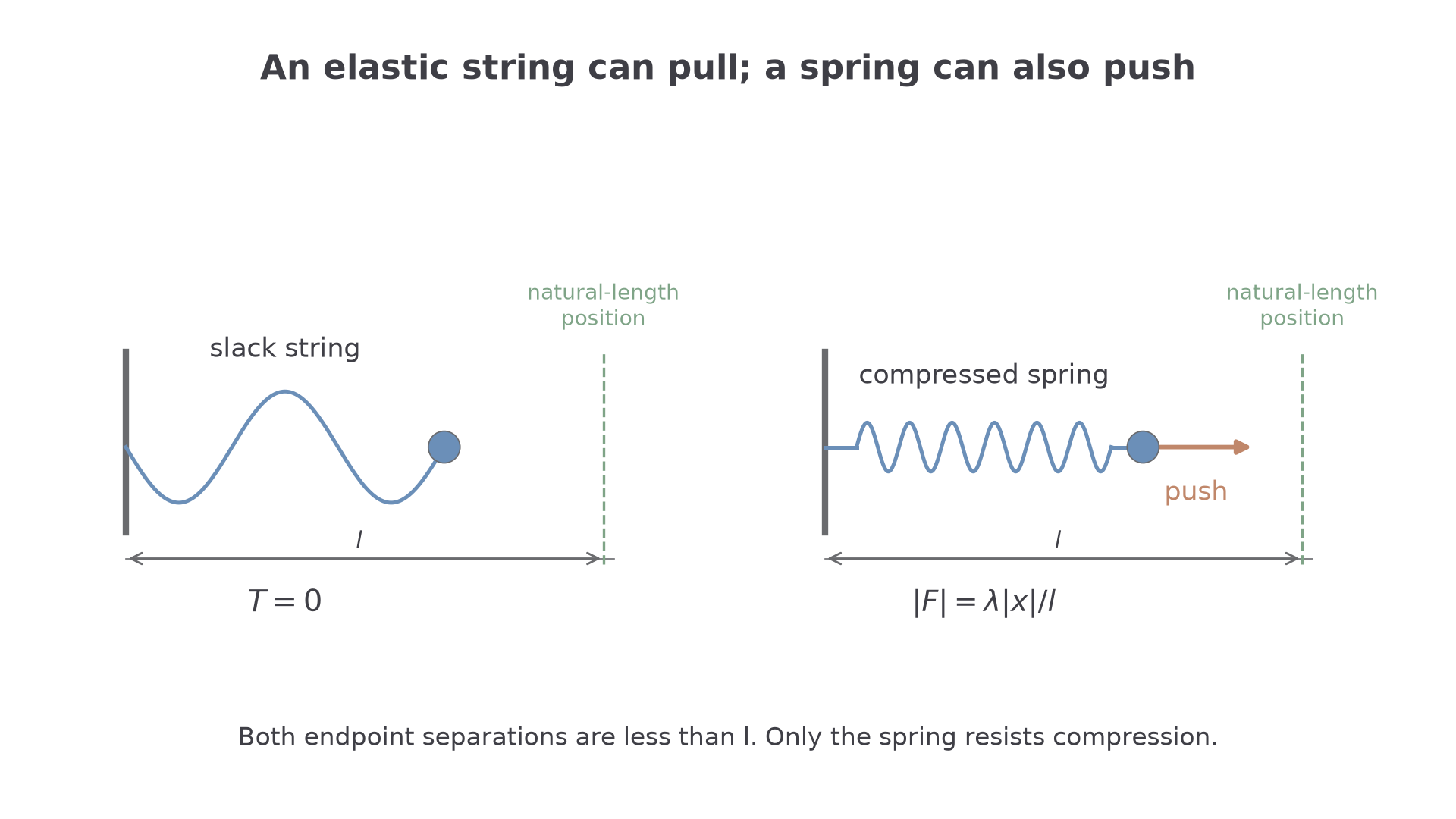
An elastic string can pull when stretched, but it cannot push when its endpoints are too close together. A spring can resist both stretching and compression.
If the endpoint separation of an ideal elastic string is no greater than its natural length, the string is slack or just unstretched. Its tension is zero. A negative answer from substituting a negative extension into the taut-string formula signals that you have used the wrong model for that state.
Elastic string and elastic spring
An ideal elastic string has tension when extended and zero tension when slack. An ideal elastic spring exerts a restoring force towards its natural length: it pulls when stretched and pushes when compressed. For a spring, if signed extension is , the restoring-force component in the direction of increasing is . Thus a negative gives a positive restoring component. The spring-force rule is not in the formula booklet: learn it.
For example, a spring with stiffness compressed by pushes with magnitude . A string of the same natural length and modulus with the same endpoint separation is slack and exerts no force.
[DIAGRAM: asset_name: A slack string and a compressed spring; asset_slug: h245_6_02_string_spring_models; caption: A string cannot push when its endpoints are closer than its natural length, while a compressed spring pushes back towards its natural length; description: Two panels have equal endpoint separation shorter than the marked natural length l. The first shows a loose bowed string with a particle at its right endpoint, labelled tension zero. The second shows a compressed coiled spring between a fixed support and a particle, with a rightward restoring-force arrow on the particle. A dotted marker further right marks the natural-length position in each panel.]
Hooke's law is a model, not a promise that every elastic material is linear at every extension. A real material can have force proportional to extension only over a limited range. Beyond its proportional range, the force-extension graph is curved; sufficiently large loading can cause permanent deformation or breakage. Some materials do not obey Hooke's law even before permanent deformation occurs. Compression can also make a real spring buckle. Use the ideal model only where the question permits it.
Key idea
Check the state before the equation: taut string means a tensile force; slack string means zero force; a spring can also exert a compressive restoring force.
This state check will become essential when energy problems take a string from slack to taut.
Elastic potential energy
The work needed to stretch a Hookean string or spring is an area under its force-extension graph. Because the force rises from zero, using the final force for the whole stretch would count too much work.
Extend the string slowly from natural length to extension . With temporary extension , the applied stretching force has magnitude , so
The area is also the triangle . For an ideal spring compressed by magnitude , the work needed is similarly , which is positive.
Elastic potential energy
The elastic potential energy of a taut Hookean string or a Hookean spring, measured from its natural state, is
For a spring, may be signed extension or compression; the square makes . A slack ideal string stores zero elastic energy. You may state this result unless a derivation is explicitly requested.
Not in the formula booklet: learn it.
Continue this lesson.
You’re previewing NovaLearn without an account. Create a free account to read the rest.
Create free account