8.03e–8.03h - Orders, subgroups and cyclic groups
The order of a group counts its elements; the order of an element counts how many repetitions return to the identity. You will find both, decide whether a subset is a subgroup, recognise cyclic groups and find generators. You will also see how two generators can reach elements that no single generator reaches.
Orders of groups and elements
Can a group with four elements fail to have an element of order four? It can: the three non-identity symmetries of a non-square rectangle all undo themselves after two applications. By the end of this lesson, you will be able to explain how two of them nevertheless generate the whole group.
You already know
A group is closed and associative, with an identity and inverses. A product of transformations applies first. For modular multiplication, reduce products to the stated representatives after each step.
Powers mean repeated group products: , not necessarily the ordinary cube of a printed label. Set . Associativity makes meaningful without choosing brackets.
Order
The order of a finite group is its number of elements, written or . The order of an element , written , is the least positive integer for which , if such an integer exists. Otherwise has infinite order. The identity has order , since .
For example, under addition modulo , the “powers” of mean repeated additions , so its order is . Under multiplication modulo , its powers instead give , so its order is . Always identify the operation and identity first.
The order of an element in a finite group
If is a finite group and , then
so the order of is a positive factor of the group order. Also, if , then
for positive integers .
Not in the formula booklet: learn it.
The second result follows by writing , with . Then , so would force , by the minimality of . The first result is a consequence of the subgroup structure that leads to Lagrange's theorem in the next lesson. Use it now to rule out impossible element orders; it does not say that every factor actually occurs.
Worked example 1: a full cycle of powers
Question. The set is a group under multiplication modulo . State and determine the order of .
Plan. Count the elements, identify the multiplicative identity and list powers until the first return to it.
Why stop at the first ? The order is the least positive exponent, not merely an exponent that works.
Answer. and .
Check. All six residues occur before the cycle repeats, and divides the group order .
Change just the element from to , within the same group. An element need not travel through the entire group.
Worked example 2: a shorter cycle
Question. In the same multiplication-modulo- group, determine the order of .
Plan. List successive powers of until the identity first appears.
Why not answer , since ? A later return does not change the least positive exponent.
Answer. .
Check. The next powers are again; the cycle has length , a factor of .
The identity is self-inverse but does not have order ; its first return occurs at exponent .
Watch out
Wrong: “, so has order .” Right: this only shows that divides . Exclude the smaller positive factors before claiming the order is .
A different starting residue makes another short cycle.
Subgroups and proper subgroups
A smaller collection inside a group can be a group in its own right, but it must use exactly the same operation.
Subgroup
A subset of a group is a subgroup if , with the operation inherited from , is itself a group. A proper subgroup has . The subgroup is called the trivial subgroup; it is proper when . The whole group is also a subgroup of itself, but is not proper.
Associativity is inherited: three elements of are also elements of , where the associative law is already known. The identity of a subgroup must be the identity of . To check a non-empty subset, it is enough to show that it contains , is closed under the operation, and contains the inverse of each of its elements. Each check is about membership in , not merely in . This subgroup test is not in the formula booklet.
For a finite non-empty subset of a group, closure alone also forces the identity and inverses: the powers of any member eventually return to , and its inverse is a power as well. The explicit identity–closure–inverses check is often easier to display, and works for infinite subsets too. Do not transfer “finite closure is enough” to an infinite set: the non-negative integers are closed under addition but do not contain the additive inverse of .
Worked example 3: a two-element subgroup
Question. The set is a group under multiplication modulo . Show that is a proper subgroup.
Plan. Check the identity, the products and the inverses inside ; inherit associativity from .
Why check just these four products? They exhaust all ordered pairs in a two-element set, so they establish closure completely.
Answer. Associativity is inherited and the remaining axioms hold in . Thus is a subgroup, and it is proper since .
Check. Its Cayley table has rows and , using each member of once per row and column.
Add just one member to the subset. Having more elements does not necessarily preserve the subgroup property.
Worked example 4: closure lost by enlarging a subset
Question. In the same group , determine whether is a subgroup.
Plan. Look for a product of two allowed members that leaves .
Why stop here? One failed group axiom is enough; the presence of the identity cannot repair failed closure.
Answer. is not a subgroup.
Check. The output is in , as it must be, but is outside the proposed subgroup.
A subgroup question is about a set and an operation together. A subset that forms a group under a different operation is not thereby a subgroup of .
Watch out
Wrong: “ contains the identity, so it is a subgroup.” Right: also check closure and inverses within , with associativity inherited from the original group.
Keep the same ambient group and remove a different non-identity element.
Cyclic groups and their generators
One element can sometimes reach every member of a group just by repeated use.
Cyclic group and generator
A group is cyclic if all its elements are powers of a single element , called a generator. Write . If , then
contains exactly distinct elements. Consequently, in a finite group, an element generates the whole group exactly when its order equals the group order. A cyclic group may have more than one generator.
The powers before the first return are distinct: if with , cancellation gives , contradicting the definition of . Every cyclic group is abelian, since
for any two elements. The converse is false; the rectangle symmetries will give an abelian group that is not cyclic. Neither of these results is supplied in the formula booklet.
[DIAGRAM: asset_name: Different steps around a cyclic group; asset_slug: h245_8_03_cyclic_steps; caption: In a cyclic group of order eight, steps of three visit every element, whereas steps of two visit only four; description: Two circles place nodes in successive power-cycle order. Left arrows follow exponent sequence 0, 3, 6, 1, 4, 7, 2, 5, 0, showing repeated multiplication by a cubed and reaching eight elements. Right arrows follow exponent sequence 0, 2, 4, 6, 0, showing repeated multiplication by a squared and reaching only four elements. The unreached odd powers are listed below the right circle. The identity is labelled e equals a to the power 0.]
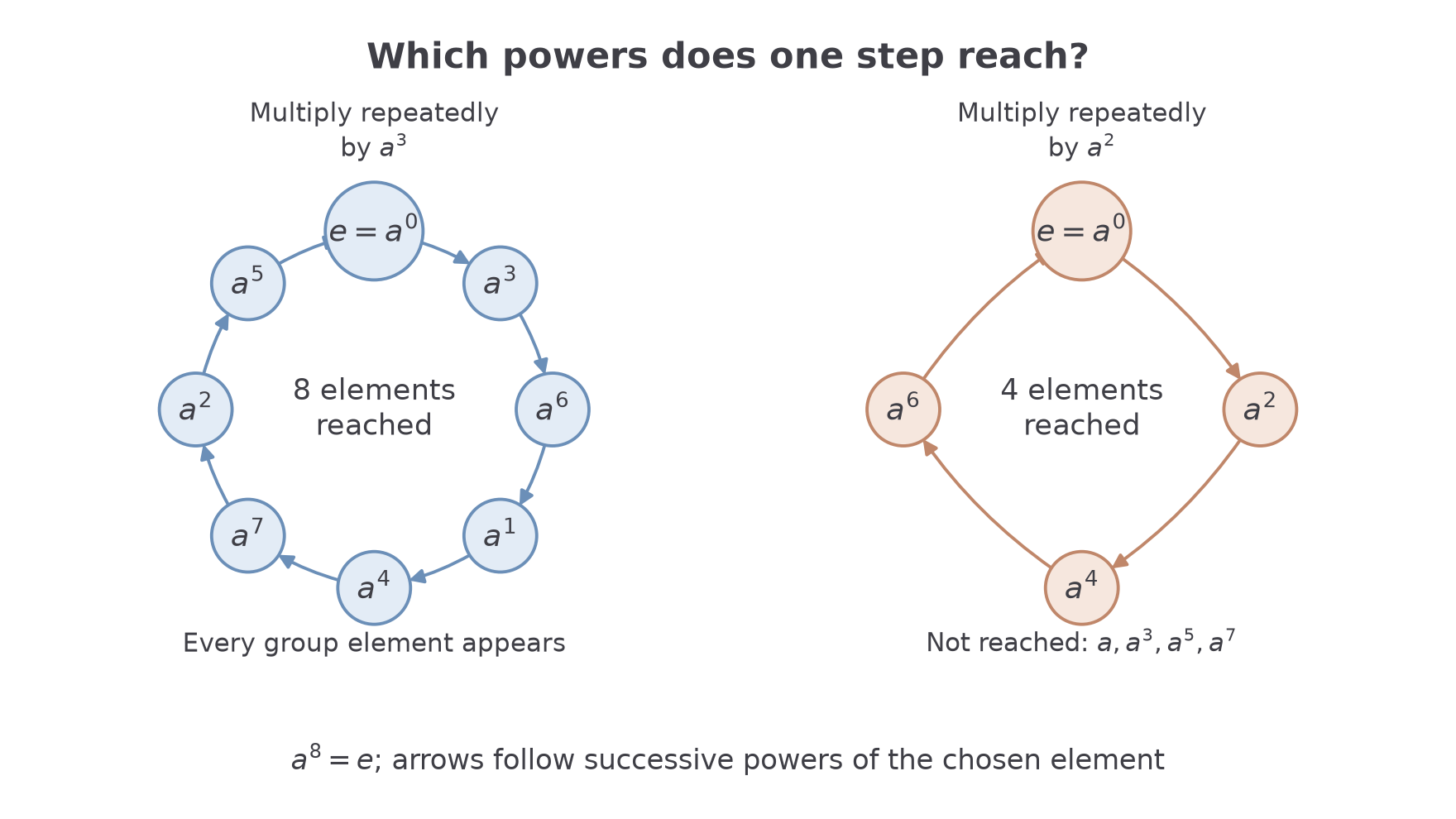
The diagram is a record of powers, rather than an assertion that every group element is a rotation. Adding a fixed step to exponents describes multiplication by a fixed power of .
Worked example 5: a second generator
Question. A cyclic group has order and generator . Show that is also a generator.
Plan. List the exponents reached by successive powers of , reducing exponents modulo .
Why reduce exponents? A further powers of contribute only a factor .
Answer. The eight powers give every element of the group, so is a generator.
Check. The exponent list contains every residue modulo once.
Change just the candidate generator from to . Repeated steps can now return too soon.
Continue this lesson.
You’re previewing NovaLearn without an account. Create a free account to read the rest.
Create free account