4.06b - The method of differences
Add a series by exposing terms that cancel. You will use differences and partial fractions to find finite sums, keep the correct terms when the cancellation spans several rows, and take limits to find infinite sums and the error after a finite number of terms. When only part of a series cancels, you will retain the other part and use a supplied sum if one is given.
Cancellation between consecutive terms
Can infinitely many positive fractions add up to exactly one half?
The first three terms total , already close to . Each new term adds something, so no finite sum can equal one half. Yet one half can still be the limit. The route to that limit starts with a finite sum and a cancellation pattern you can see.
You already know
Partial fractions replace a rational expression by simpler fractions with the same value. A sum with limits to includes both endpoints. Its number of terms is , not .
Take the simpler expression . At , its terms are , and . Adding them leaves . Nothing has been approximated: each middle fraction occurs once positively and once negatively.
Method of differences
The method of differences finds a sum by rewriting its terms so that intermediate contributions cancel, leaving boundary terms. This cancellation is also called telescoping. For example, telescopes to . A list of positive terms alone does not telescope until a suitable difference has been exposed.
The cancellation depends on matching expressions, including their signs. A term in one row is cancelled by in the next.
Consecutive differences
For integers , provided every displayed value of is defined,
Not in the formula booklet: learn it.
Rather than quote this as a shortcut when asked to use the method, show enough terms to make the cancellation clear. The first two rows and the last row usually reveal both boundaries.
Worked example 1: exposing the boundaries
Question. Use the method of differences to show that
Plan. Write the first two terms and the last term, then identify the unmatched positive and negative fractions.
For ,
Why this step? The negative fraction from each row cancels the positive fraction from the next. The first positive fraction has no earlier partner, and the last negative fraction has no later partner.
Answer. , as required. At and , direct addition gives the same formula, so it holds for every positive integer .
Check. At , .
Worked example 2 changes only the lower limit from to . The cancellation is identical, but the first surviving positive term changes.
Worked example 2: starting later
Question. Use the method of differences to find
Plan. Start the expansion at , keep the final row at , and cancel the fractions between them.
For ,
Why this step? The first index is , so survives. The negative fraction in the last term still has denominator , even though the sum ends at index .
Answer. . Directly checking and gives the same expression, so it is valid throughout the stated range.
Check. At , .
For short sums, write every term. Ellipses describe missing intermediate terms; they should not create extra copies of an endpoint when there are only one or two rows.
Watch out
Wrong: . That drops the final negative fraction too soon. Right: the row with is , so the surviving negative term is .
Use the first and last actual rows to check a changed range before you simplify.
Differences from partial fractions
A rational summand often hides the difference that makes the whole sum collapse.
For instance, has partial fractions . These fractions are larger than the original term, but their difference is exactly equal to it. That is why adding positive original terms can become a calculation with subtraction.
You already know
To find and in , multiply by the denominator, then substitute convenient values or compare coefficients. Check the identity by combining the fractions again.
Choose partial fractions first, then inspect whether a fraction at index reappears with the opposite sign at the next index. Partial fractions alone do not guarantee cancellation; the denominators must line up.
Worked example 3: consecutive integer factors
Question. Use partial fractions and the method of differences to find
Plan. Decompose one term, show its cancellation across consecutive rows, and simplify the boundary terms.
For ,
Why this step? Partial fractions turn each product in a denominator into a difference of consecutive reciprocals. Those reciprocals, rather than the original fractions, have matching neighbours.
Answer. for positive integers ; direct addition confirms the same formula for .
Check. At , , matching .
Worked example 4 changes the factor progression from consecutive integers to consecutive odd integers. The gap between the factors is now , so the partial-fraction coefficients change; the denominators still match between neighbouring rows.
Worked example 4: consecutive odd factors
Question. Use the method of differences to determine
Plan. Find the two partial fractions, then check that in one row equals in the next.
For ,
Why this step? The factors differ by , but their values also increase by when increases by one. Cancellation therefore still takes place between consecutive rows.
Answer. , also valid at by direct addition.
Check. At , , matching .
The decompositions and the resulting special sums are not in the formula booklet: derive them when needed. A quick recombination catches a missing scale factor before it spreads through the sum.
Watch out
Wrong: . The right side has numerator , not . Right: include the factor , giving .
In the next sum the factor progression advances by . Find the coefficients before deciding which terms cancel.
Cancellation over several rows
When the index shift is larger than one, several terms survive at each end of the sum.
Consider . The negative from the first row cancels from the third row, not the second. The first two positive fractions, and , survive; so do the last two negative fractions.
[DIAGRAM: asset_name: Two rows between matching fractions; asset_slug: h245_4_06_two_step_cancellation; caption: For four rows, the fractions with denominators 3 and 4 cancel, leaving the first two positive and last two negative fractions; description: Four rows labelled r = 1 to r = 4 show 1/r minus 1/(r+2), with equal denominators aligned in six columns. The rows are 1 minus 1/3, 1/2 minus 1/4, 1/3 minus 1/5 and 1/4 minus 1/6. Sage lines connect equal and opposite fractions in columns 3 and 4. Blue highlights identify surviving 1 and 1/2, and clay highlights identify surviving minus 1/5 and minus 1/6. A final line gives 1 + 1/2 - 1/5 - 1/6.]
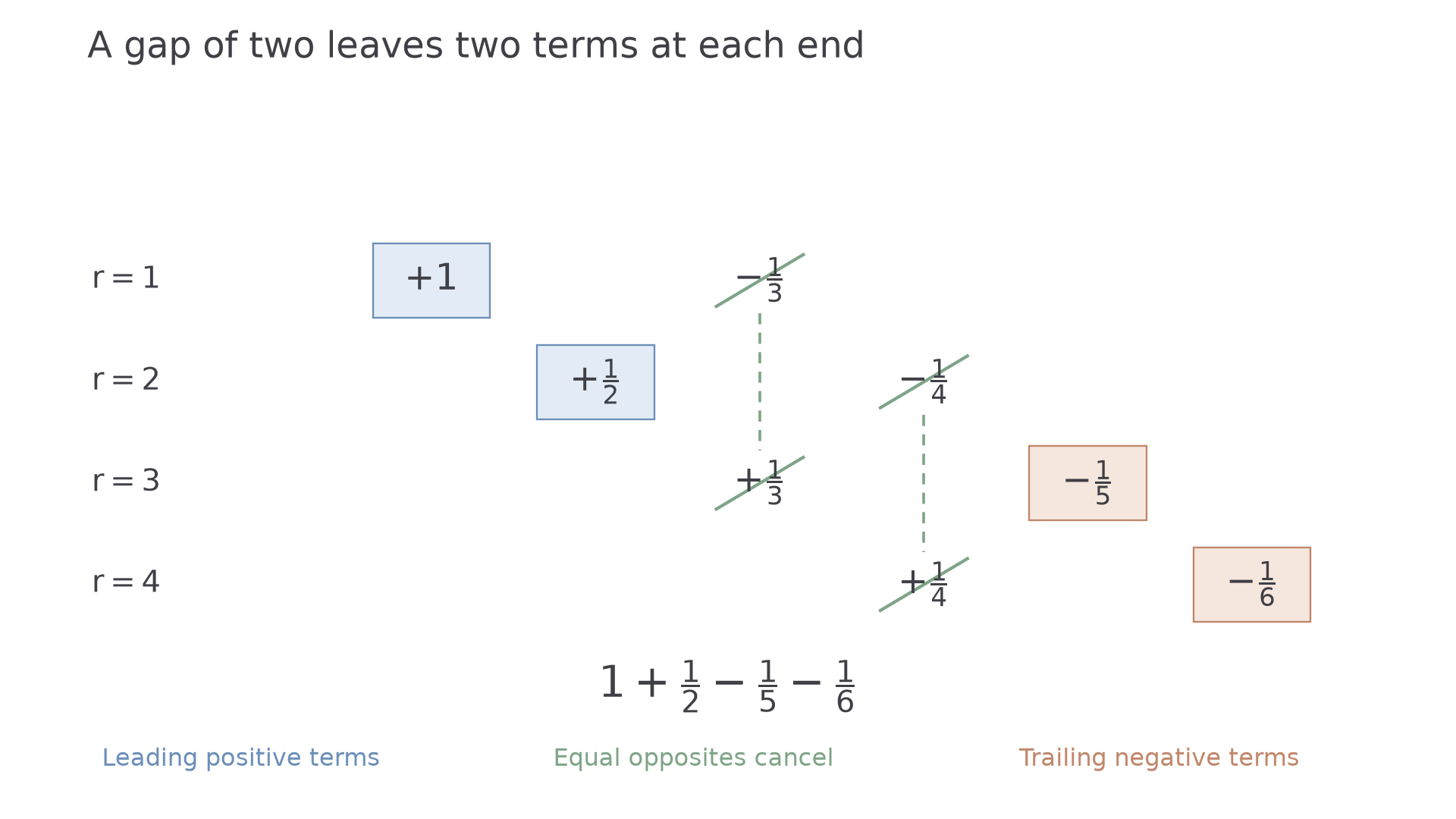
Count the shift before you cancel. For a positive integer shift , matching requires the row whose index is later.
Differences with an index gap
For positive integers and , with all terms defined,
When the boundary blocks overlap, equal terms within this expression also cancel.
Not in the formula booklet: learn it.
This formula follows by writing the second sum with index values to . The common index range disappears, leaving the leading and trailing blocks. In a worked solution, display those blocks so that the number of surviving terms is visible.
Worked example 5: a gap of two
Question. Use the method of differences to find
Plan. Write each term as half a difference of reciprocals, then retain two positive and two negative boundary terms.
For ,
Why this step? With a shift of two, the final negative fractions have denominators and . Neither has a matching positive term inside the sum.
Answer. . Direct substitution verifies as well.
Check. At , , and .
Worked example 6 changes only the factor gap from to . Three boundary terms now survive at each end, and the partial-fraction scale becomes .
Worked example 6: a gap of three
Question. Use the method of differences to find
Plan. Decompose with scale , write enough rows to expose the three-term boundary blocks, and simplify their constant part.
For ,
Why this step? The first three negative denominators are , so none can cancel the leading positive fractions with denominators . The same unmatched width appears at the other end.
Answer. . The boundary-block formula also applies for ; overlapping fractions cancel within it.
Check. At , the expression is , the first term.
Continue this lesson.
You’re previewing NovaLearn without an account. Create a free account to read the rest.
Create free account