4.03g - Invariant points and lines
Find the points that a two-dimensional transformation leaves fixed and the lines that it maps onto themselves. These are different questions: a line can remain in place while its points move along it. Use coordinate equations to distinguish the two, including lines that do not pass through the origin.
Two meanings of unchanged
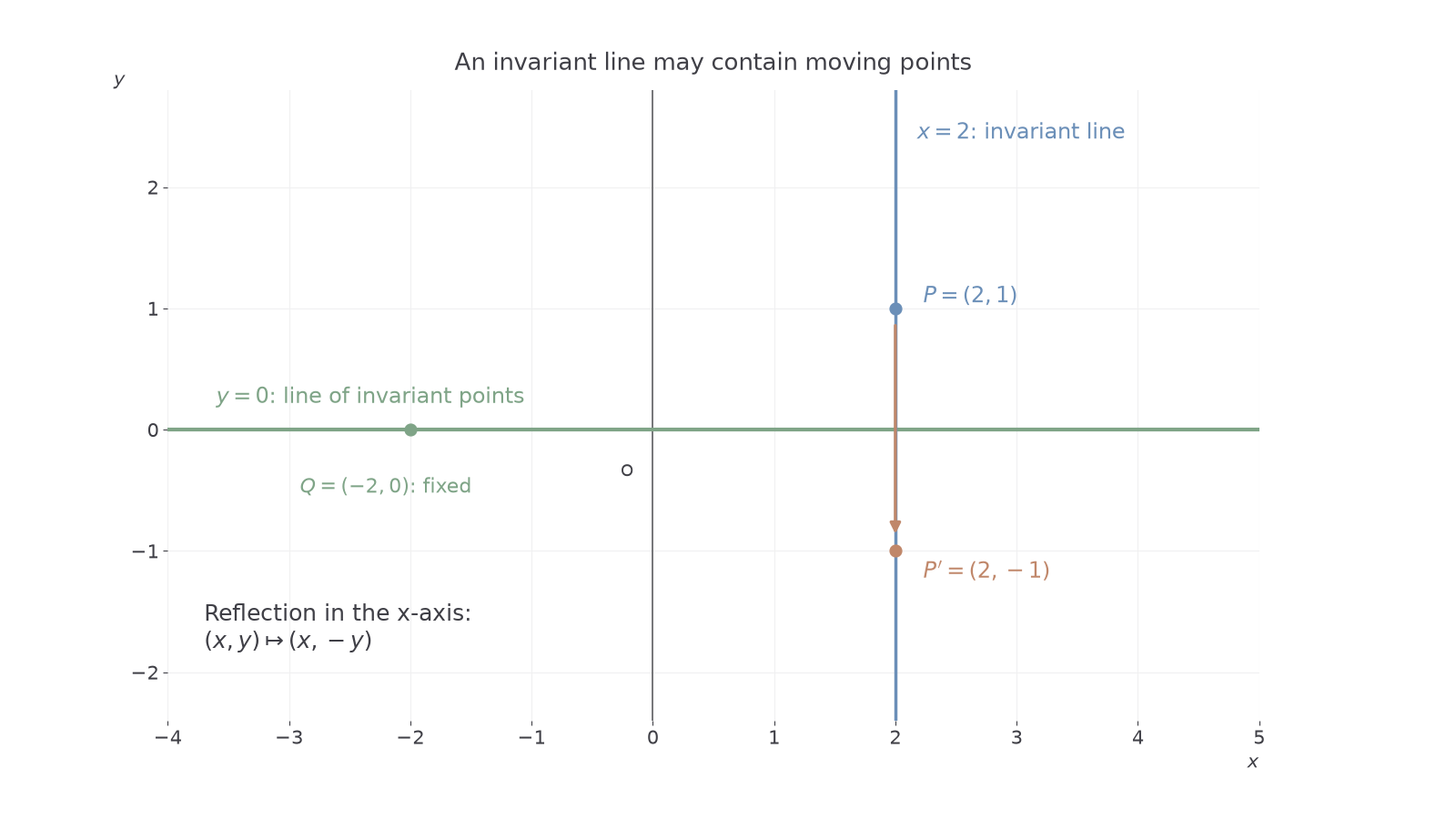
Can a line stay unchanged even though almost every point on it moves? Reflect the plane in the -axis. The vertical line is still the line , but moves to . The line is unchanged as a set of points, not point by point.
You already know
A matrix maps to . A linear transformation fixes the origin. A line may be written , except that vertical lines need the form .
An object and image can coincide in two senses. The mirror stays in place and every one of its points stays fixed. The vertical line stays in place but most of its points swap positions.
[DIAGRAM: asset_name: An invariant line need not have fixed points; asset_slug: h245_4_03_invariant_lines; caption: Reflection in the x-axis fixes every point of y = 0, while the invariant line x = 2 contains moving points; description: Equal-scale coordinate diagram with the x-axis highlighted sage and labelled line of invariant points. The vertical line x=2 is blue and labelled invariant line. The point P=(2,1) is blue and its image P'=(2,-1) is clay, with an arrow down the vertical line. A point Q=(-2,0) on the mirror is marked and labelled fixed]
Invariant point and invariant line
An invariant point maps to itself. A line of invariant points has every point fixed. An invariant line maps onto itself as a whole; individual points may move to other positions on it. For example, under reflection in the -axis, is a line of invariant points and every vertical line is an invariant line. A line mapped to a different parallel line is not invariant.
The terminology and tests for invariance are not supplied in the formula booklet. In this lesson we work only in two dimensions. The essential distinction is between testing one point and testing the image of an entire set.
Key idea
Fixed point: the same coordinates. Invariant line: the same line. A line of invariant points satisfies both conditions.
Keep those demands separate in this check.
Finding all invariant points
To find invariant points, set the image coordinates equal to the starting coordinates and solve both equations together.
Invariant-point equations
For , invariant points satisfy
Both equations must hold. Not in the formula booklet: learn it.
The equations may describe only the origin, an entire line, or the whole plane for the identity transformation. The origin is always a solution, so “no invariant points” cannot be correct for a linear transformation of the plane.
Worked example 1: a line of invariant points
Question. Find all invariant points under .
Plan. Equate both image coordinates to the original coordinates, then solve their common condition.
Why this step? The two equations are the same condition, so choosing one point would miss infinitely many others.
Answer. Every point on , and no other point, is invariant.
Check. for every real .
The second example changes only the bottom-right entry, from to . The second fixed-point condition is now independent of the first.
Worked example 2: only the origin
Question. Find all invariant points under .
Plan. Form the same two fixed-point equations and solve them simultaneously.
Why this step? Satisfying just the first equation gives a candidate line; the second equation removes every non-zero point on it.
Answer. The origin is the only invariant point.
Check. , which was fixed in the first example, now maps to , so it no longer works.
The fixed-point set can shrink when just one entry changes. Always use both coordinate equations, even if the first gives an attractive answer.
Watch out
Wrong: solving and concluding that all points on are fixed without checking the second coordinate. Right: impose both and .
Vary the same entry again and find the complete fixed-point set.
Invariant lines through the origin
For an invariant line, an image point needs to satisfy the same line equation; it need not have its original coordinates.
Take a general point on . Under ,
To lie on the same line, the image must have for every . Therefore . This compares the image line with the object line rather than fixing each individual point.
Testing a line through the origin
A non-vertical line is invariant under if
The non-zero condition ensures that the whole line maps onto a line, rather than collapsing to the origin. Test the vertical line separately: it is invariant if and . Not in the formula booklet: learn it.
You can always rebuild the slope equation from ; it is usually clearer than memorising it. If a line collapses to a single point, its image is a point, not the same whole line.
Worked example 3: different stretches along the axes
Question. Find all invariant lines through for .
Plan. Transform , compare with , then check the vertical line.
Why this step? The form never includes the -axis, so omitting a separate vertical check would lose a solution.
Answer. The two coordinate axes, and .
Check. Points on each axis move along it; neither factor nor is zero, so its whole image is that axis.
The second example changes only the top-right entry, from to . One invariant direction tilts away from the vertical.
Worked example 4: a tilted invariant line
Question. Find all invariant lines through for .
Plan. Transform a general point on and compare coefficients, then test the vertical direction.
Why this step? The condition compares whole lines. For , points are multiplied by along the line, so they move but stay on it.
Answer. and , with no other lines through .
Check. , and ; both give their full lines as varies.
One transformed point is useful for rejecting a candidate, but cannot by itself establish that a whole line is invariant.
Watch out
Wrong: choosing the origin as the only test point on a proposed invariant line. Every linear transformation fixes , so this says nothing about its direction. Use a general point or a non-zero direction vector, then check that the line does not collapse.
The next matrix changes the relative scaling while keeping a tilted direction.
Invariant lines away from the origin
A search for all invariant lines must allow a non-zero intercept as well as every direction.
The reflection from the opening has all vertical lines invariant, including lines far from . Restricting attention to would miss almost all of them. For a general non-vertical line, substitute , then require for every point. The coefficients of and the constant terms must both agree.
Testing all straight lines
For a non-vertical line , transform a general point and impose
For a vertical line , require for every . In either case ensure that the image covers the whole line. These tests are not in the formula booklet: learn them.
A line can therefore keep its direction but fail the intercept condition. A horizontal line sent from to is parallel to its image, but is not invariant.
Worked example 5: a family of parallel invariant lines
Question. Find all invariant lines under .
Plan. Test , then test vertical lines separately.
Why this step? The intercept cancels here, so every horizontal line survives, not just the -axis.
Answer. Every horizontal line , where is real, and the -axis .
Check. covers the same horizontal line. Every is fixed, so is also a line of invariant points.
The second example changes only the bottom-right entry from to . This introduces a restriction on the intercept.
Worked example 6: the intercept must be zero
Question. Find all invariant lines under .
Plan. Use the same general line and compare both coefficients and constants.
Why this step? Matching the slope alone would admit all horizontal lines; matching the constant term removes every horizontal line except the axis.
Answer. Only and .
Check. maps to , so it is not invariant despite keeping its direction. Both coordinate axes map onto themselves.
This completes the distinction from the opening puzzle. Under reflection in the -axis, is invariant because its image is the same set; it is not a line of invariant points because moves.
Watch out
Wrong: finding invariant slopes and stopping when the question asks for all invariant lines. A slope specifies a direction, not an intercept. Test , and include vertical lines .
Finish with both types of line explicitly included.
Quick Recap
- An invariant point has the same coordinates after the transformation: solve both fixed-point equations.
- An invariant line maps onto itself; its points may move. A line of invariant points has every point fixed.
- For , impose ; test separately and exclude collapse to a point.
- For all invariant lines, use and , comparing constants as well as slopes.
A line can stay unchanged while its points move: reflection in the -axis keeps in place but swaps with .