6.02a–6.02c - Work done by a force
Calculate work by resolving a constant force, by taking a scalar product in two dimensions and by integrating a variable force along a straight line. You will keep the sign of the work and distinguish the work done by one force from the work done by the resultant.
The meaning and sign of work
Can a force act throughout a journey and do zero total work? Take a constant horizontal force of . If its point of application moves to the right and then to the left, the force does on the outward leg and on the return. Its total work is zero, although it acted throughout.
Work measures an energy transfer associated with a force acting through a displacement. It does not measure how tiring it feels to maintain the force. A person holding a stationary suitcase may tire, but the upward supporting force does no mechanical work on the stationary suitcase.
You already know
Resolve a force using sine and cosine. The scalar product satisfies , where is the angle between the vectors. A displacement points from the initial position to the final position.
For a straight displacement, only the component of force along that displacement contributes. A force perpendicular to the displacement does no work; it can still change the direction of motion.
Work done by a force
For a constant force of magnitude acting through a straight displacement of magnitude , the work done by the force is the component of the force in the displacement direction multiplied by . Work is a scalar measured in joules, with . For example, a force acting along a displacement does . Force alone is not work.
A force with a component in the displacement direction does positive work. A force with a component against the displacement does negative work. Thus a resistance of magnitude acting against a distance does work ; the positive quantity is the work done against the resistance. Keep these two descriptions distinct. When motion continues against resistance, mechanical energy is transferred to other forms, such as thermal energy.
Key idea
The sign belongs to the work, even though work is a scalar: positive means a component along the displacement, negative means a component against it.
A right angle is the boundary between those two signs. The same upward force on a load can do positive work while the load rises, zero work while it moves horizontally, and negative work while it descends.
Resolving a constant force
The angle you need is the angle between the force and the actual displacement, not automatically the angle drawn next to a slope.
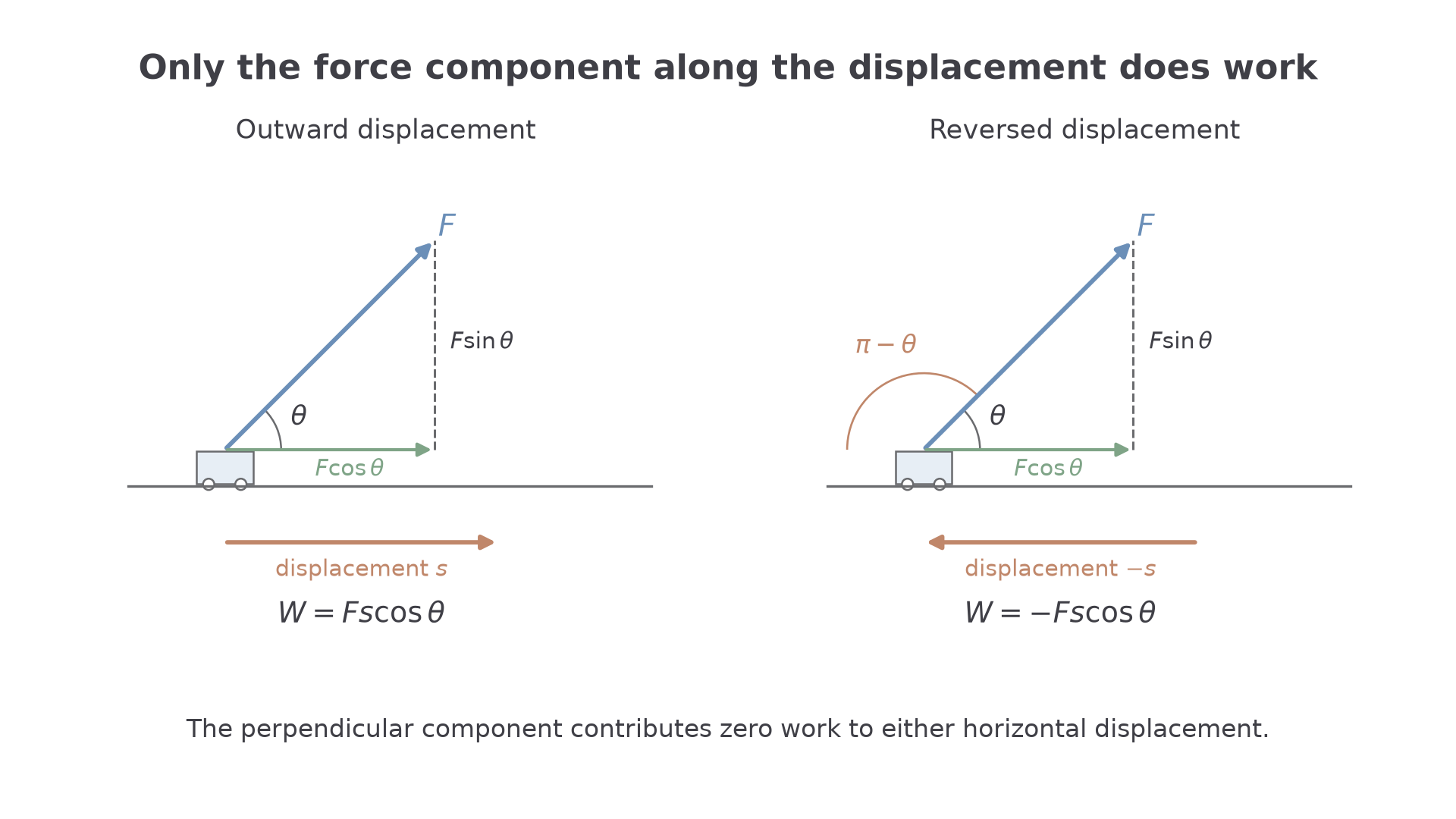
Imagine pulling a trolley horizontally with a force directed above the horizontal. Only its horizontal component contributes to work during that displacement. The vertical component may affect the contact force, but it does no work when the trolley stays at the same height.
[DIAGRAM: asset_name: Resolving a force along a displacement; asset_slug: h245_6_02_work_resolving; caption: The component F cos theta acts along the displacement while the perpendicular component does no work; description: A trolley on a horizontal line moves to the right through displacement s. A blue force arrow F slopes upwards at angle theta to the right and its sage horizontal projection is labelled F cos theta. A pale perpendicular projection is labelled F sin theta and zero work for a horizontal displacement. A second panel reverses the displacement and shows that the angle becomes pi minus theta and the work changes sign.]
Work by a constant force
For a constant force and straight displacement of magnitude , with angle between them,
Use SI units to obtain in joules. The formula includes positive, zero and negative work.
Not in the formula booklet: learn it.
Resolving first and multiplying afterwards makes the direction choice visible.
Worked example 1: a pull above the horizontal
Question. A constant force of acts at above the rightward horizontal. A trolley moves horizontally to the right. Find the work done by this force.
Plan. Resolve the force along the rightward displacement, then multiply by the distance.
Why this step? The displacement has no vertical component, so multiplying by the full would include a force component that does no work.
Answer. The force does of work.
Check. The result is positive and less than , as the force is oblique to the displacement.
Worked example 2 changes just the displacement direction. The force is unchanged; the sign of its work must reverse.
Worked example 2: the same force on a return journey
Question. The same force still acts at above the rightward horizontal. The trolley now moves horizontally to the left. Find the work done by the force.
Plan. Measure the force angle from the leftward displacement, or use its signed component in that direction.
Why this step? The original was measured from the right. Reusing it after reversing the displacement would lose the sign.
Answer. The force does of work.
Check. The two legs together give , although their total distance is .
An angle measured from the vertical needs the corresponding complementary angle before you use cosine.
Watch out
Wrong: whenever the force is constant. That assumes force and displacement point the same way. Right: , with the angle between those two directions.
The return leg supplies a useful sign test for your own calculation.
Work in two dimensions using vectors
A scalar product performs the resolving for you when force and displacement are given as vectors.
For instance, acting through displacement does work . The positive horizontal contribution and negative vertical contribution partly cancel. Multiplying the magnitudes would miss that cancellation.
Work as a scalar product
For a constant force in two dimensions and displacement ,
If initial and final position vectors are and , use . This agrees with .
Not in the formula booklet: learn it.
Continue this lesson.
You’re previewing NovaLearn without an account. Create a free account to read the rest.
Create free account