4.04e - Intersecting, parallel or skew lines
Determine whether two lines meet, run parallel or are skew, and find their intersection when it exists. You will use separate parameters for the two lines, check all three coordinates in space, and distinguish separate parallel lines from two equations of the same line.
How lines can be arranged
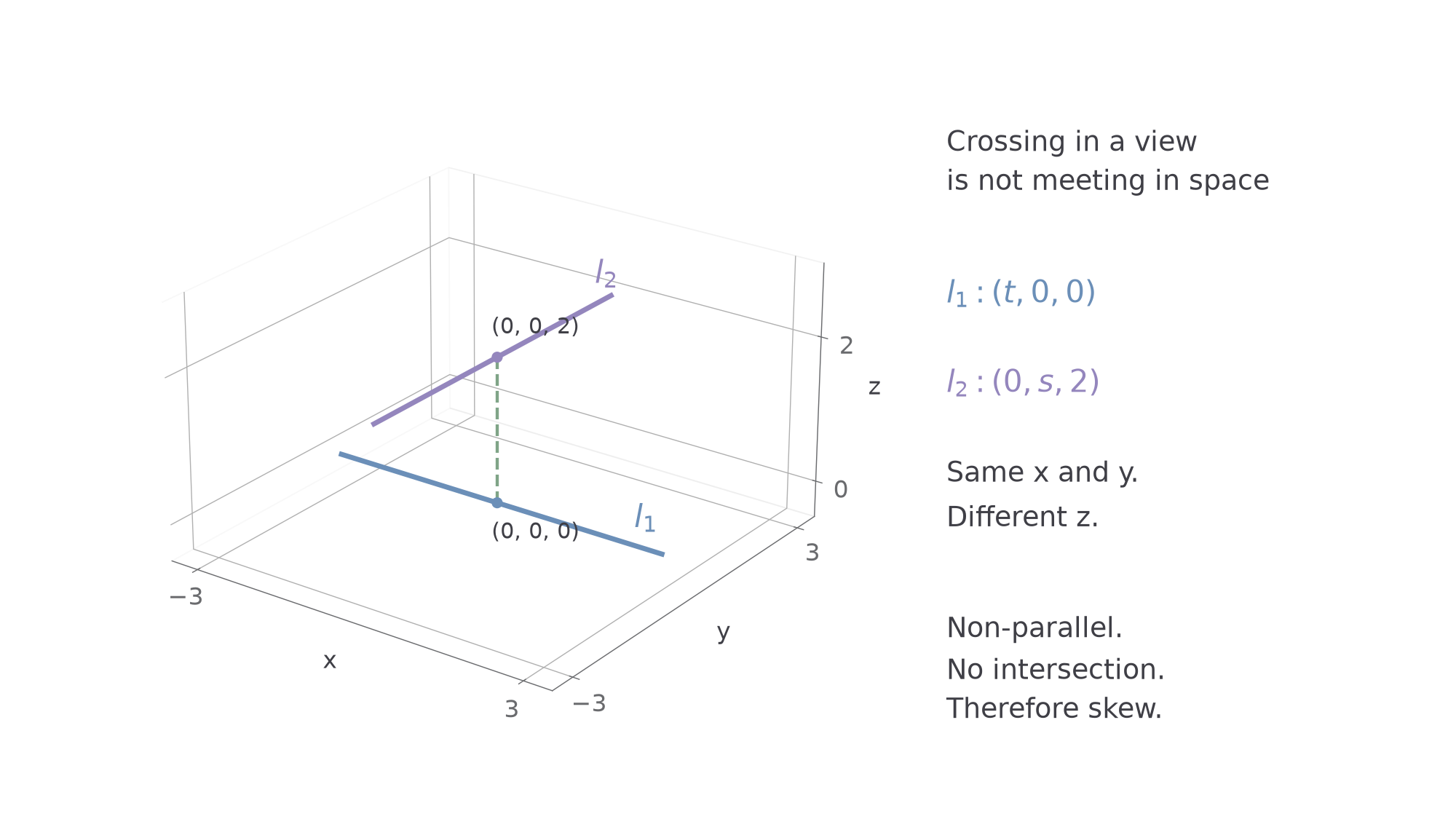
Two roads cross on a map. Must they meet in space? A bridge gives a familiar counterexample. In coordinates, consider
Their views from above cross at , but one line has height 0 and the other height 2. How can we prove that two lines really meet, rather than merely appear to cross?
You already know
A line has a starting point and a non-zero direction: . A point lies on the line only when one parameter value gives all its coordinates. Proportional direction vectors describe parallel directions.
[DIAGRAM: asset_name: Lines crossing in projection but not in space; asset_slug: h245_4_04e_skew_lines; caption: The two lines share an apparent crossing from above, but their heights differ; description: Three-dimensional coordinate diagram of the x-directed line (t,0,0) and the y-directed line (0,s,2), with the points (0,0,0) and (0,0,2) marked and joined by a dashed vertical guide. A side annotation explains that the lines are non-parallel and do not intersect.]
Intersecting, parallel and skew lines
Distinct lines are intersecting if they share a point. They are parallel if their direction vectors are proportional; distinct parallel lines share no point. They are skew if they are neither parallel nor intersecting. Coincident lines are two descriptions of the same line, so every point is shared.
Two distinct intersecting lines share exactly one point: if they shared two distinct points, both would be the line through those points. Skew lines occur only in three dimensions or more. In a single plane, non-parallel lines must meet. This is the extra possibility that a flat sketch can hide.
Here is a useful mathematical surprise: two directions can be at right angles while the lines themselves never meet. The two lines in the opening example have directions and , but their constant heights prevent an intersection. Direction and location answer different questions.
Key idea
An intersection requires the same point on both lines: every coordinate must agree. A crossing on a sketch establishes neither the coordinates nor the height.
Before solving, be clear about what each word asserts.
Finding a common point
Use a different parameter for each line, equate corresponding coordinates and solve; then verify that the proposed common point satisfies every coordinate equation.
The parameters are labels chosen independently. An intersection may occur at on one line and on the other. Setting would impose an extra condition with no geometric reason.
Intersection condition
For lines and , a common point exists precisely when real values of satisfy
in every component.
Not in the formula booklet: learn it.
Choose two component equations that give enough information to solve for the parameters. In three dimensions, the remaining equation is a separate consistency check.
Worked example 1: intersecting lines in a plane
Question. Determine the point of intersection of
Plan. Equate both coordinates, solve for the two parameters and substitute into either line.
Why this step? Each line has its own parameter, but their coordinates must match at a shared point.
Answer. The intersection is .
Check. On , as well.
Worked example 2 changes one feature: the points and directions gain a third component. The first two equations still give the same candidate, but it must now pass a third test.
Worked example 2: a third coordinate to check
Question. Determine the point of intersection of
Plan. Solve the - and -equations, check , then state the common point.
Why this step? Matching and alone only establishes a crossing in projection. Matching establishes a shared point in space.
Answer. The lines intersect at .
Check. Substituting into both full vector equations gives , so all three coordinates agree.
The final check is part of determining the intersection, not an optional afterthought.
Watch out
Wrong: “, so the lines intersect,” after using only two coordinates. Right: substitute those values into the third equation and evaluate both sides before concluding.
OCR's “Determine” asks for justification: show the equations and consistency check, not just the output of a simultaneous-equation solver.
Parallel, coincident or skew
Check directions first: proportional directions call for a point-on-line check; non-proportional directions call for an intersection check.
| Direction vectors | Point check | Conclusion |
|---|---|---|
| Proportional | One starting point lies on the other line | Coincident |
| Proportional | One starting point does not lie on the other line | Distinct parallel lines |
| Not proportional | All coordinate equations are consistent | Intersecting |
| Not proportional | Coordinate equations are inconsistent | Skew |
For proportional directions, why is checking one point enough? If they share one point , both lines contain every real multiple of the same direction from , so they are the same line. If they share no starting point, their parallel directions cannot bring them together later. These classification tests are not in the formula booklet: learn them.
Worked example 3: inconsistent coordinates mean skew
Question. Determine whether the following lines intersect, are parallel or are skew.
Plan. Compare directions, then solve two coordinates and test the third.
Why this step? The only parameter pair that matches and fails to match , so there is no possible common point.
Answer. The lines are skew: they are not parallel and do not intersect.
Check. The two candidate points are and , displaying the mismatch explicitly.
Worked example 4 changes one feature: the second line's direction becomes a multiple of the first. The starting point stays the same. A point-on-line check now settles the classification more efficiently.
Worked example 4: parallel directions and different lines
Question. Classify
Plan. Verify proportional directions and test whether lies on .
Why this step? Proportional directions alone allow either the same line or distinct parallel lines; the starting point distinguishes them.
Answer. The lines are distinct and parallel.
Check. The displacement between their starting points is , which is not a multiple of .
If only the second starting point's last coordinate were changed from 6 to 5, it would lie on at . The directions would still be proportional, so the two equations would then describe coincident lines. An intersection problem that produces dependent equations is not automatically wrong: it may be describing this same-line case.
Watch out
Wrong: “No intersection, so skew.” Distinct parallel lines also have no intersection. Right: establish non-parallel directions as well before concluding that lines are skew.
The opening roads are skew: their directions are not proportional, and cannot also be . A complete coordinate check settles what a flat map cannot.
Quick Recap
- Compare direction vectors first: proportional directions mean parallel or coincident lines.
- Use different parameters and equate corresponding coordinates to find a common point.
- In three dimensions, every coordinate equation must agree; two alone are insufficient.
- Non-parallel lines with no intersection are skew. Parallel lines with one common point are coincident.
The opening lines cross only in projection: their different heights prove that they never meet.