4.03d - Matrices for 2D transformations
A transformation matrix tells you where every point goes, using only two columns. Find and use matrices for reflections, rotations, enlargements, stretches and shears, and describe each transformation with the details that identify it completely. Pictures will make the entries mean something before you memorise them.
Columns and images
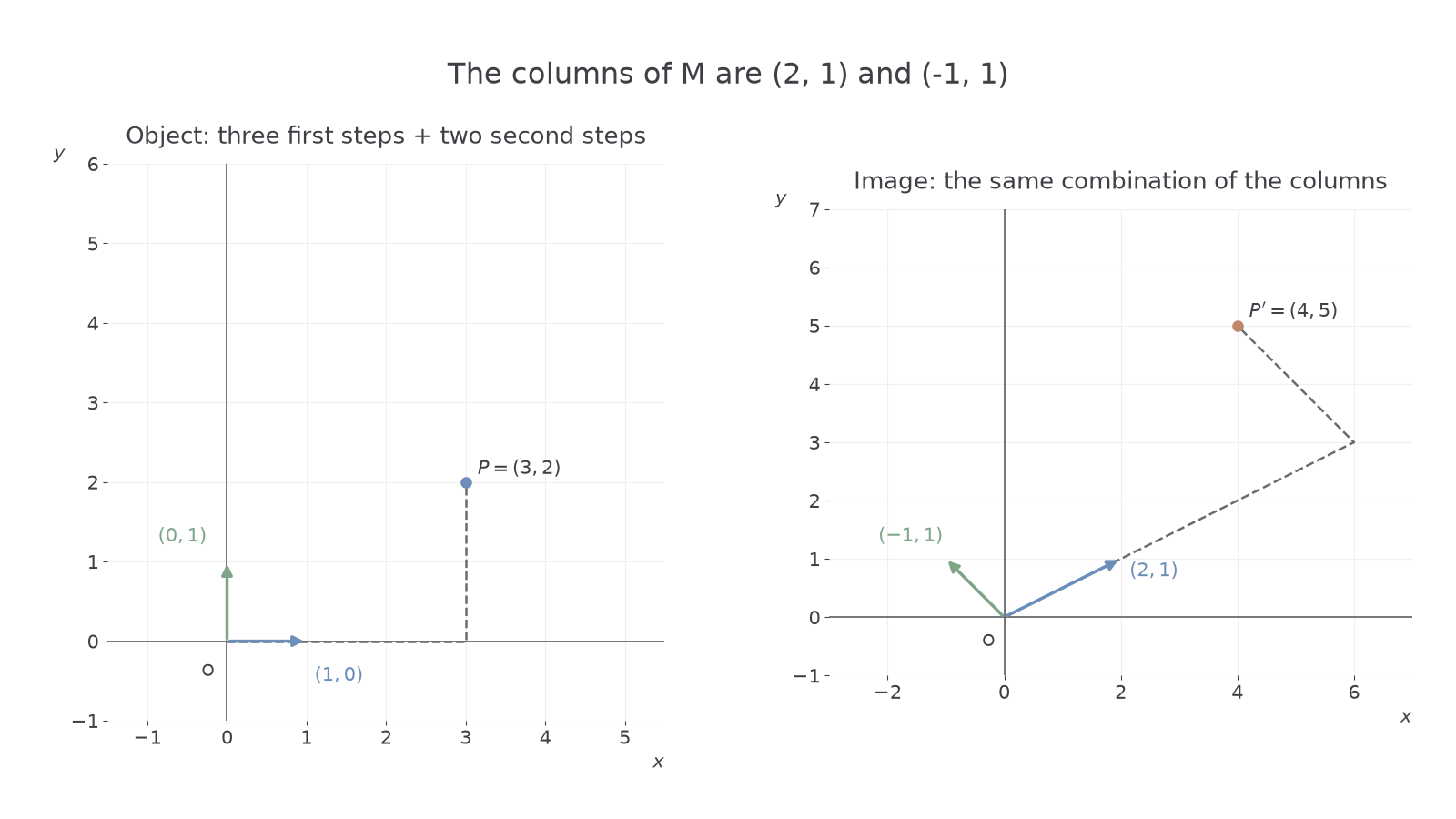
How can just four numbers move every point in the plane? Consider a transformation that sends to and to . Its matrix is
Those two images become its columns. The point is three steps in the first coordinate direction and two in the second, so its image is . This is the surprising economy of a linear transformation: the images of two independent unit steps fix the images of infinitely many points.
You already know
A position vector represents the point . Matrix multiplication combines each row of a matrix with the column vector; vector addition and scalar multiplication combine coordinate steps.
The starting point or shape is the object; the result is its image. Write for the image of . A linear transformation sends coordinate combinations to the same combinations of their images, so it fixes the origin and sends straight lines to straight lines or, in a collapse, to points.
[DIAGRAM: asset_name: Two columns determine every image; asset_slug: h245_4_03_columns; caption: The two unit steps become the columns of M, and the point (3,2) becomes (4,5); description: Two equal-scale coordinate panels show unit vectors and the point P=(3,2) on the object panel, then their images (2,1), (-1,1) and P'=(4,5) on the image panel. A dashed path builds P from three horizontal plus two vertical steps and builds P' from three first-column plus two second-column steps]
Using and constructing a 2D matrix
For ,
Column 1 is the image of ; column 2 is the image of . Not in the formula booklet: learn it.
Each image coordinate is a row-column sum. Apply the first row to find the horizontal image coordinate, then the second row to find the vertical one.
Worked example 1: using a matrix
Question. Find the image of under .
Plan. Multiply the position column by the matrix on its left.
Why this step? The coordinates form a column, so pre-multiplication produces another position column.
Answer. The image is .
Check. Twice column 1 minus column 2 is .
The second example changes the direction of the task: you are given the two unit images and must reconstruct the matrix before using it.
Worked example 2: building the matrix
Question. A linear transformation sends to and to . Find its matrix and the image of .
Plan. Place the two given image columns in order, then multiply.
Why this step? Putting the images in rows would describe a different transformation.
Answer. , and the image is .
Check. and , as required.
The unit-point check tests both the matrix construction and the order of its columns.
Watch out
Wrong: putting the unit images in rows. Right: use the first unit image as column 1 and the second as column 2. A by matrix also always fixes , so it cannot represent a non-zero translation.
Construct and use another matrix in the same way.
Reflections
A reflection reverses the perpendicular coordinate and preserves the coordinate along its mirror line.
For reflection in the -axis, becomes . Its unit images are and , so the matrix is . The coordinate names are useful: reflection in the -axis changes , not .
Coordinate-axis reflections
Not in the formula booklet: learn it.
For the diagonal mirror , the coordinates exchange places. For , they exchange places and both change sign.
Diagonal reflections
In the formula booklet.
A reflection is specified by its mirror line. The following examples change only that line.
Worked example 3: an axis reflection
Question. Write down the matrix for reflection in the -axis and find the image of .
Plan. Change the sign of the horizontal coordinate only.
Why this step? The distance across the vertical mirror changes side while the height stays fixed.
Answer. , image .
Check. The midpoint lies on the mirror, and the joining segment is horizontal.
Now change the mirror to ; the point stays the same.
Worked example 4: a diagonal reflection
Question. Find the image of under reflection in .
Plan. Use the diagonal-reflection matrix, which swaps and negates the coordinates.
Why this step? Swapping without negating would reflect in , a different mirror.
Answer. .
Check. The midpoint is on ; the segment joining the points has gradient , perpendicular to that line.
A point on the mirror must remain unchanged. This gives a quick way to distinguish the two coordinate-axis reflections.
Watch out
Wrong: describing as reflection in the -axis because its first diagonal entry is negative. It reverses , so its mirror is the -axis.
Try the other diagonal mirror.
Rotations about the origin
A rotation through about sends the first unit point to and the second to .
The second unit direction starts a quarter turn ahead of the first. Rotating both by the same angle explains the minus sign in the top-right entry.
Rotation about the origin
An anticlockwise rotation through angle about the origin is represented by
Positive angles mean anticlockwise; negative angles mean clockwise. In the formula booklet.
[DIAGRAM: asset_name: Reflection and rotation move points differently; asset_slug: h245_4_03_reflection_rotation; caption: Reflection in y = -x sends (3,-2) to (2,-3), while a quarter turn sends (2,1) to (-1,2); description: Two equal-scale panels. Left shows the diagonal mirror y=-x, the object point (3,-2), image (2,-3), and their perpendicular joining segment. Right shows vectors from O to (2,1) and (-1,2), joined by an anticlockwise quarter-circle arrow labelled pi/2]
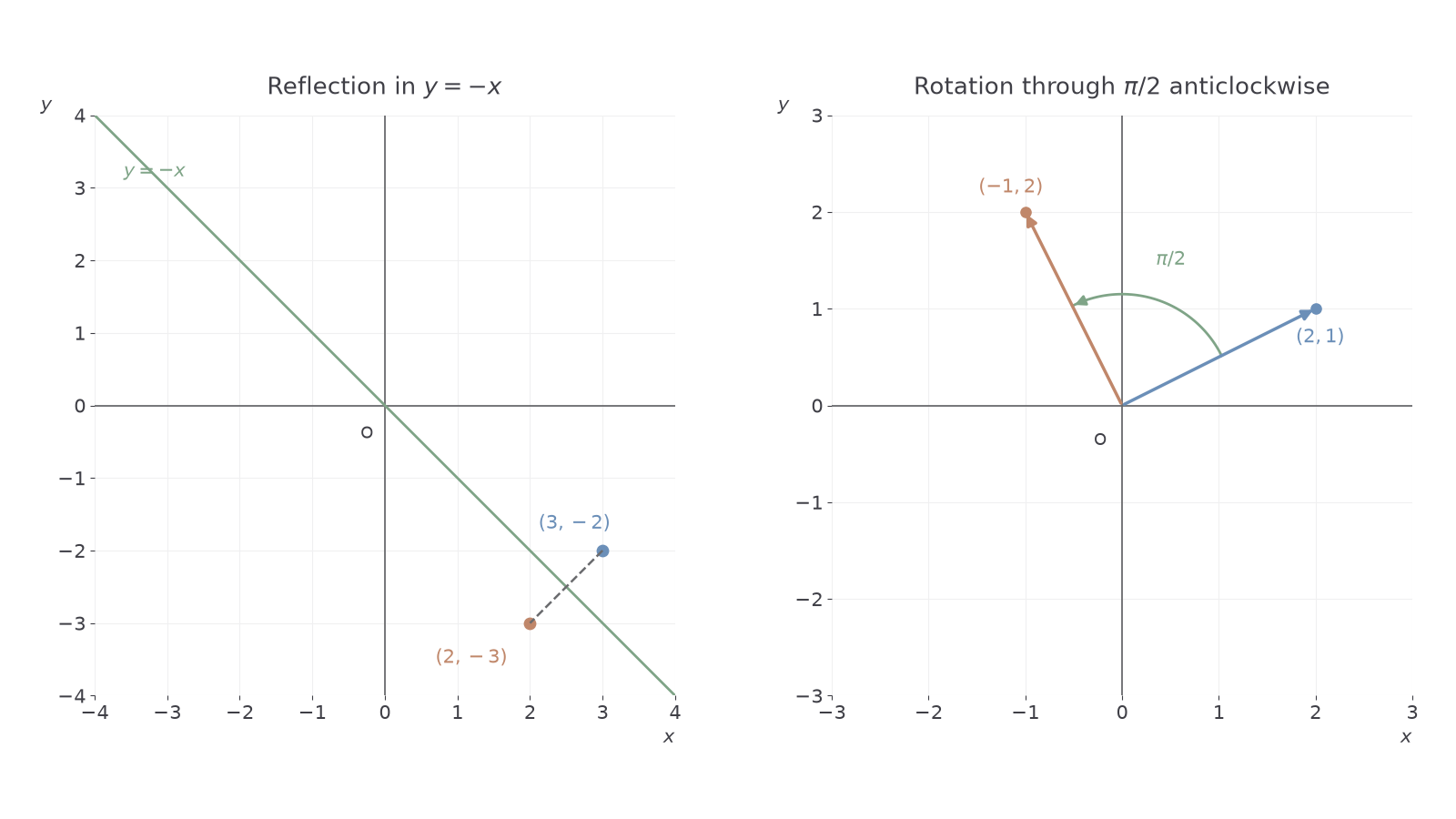
For a standard angle, evaluate every sine and cosine. Then a quick unit-point check confirms the direction.
Worked example 5: a quarter turn
Question. Find the matrix for a rotation through anticlockwise about , and the image of .
Plan. Substitute the exact sine and cosine, then multiply the point column.
Why this step? The exact entries expose the direction of the rotation and avoid leaving a standard angle unevaluated.
Answer. Matrix , image .
Check. The image remains at distance from , and is a quarter turn anticlockwise from the object.
The second example changes only the rotation angle, including its sign.
Worked example 6: a clockwise turn
Question. Find the matrix for a rotation through clockwise about , and the image of .
Plan. Use , then substitute exact values.
Why this step? Clockwise is encoded by the negative angle; inserting a positive angle would reverse the turn.
Answer. Matrix as displayed, image .
Check. The sum of the squared image coordinates is , the original squared distance.
Length alone cannot check the direction: both clockwise and anticlockwise turns preserve it. Check a unit image as well.
Watch out
Wrong: using for an anticlockwise quarter turn. It sends to , which is clockwise. Test the first unit point if the signs feel uncertain.
The direction is an essential part of a description, alongside the centre and angle.
Enlargements and stretches
An enlargement changes both coordinates by the same factor; a stretch parallel to one axis changes only the coordinate in that direction.
Enlargement and axial stretches
An enlargement of scale factor , centre , has matrix . A stretch of scale factor parallel to the -axis, with the -axis invariant, has matrix . A stretch parallel to the -axis, with the -axis invariant, has matrix . Not in the formula booklet: learn it.
An invariant axis here is an axis whose points do not move. For example, stays under a stretch parallel to the -axis. A positive factor greater than expands; a factor between and contracts. A negative factor also reverses the affected direction. The zero-factor matrix collapses that direction, rather than giving an ordinary non-zero enlargement or stretch.
An enlargement preserves a shape's proportions. A one-direction stretch usually changes them: a circle becomes an ellipse. This is why the transformation name matters.
Worked example 7: a uniform enlargement
Question. Describe and find the image of .
Plan. Read the common diagonal factor, then scale both coordinates.
Why this step? Both diagonal entries equal , so both coordinate directions scale equally.
Answer. Enlargement of scale factor , centre ; image .
Check. The image position vector is exactly three times the object position vector.
The second example changes only whether the factor acts in both directions or just one.
Worked example 8: a one-direction stretch
Question. Describe and find the image of .
Plan. Identify the changed coordinate and the axis whose points stay fixed.
Why this step? “Parallel to the -axis” describes the movement; the unchanged axis is the -axis.
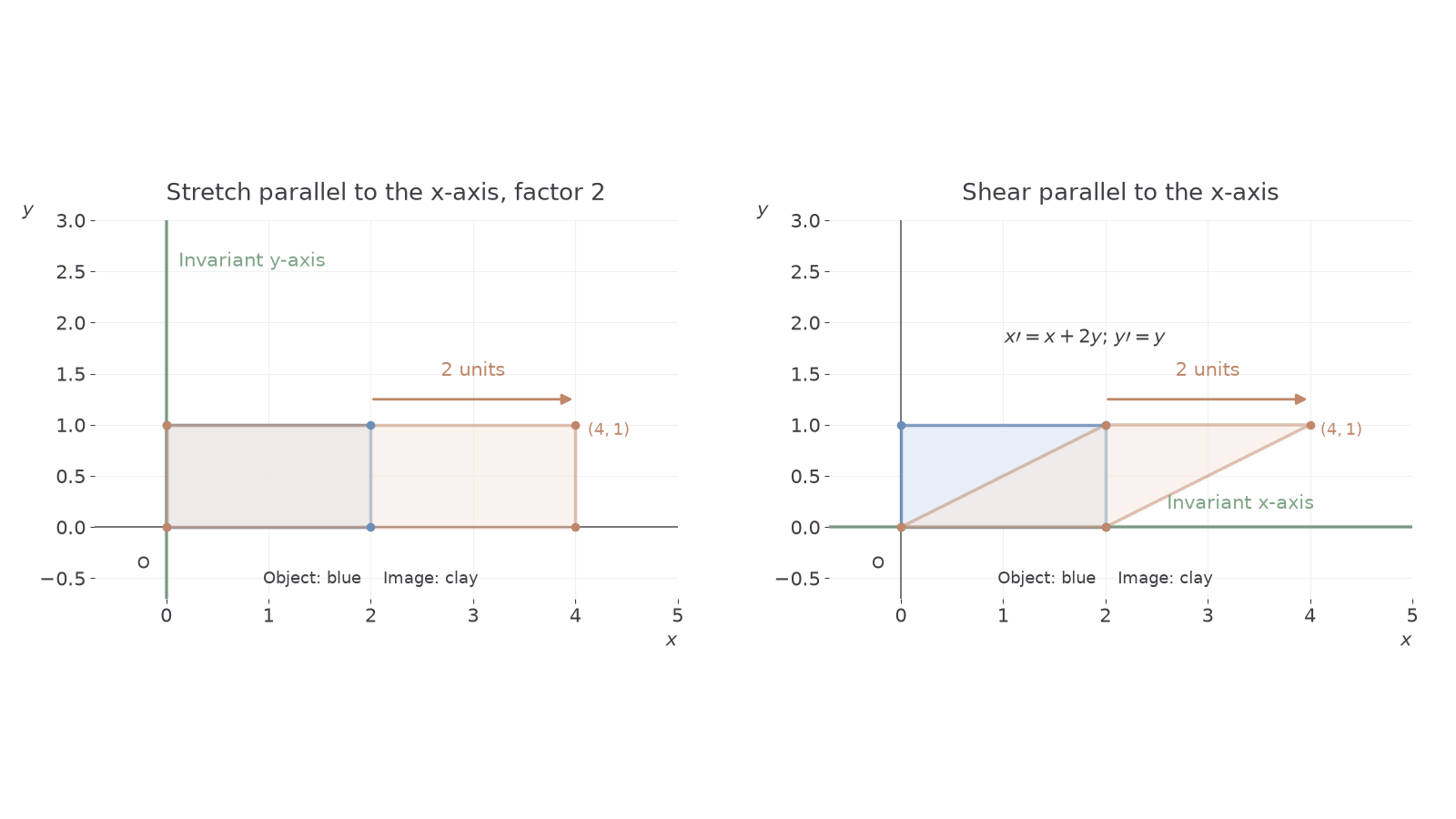
Answer. Stretch parallel to the -axis, scale factor , invariant -axis; image .
Check. A point maps to itself, confirming the invariant axis.
The two examples have the same horizontal effect but different vertical effects, so their full descriptions must distinguish them.
Exam tip
For an enlargement, give the scale factor and centre. For a stretch, give its direction, scale factor and invariant axis. Saying only “scale factor ” does not identify a transformation.
Now stretch the other coordinate direction.
Shears parallel to an axis
A shear slides parallel layers by different amounts: one coordinate stays fixed and the other gains a multiple of it.
For example, , moves a point at height two units right, and a point at height six units right. Points on do not move. Unlike a translation, the displacement depends on the point.
[DIAGRAM: asset_name: A stretch and a shear act differently; asset_slug: h245_4_03_stretch_shear; caption: A stretch scales horizontal distances; a horizontal shear shifts each row by an amount proportional to its height; description: Two equal-scale panels show the same blue rectangle with vertices (0,0), (2,0), (2,1), (0,1). The left clay image is under diag(2,1), with vertices (0,0), (4,0), (4,1), (0,1); its y-axis is labelled invariant. The right clay image is under the horizontal shear matrix (1,2;0,1), with vertices (0,0), (2,0), (4,1), (2,1); its x-axis is labelled invariant. Arrows show the upper-right vertex moving two units right in each panel]
Axial shear matrices
A shear parallel to the -axis with invariant -axis has
A shear parallel to the -axis with invariant -axis has
The value determines displacement per unit perpendicular distance. To describe a shear, state its direction, invariant axis and the image of a suitable point away from that axis. Not in the formula booklet: learn it.
The axis in a shear description is parallel to the sliding. In a stretch parallel to the -axis, the invariant axis was the -axis; in a shear parallel to the -axis, the invariant axis is the -axis. Test a general point on the proposed axis to distinguish them.
Worked example 9: finding a horizontal shear
Question. A shear parallel to the -axis leaves the -axis invariant and maps to . Find its matrix and the image of .
Plan. Use to find , then apply the matrix.
Why this step? The horizontal displacement occurs at height , so the coefficient is , not .
Answer. , image .
Check. The given point maps to , and every stays fixed.
The second example changes only the direction: interchange the coordinate roles.
Worked example 10: finding a vertical shear
Question. A shear parallel to the -axis leaves the -axis invariant and maps to . Find its matrix and the image of .
Plan. Use to find , then apply the matrix.
Why this step? The unchanged coordinate is now , so the extra term belongs in the bottom-left entry.
Answer. , image .
Check. The given point maps to ; every stays fixed.
The invariant axis and one point away from it determine the amount and direction of the slide.
Watch out
Wrong: describing just as “a shear of factor ”. State the invariant axis and a point-image pair, for example shear parallel to the -axis, invariant -axis, mapping to .
You can now answer the opening question: four entries encode the two unit images, and linearity combines those images to move every other point. The final check asks you to recover such entries from a shear description.
Quick Recap
- Apply a matrix by pre-multiplying the object position column. The unit images are the matrix columns.
- Reflections need a mirror line; rotations need a centre, angle and direction.
- An enlargement scales both coordinates equally; an axial stretch scales one and has the perpendicular axis invariant.
- An axial shear preserves one coordinate and adds a multiple of it to the other; specify its invariant axis and a point-image pair.
Four numbers move the plane because they give the two unit images; every other point is a combination of those two steps.