4.04f - Where a line meets a plane
Find a line-plane intersection by substituting the line's general point into the plane. You will recognise a unique intersection, a line parallel to the plane and a line contained in it, then find the foot of a perpendicular from a point.
Finding the intersection point
A laser follows towards a flat screen . Where does it strike, and how could the same calculation reveal that a different beam never strikes at all? The key is to ask when a general point on the line satisfies the plane equation.
You already know
A line gives three coordinate expressions using one parameter. A plane gives one scalar constraint; is its normal.
For this beam, , , . Substituting all three expressions gives . This single equation determines the parameter at the intersection. Substitute that value back into the line to find the point: the parameter itself is not a coordinate.
The general substitution explains why this method is so efficient.
Line-plane intersection equation
For and , substitute to obtain
When , there is one solution for and exactly one intersection point.
Not in the formula booklet: learn it.
A useful geometric fact is hidden here: a whole straight line cannot meet a plane in exactly two distinct points. If the equation has two parameter solutions, its coefficient and constant difference must both be zero; then every parameter works and the whole line lies in the plane.
Worked example 1: a positive parameter
Question. Determine where meets .
Plan. Substitute the coordinate expressions into the plane, solve for and evaluate the line.
Why this step? The plane equation decides which parameter is allowed; the vector equation then turns that parameter into the required point.
Answer. The intersection is .
Check. , and the point comes from on the line.
Worked example 2 changes one feature: the screen's constant changes. The orientation stays the same, but the intersection parameter becomes negative.
Worked example 2: a negative parameter
Question. Determine where meets .
Plan. Use the same substituted left side with the new right side.
Why this step? A mathematical line includes negative parameters. Reject one only if a ray or segment restriction in the question excludes it.
Answer. .
Check. . The point lies in the direction opposite to the line's given arrow.
The laser ray travelling forward would have , so it would not hit this second screen. The full line still intersects it.
Watch out
Wrong: stopping at when asked for the intersection. Right: substitute into every coordinate and state . Apply any stated parameter range only after finding the candidate intersection.
For “Determine”, show the substitution rather than giving only a calculator answer.
Parallel to the plane or contained in it
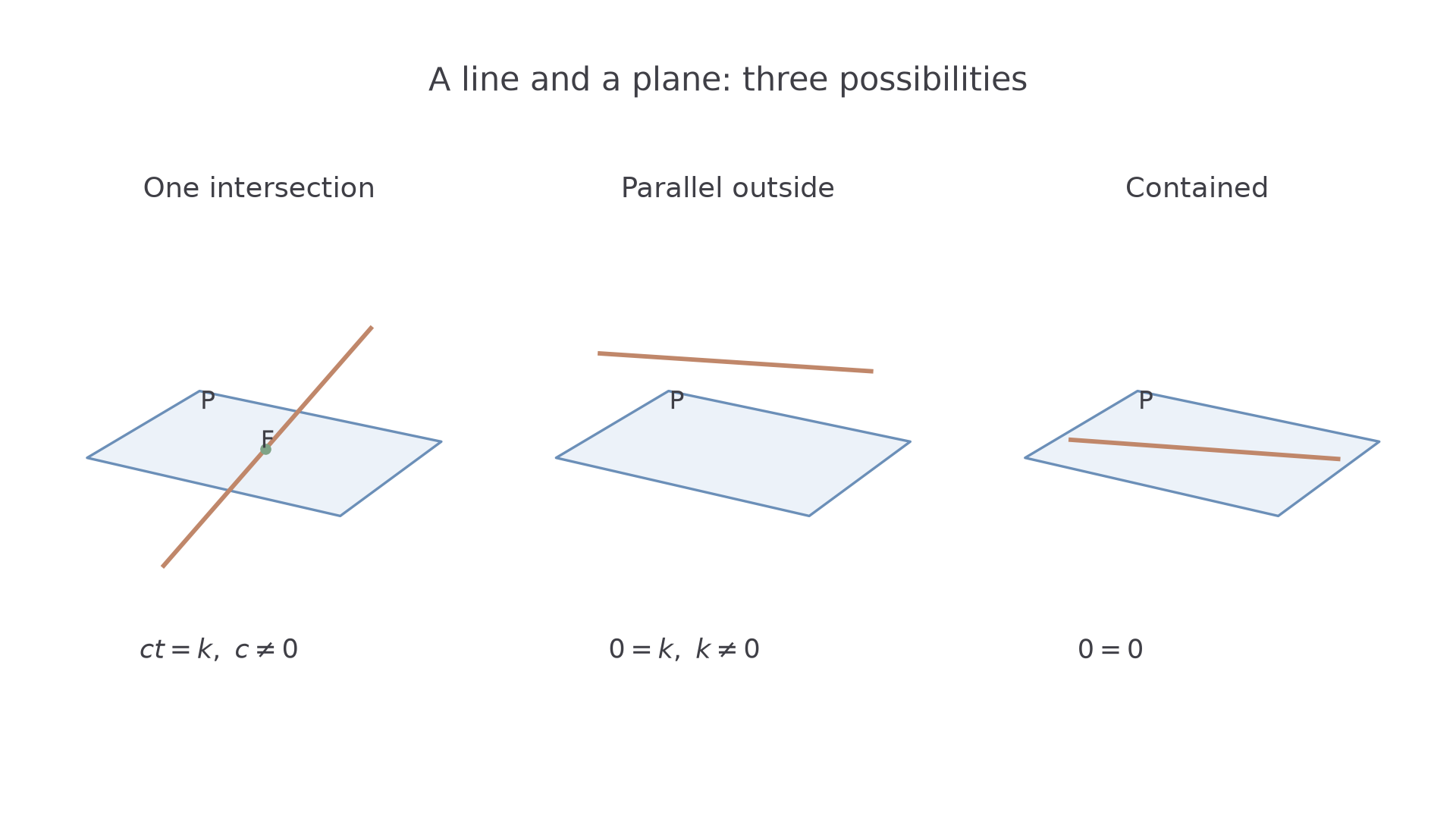
When the parameter disappears, read the remaining statement: a contradiction means no intersection; an identity means every point of the line lies in the plane.
A direction with is parallel to the plane. Its starting point then decides whether the whole line is inside or outside. This is the only exceptional case, so the following three outcomes exhaust the possibilities.
| Substitution result | Geometric relationship |
|---|---|
| , with | One point of intersection |
| , with | Line parallel to and outside the plane |
| Line contained in the plane |
These classification tests are not in the formula booklet: learn them. A line and a plane cannot be skew: a line outside a plane with no intersection has a direction parallel to it. “Skew” describes a pair of lines.
[DIAGRAM: asset_name: Three line-plane relationships; asset_slug: h245_4_04f_relationships; caption: A line meets a plane once, is parallel outside it, or lies wholly in it; description: Three exact three-dimensional panels of the plane z=0. The first line crosses it obliquely once, the second is horizontal above it, and the third lies within it. Each panel labels its relationship and parameter-equation outcome.]
Worked example 3: a contradiction
Question. Determine the relationship between and .
Plan. Substitute the line into the plane and interpret the result.
Why this step? The false equality means no real parameter works; the zero scalar product explains the missing intersection geometrically.
Answer. The line is parallel to and outside the plane.
Check. Its starting point gives 6, rather than 3, in the plane equation; moving along its direction never changes that value.
Worked example 4 changes one feature: the plane constant becomes 6. The same cancellation now produces an identity.
Worked example 4: an identity
Question. Determine the relationship between and .
Plan. Substitute a general line point and check whether any restriction on remains.
Why this step? An identity is not a failed calculation: it says that all points generated by the line satisfy the plane's constraint.
Answer. The whole line lies in ; there are infinitely many intersection points.
Check. At the point satisfies ; the direction has zero product with its normal.
The angle is zero in both examples, but only the second line is contained in the plane.
Watch out
Wrong: “, so no intersection.” Right: test a point as well. A parallel direction allows either no intersection or the entire line.
A parameter in the direction vector can switch the problem between these cases.
The foot of a perpendicular
To find the point directly beneath a point on a plane, intersect the plane with the line through the point in the normal direction.
Foot of a perpendicular
The foot of the perpendicular from to a plane is the point on the plane for which is normal to it. If already lies on the plane, its foot is itself. For any other point on the plane, the right-angled triangle with shows that its distance from is at least .
Thus the normal line finds both the required foot and, if needed, the direction of the shortest displacement. This construction is not in the formula booklet: learn it. The distance formula itself comes in the next lesson.
Worked example 5: a perpendicular from a point
Question. Determine the foot of the perpendicular from to .
Plan. Form the normal line through , then intersect it with .
Why this step? The normal line fixes the perpendicular direction; its intersection fixes where that perpendicular reaches the plane.
Answer. .
Check. , and , so both required conditions hold.
Worked example 6 changes one feature: the point's last coordinate moves to the other side of the plane. The sign of the required normal displacement reverses.
Worked example 6: approaching from the other side
Question. Determine the foot of the perpendicular from to .
Plan. Intersect the normal line from the new point with the same plane.
Why this step? A normal can point either way. Let the equation choose the sign instead of deciding by a sketch which direction to add.
Answer. .
Check. , and .
A negative parameter is perfectly valid in a normal line, just as in any other line.
Watch out
Wrong: finding a normal vector and giving it as the foot's position vector. A normal is a direction. Right: construct the normal line through the given point, then find its intersection with the plane.
The opening laser strikes at . The same substitution test would produce either a contradiction for a parallel beam outside the screen's plane or an identity for a beam lying in it. These three algebraic outcomes tell the whole geometric story.
Quick Recap
- Substitute the line's general coordinates into the plane, then evaluate the line at the resulting parameter.
- A non-zero parameter coefficient gives exactly one intersection.
- If the parameter cancels, a contradiction means parallel outside; an identity means contained.
- For a perpendicular foot, use the plane's normal as the direction of a line through the given point.
The opening laser meets the screen at ; parallel or contained beams are identified by the same substitution method.