4.02g–4.02j - Solving equations with complex roots
Solve real quadratic equations with non-real roots, find both square roots of a complex number algebraically, and use conjugate pairs to factorise real cubics and quartics. You will see why a single given complex root can reveal a whole real quadratic factor, and how to keep the two different kinds of pairing straight.
Quadratic equations with complex roots
How can knowing just one root, , be enough to solve the cubic ? The missing information is hidden in the phrase “real coefficients”. First, look at the simplest place where that phrase forces roots to travel in pairs.
You already know
For real , and , with , the quadratic formula is . Also, , so for real .
Compare and . Completing the square gives in the first case and in the second. The first has roots ; the second has roots . The real graphs show real intercepts only: the second graph has no real intercept, although its equation has complex solutions.
[DIAGRAM: asset_name: Real and complex roots of two parabolas; asset_slug: h245_4_02_quadratic_complex_roots; caption: Completing the square separates the common real part from a real or imaginary displacement; description: Two parabolas y = x squared + 6x + 5 and y = x squared + 6x + 34 share the symmetry line x = -3. The first crosses the real axis at -5 and -1. The second has vertex (-3, 25) and no real intercept. A separate annotation gives its complex roots -3 plus or minus 5i.]
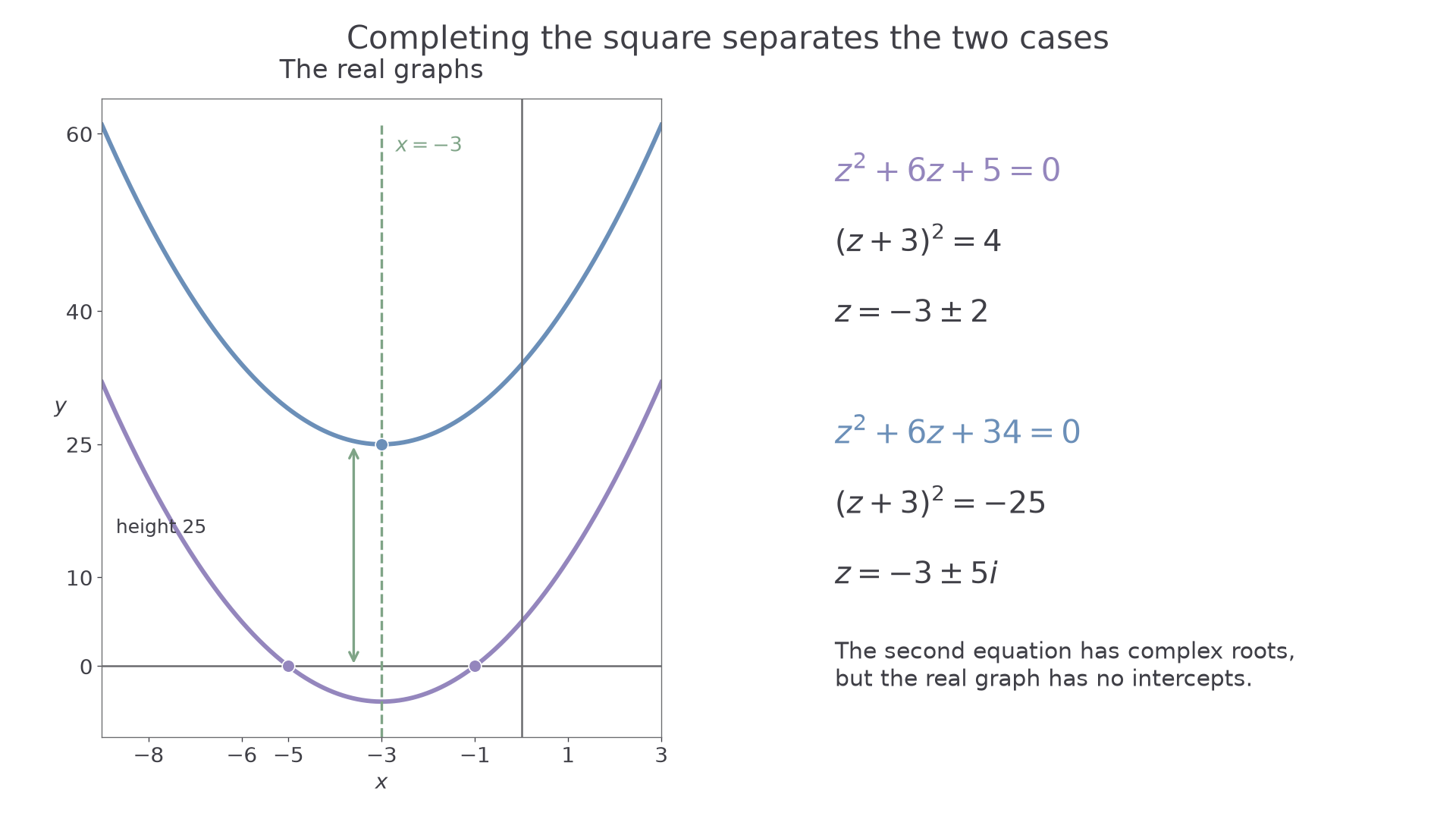
Complex roots of a real quadratic
For real , , , with and :
The roots have the same real part and opposite imaginary parts: they are conjugates.
Not in the formula booklet: learn it.
Apply the familiar method and show the step where the negative square root becomes imaginary.
Worked example 1: completing the square
Question. Solve .
Plan. Complete the square and then solve the resulting square equation.
Why this step? Completing the square isolates the part that needs a square root and makes the common real part visible.
Answer. or .
Check. For , , so . Replacing by checks the second root.
The next example changes the leading coefficient from . The formula now avoids fractions during completing the square, but its final denominator must divide both terms.
Worked example 2: a non-monic quadratic
Question. In this question you must show detailed reasoning. Solve , giving your answers in the form .
Plan. Apply the quadratic formula, simplify the negative discriminant, and divide the whole numerator by .
Why this step? The line supplies the analytical reasoning; the two calculator roots alone do not show it.
Answer. or .
Check. For , , giving .
A repeated root occurs when the discriminant is zero; negative discriminant gives two distinct non-real roots. These are separate cases.
Watch out
Wrong: . The denominator divides the real term as well. Right: .
Give the roots in the requested form and leave irrational values exact when asked.
The two square roots of a complex number
A square root of must itself have real and imaginary parts: . Equating parts turns the problem into two real equations.
Square root of a complex number
A square root of is a complex number satisfying . If , its two square roots are and . For example, , so its roots are and . These two roots are negatives, rather than conjugates.
If , then . There are no further roots: gives , so or . For , these coincide at .
Equations for algebraic square roots
For real , , , , if , then
Also , so . The positive square root is used because .
Not in the formula booklet: learn it.
You can eliminate a variable using , or combine the sum and difference of the squares. Both are algebraic methods.
Worked example 3: solving by sum and difference
Question. Use an algebraic method to determine the two square roots of .
Plan. Equate parts and find , then use to pair the signs.
Thus gives , and gives .
Why this step? The squares give magnitudes but lose signs; forces the real and imaginary parts to have the same sign.
Answer. The two roots are and , or .
Check. , and squaring its negative gives the same result.
Now change only the sign of the imaginary part of the given number. The sizes of and stay the same, but their signs must be opposite. This example uses elimination so you can recognise that route too.
Worked example 4: pairing opposite signs
Question. Use an algebraic method to determine the two square roots of .
Plan. Set , eliminate , and reject a negative value of .
Since is real, is impossible. Thus , and gives or .
Why this step? is the real part of a complex number, so itself is real; introducing imaginary values for would invalidate the comparison of parts.
Answer. and .
Check. .
The sign pairing is the final mathematical step, not a choice of presentation.
Watch out
Wrong: the square roots of are . In fact . Right: write , so both parts change sign together.
OCR's “use an algebraic method” asks for the real equations and their solution. A polar conversion or calculator output cannot replace those steps.
Conjugate roots and real quadratic factors
The two square roots of a number are negatives; non-real roots of a polynomial with real coefficients are conjugate pairs. These are different statements with different conditions.
To see why real coefficients matter, suppose , with , , real. Taking conjugates of a sum or product conjugates each term, while a real coefficient stays unchanged. Thus
If , then . The same reasoning works in every polynomial degree.
Conjugate root theorem
For a polynomial with real coefficients, if is a root, then is a root, where , are real. The corresponding monic real quadratic factor is
Not in the formula booklet: learn it.
A non-example is : is a root but is not. Its constant coefficient is not real. A real root is its own conjugate, so the theorem does not force it to appear twice.
Worked example 5: rebuilding a quadratic
Question. The equation , where , are real, has root . Find and .
Plan. Use the conjugate root and multiply the two monic factors.
Why this step? Pairing conjugates cancels all imaginary coefficients, giving the real factor you need.
Answer. , .
Check. At , .
Change the real part of the given root to a negative number. The factor now contains , so the linear coefficient changes sign.
Worked example 6: a negative real part
Question. Find the monic real quadratic with root .
Plan. Include and expand the conjugate factors.
Why this step? A root gives the factor ; subtracting the negative real part produces .
Answer. .
Check. At , .
A useful consequence is that a real cubic must have a real root. Non-real roots use up two places at a time; three places cannot all be filled that way. This is why the cubic in the opening puzzle leaves a real linear factor after its conjugate pair is removed.
Watch out
Wrong: “Every complex polynomial has conjugate roots.” Right: the coefficients must all be real. Check this condition before writing down the partner root.
Use the factor form to control the signs in your next calculation.
Solving real cubics and quartics
Remove the real quadratic factor supplied by a conjugate pair, then solve the remaining factor. For a cubic the quotient is linear; for a quartic it is quadratic. The factor theorem is the bridge from roots to factors.
You already know
The factor theorem says if and only if is a factor of . Polynomial division or comparison of coefficients then finds the quotient. This result is not in the formula booklet: learn it.
You are given enough information to start. You do not need a general cubic or quartic formula.
Worked example 7: solving the opening cubic
Question. Given that is a root of , determine all the roots.
Plan. Build the quadratic from the conjugate pair and find the remaining linear factor.
Verify the whole factorisation:
Why this step? Matching one coefficient suggests the quotient; checking all coefficients proves that it is the quotient.
Answer. , , or .
Check. ; the other two roots make zero.
The next example changes the polynomial degree to four. The first conjugate pair still supplies a quadratic factor, but the quotient needs solving too.
Worked example 8: a quartic with two conjugate pairs
Question. Given that is a root of , determine all four roots.
Plan. Divide by , then solve the quotient by completing the square.
The remaining coefficients check: and . Therefore
Why this step? A real quadratic factor has real coefficients even when its roots are non-real; solving the quotient can reveal another conjugate pair.
Answer. , , , .
Check. Expanding the two real factors gives every coefficient of ; substituting each conjugate pair makes its own quadratic factor zero.
If a question asks for a product of real factors, stop at real linear or quadratic factors. If it asks for all roots, solve every factor.
Watch out
Wrong: from a given root , using as the factor. Right: . The sign in matters twice.
The opening puzzle is now solved: supplies , their factor is , and the remaining factor is .
Quick Recap
- A negative discriminant gives two conjugate roots of a real quadratic; show the negative-square-root step in detailed reasoning.
- Square roots of a non-zero complex number are negatives of each other. Use and to find and pair their parts.
- A polynomial with real coefficients has non-real roots in conjugate pairs. Their real quadratic factor is .
- Use that factor and the factor theorem to reduce a cubic or quartic, then solve the remaining factor.
The opening cubic has roots , and : one given non-real root really was enough.