8.04a–8.04d - Vector product, areas and lines
Give the vector product a geometric meaning: its length measures area and its direction records orientation. You will use its algebraic properties, calculate areas, interpret a zero product and describe a line by a vector-product equation.
Magnitude and orientation
A triangular panel has corners , and . Slide to , parallel to . Does the panel's area change, and can one vector calculation settle it? We will answer this without finding either triangle's angles.
You already know
The component formula for is in the formula booklet. It gives a vector perpendicular to both inputs. The scalar product tests perpendicularity, and describes a plane through with non-zero normal .
The new information is how long the vector product is, and which of the two perpendicular directions it chooses. Start in the coordinate plane. The vectors and enclose an angle . Their component product is : length , pointing above their plane.
[DIAGRAM: asset_name: The orientation and magnitude of a vector product; asset_slug: h245_8_04_vector_orientation; caption: Reversing the turn reverses the normal, while the magnitude stays 3; description: Two exact three-dimensional coordinate diagrams show a=(3,0,0), b=(sqrt(3),1,0) and a cross b=(0,0,3) on the left, then a=(3,0,0), b=(sqrt(3),-1,0) and a cross b=(0,0,-3) on the right. Blue and lavender arrows are the input vectors, clay arrows are the vector products. Each input angle is pi/6. The first ordered triple is right-handed upwards and the second right-handed downwards.]
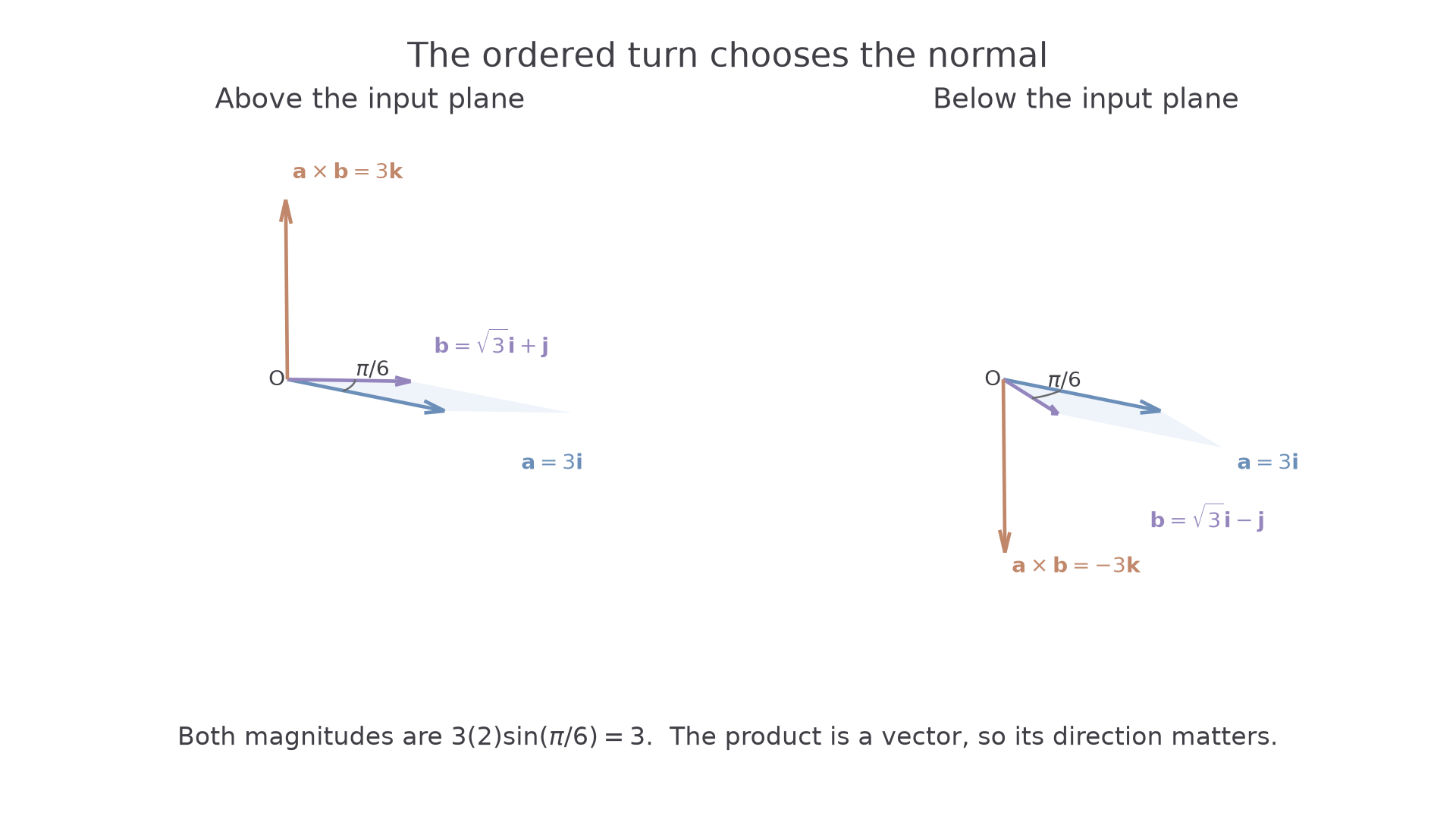
A right-handed triple has the orientation of , in that order. Point the fingers of your right hand along the first vector and curl them towards the second through the smaller angle; your thumb gives the product's direction. This chooses a direction, not an extra sign to attach afterwards.
Geometric vector product
For non-parallel non-zero vectors and , their vector product is perpendicular to both and points in the direction for which , in that order, form a right-handed triple. Its magnitude is , where is the angle between the inputs.
This combines direction and length in one expression. The unit normal has length ; the factor before it supplies the product's length.
Vector product in geometric form
For non-parallel non-zero vectors,
where is the unit normal making a right-handed triple. For parallel inputs, or a zero input, the product is ; no unit normal is selected by this formula.
In the formula booklet.
In particular, , and . These unit-vector identities are not printed separately in the formula booklet: learn them. Reversing either ordered pair reverses the answer.
Worked example 1: magnitude and an upward normal
Question. Find , where and , using its geometric definition.
Plan. Find the input lengths and angle, then choose the normal using the ordered turn from to .
Why this step? Length alone leaves two possible normals. The ordered turn chooses .
Answer. .
Check. The component formula gives ; its scalar product with each input is zero.
Worked example 2 changes one feature: the component of the second vector changes sign. The lengths and the angle between the inputs stay the same, but the orientation reverses.
Worked example 2: the opposite normal
Question. Find , where and , using its geometric definition.
Plan. Keep the magnitude calculation and reconsider the right-handed normal.
Why this step? The angle between vectors is non-negative. The negative sign belongs in the normal's direction, rather than in .
Answer. .
Check. Its magnitude is , and the component calculation gives the same downward vector.
A vector product contains more information than its magnitude.
Watch out
Wrong: . The left side is a vector and the right side is a scalar. Right: either include , or write .
The same sign decision applies in any coordinate plane.
Algebra of vector products
You can expand vector products of sums, provided you keep the order of every pair.
Swapping the inputs reverses their ordered turn, so the normal reverses. In components the same fact appears because every subtraction changes sign. Distribution follows by expanding components: for example, the first component of is
The other two components split in exactly the same way. This is an algebraic identity, independent of any particular drawing.
Anti-commutativity and distribution
For vectors and real scalars ,
The first property is called anti-commutativity. The zero self-product follows from the component formula, or from an angle of zero for a non-zero vector.
Not in the formula booklet: learn it.
Expand as you would brackets, then replace reversed products by negatives. The self-products disappear; they do not become lengths squared.
Worked example 3: expanding two brackets
Question. Given , find .
Plan. Distribute over both brackets, then put every surviving product into the order .
Why this step? is the negative of the known product. Treating it as the same product would change the coefficient from to .
Answer. .
Check. One possible pair is , . The bracket vectors are and ; their component product is .
Worked example 4 changes one feature: in the first bracket becomes . Track that sign before using anti-commutativity.
Worked example 4: a changed bracket sign
Question. Given , find .
Plan. Expand in the stated order, then replace self-products and reversed products.
Why this step? Two minus signs act on the reversed term: one from the first bracket and one from reversing the product.
Answer. .
Check. For the same possible pair, the bracket vectors are and ; their product is .
There is a useful area-preserving consequence: for every real . The added term has zero product with . This consequence is not in the formula booklet: learn how to derive it from distribution.
Watch out
Wrong: . Vector products are anti-commutative. Right: write before collecting coefficients.
A quick expansion can therefore save three long component calculations.
Areas from vector products
The length of a vector product is the area of the parallelogram built on its two input vectors.
If its adjacent sides are and , choose as the base. The perpendicular height is , including when is obtuse. Multiplying base by height gives exactly . A diagonal divides the parallelogram into two equal-area triangles.
Continue this lesson.
You’re previewing NovaLearn without an account. Create a free account to read the rest.
Create free account