6.05a–6.05c - Uniform circular motion
A particle can keep the same speed while accelerating all the time. Learn how angular velocity describes its turning, why its acceleration points towards the centre, and how real forces produce horizontal circles. You will model a conical pendulum, a banked track and a particle supported by a horizontal surface.
Angular velocity and speed
Two particles pass the same point on a horizontal circle at the same speed, one clockwise and one anticlockwise: do they have the same velocity? No. Their tangent directions at that point are opposite. Speed measures how fast distance is covered; velocity also has a direction, which keeps changing around a circle.
Here is the question that will guide this lesson: how can a particle accelerate without getting faster? First separate the rate of turning from the rate of covering distance.
You already know
For an angle in radians, arc length is . Velocity is the rate of change of displacement, acceleration is the rate of change of velocity, and resultant force is mass times acceleration.
Take a point from a wheel's fixed axis. A quarter-turn covers angle but distance . A point twice as far from the axis turns through the same angle and travels twice as far. All points on a rigid rotating wheel share an angular velocity; they do not share a speed.
Angular velocity
The angular velocity of a point moving about a fixed centre is , the rate of change of its angular position. Its unit is . Choose a positive sense of rotation: motion in the opposite sense has negative angular velocity. Angular speed is .
The velocity vector is tangent to the circular path, in the direction of travel. It is not directed along the radius. For uniform circular motion, the speed and angular velocity are constant, but the velocity vector is not constant.
Turning rate, speed and period
For fixed radius , differentiating gives tangential velocity
In the formula booklet, written as .
Speed is . If the positive sense is the direction of motion, write . One full revolution covers radians, so for non-zero uniform rotation the period and frequency . The period and frequency relationships are not in the formula booklet: learn them. We use for period here so that can denote tension later.
Worked example 1: revolutions per minute
Question. A point moves uniformly on a circle of radius , making anticlockwise revolutions per minute. Taking anticlockwise as positive, find its angular velocity, speed and period.
Plan. Convert revolutions per minute to radians per second before using the radius.
Why convert first? The relation between arc length and angle uses radians, so a rate in revolutions per minute cannot be substituted unchanged.
Answer. , , and .
Check. , the circle's circumference.
Change only the sense of rotation. The distance travelled per second stays the same, but the signed angular velocity reverses.
Worked example 2: clockwise rotation
Question. The same point now makes clockwise revolutions per minute. Taking anticlockwise as positive, find its angular velocity, speed and period.
Plan. Attach the direction sign to angular velocity, then use its magnitude for speed and period.
Why use a modulus? A speed or a period cannot become negative when a wheel reverses its rotation.
Answer. , , and .
Check. Reversing the motion changes the tangent direction everywhere but leaves the time for one revolution unchanged.
The sign records a direction, rather than a different amount of turning.
Watch out
Wrong: revolutions per minute means . Right: . Also distinguish angular velocity from the linear velocity tangent to the circle.
Use a different turning rate with the same direction convention.
Acceleration towards the centre
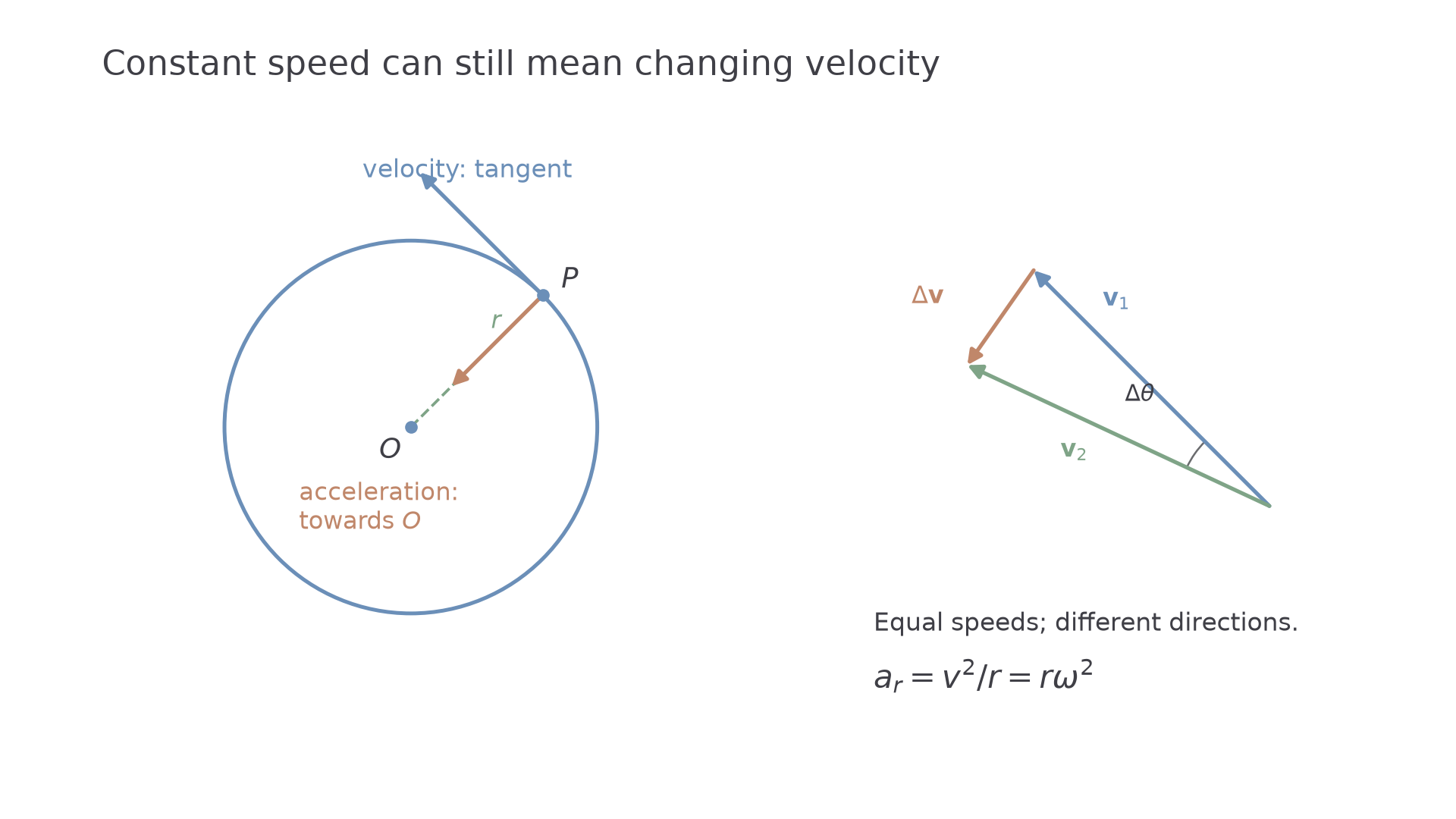
Even at constant speed, a particle's velocity changes because its direction changes. Its acceleration points towards the centre, perpendicular to its instantaneous velocity.
You can see the direction and magnitude without imagining an extra force. At two nearby positions separated by angle , the two equal-length velocity vectors also differ in direction by . The triangle formed by the velocity vectors has change of velocity of magnitude . Hence
The change-of-velocity direction tends to the inward radius. This also follows by differentiating twice: . The minus sign means towards the centre. Both derivations assume a fixed centre and fixed radius, with constant angular velocity.
[DIAGRAM: asset_name: Velocity and acceleration in uniform circular motion; asset_slug: h245_6_05_inward_acceleration; caption: Velocity is tangent to the circle and acceleration points towards its centre; description: A blue circle with centre O and a point P in its upper right quadrant. A blue velocity arrow starts at P and runs anticlockwise along the tangent. A clay acceleration arrow starts at P and points towards O. A sage radius joins O to P. A separate velocity-vector triangle shows two equal-length vectors separated by a small angle delta theta and the arrow delta v joining their tips. Text states a = v squared over r = r omega squared, directed towards O]
Radial acceleration
For uniform motion of speed on a circle of radius , the acceleration has magnitude
and is directed towards the centre.
In the formula booklet.
The equivalent form follows from ; it is not printed separately in the formula booklet. “Centripetal” means centre-seeking: centripetal force is the inward resultant of the actual forces, not another force to add to a force diagram. If tension alone acts horizontally, it supplies that resultant.
Worked example 3: tension supplies the acceleration
Question. A particle moves at on a smooth horizontal table. A light inextensible string of length joins it to a fixed point on the table. Find its acceleration and the tension.
Plan. Find the inward acceleration, then apply Newton's second law towards the fixed point.
Why use only tension horizontally? Weight and the table's normal reaction balance vertically, so neither has a component along the horizontal radius.
Answer. Acceleration towards the fixed point; tension .
Check. , so .
Change only the speed, doubling it. Turning the velocity twice as fast while its length is also doubled makes the required acceleration four times as large.
Worked example 4: doubling the speed
Question. The same particle and string now describe the same circle at . Find the acceleration and tension.
Plan. Substitute the new speed into the squared-speed relationship.
Why square before comparing? The acceleration depends on , so doubling multiplies it by , not .
Answer. Acceleration towards the fixed point; tension .
Check. , matching the factor between the two values of .
For a particle moving uniformly on a rough horizontal plane without a string, friction can instead provide the inward force. Vertical balance gives ; the condition then gives . This limiting-speed result is derived from Newton's second law and the friction law; it is not in the formula booklet. Friction need not equal below the limit.
Watch out
Wrong: put both a tension and an additional inward force on the diagram. Right: draw the actual forces and set their inward resultant equal to . The right-hand side describes the acceleration those forces produce.
Changing speed changes the required force even though the mass and path stay fixed.
Conical pendulums
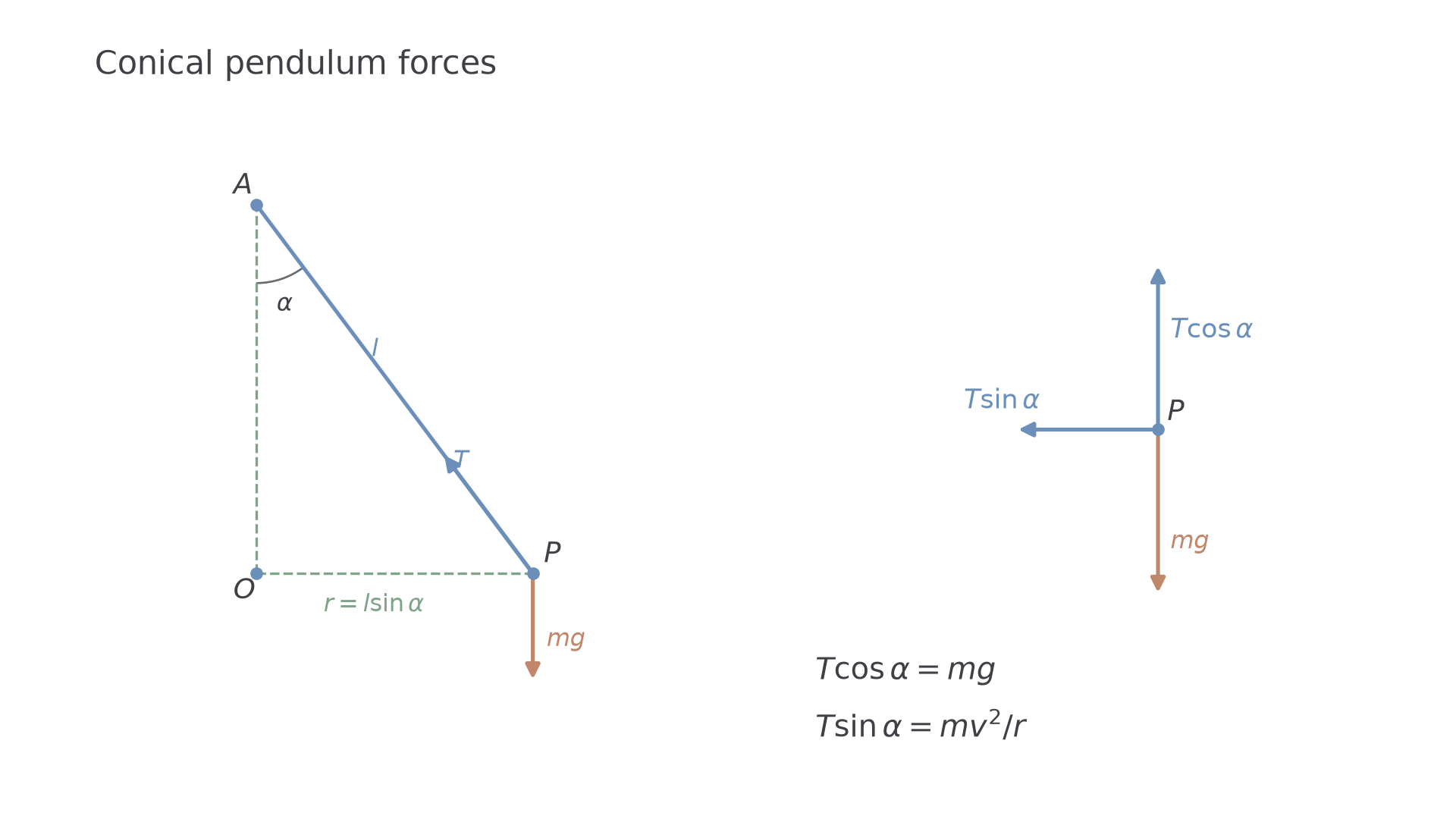
A conical pendulum moves in a horizontal circle while its supporting string sweeps out a cone. Its vertical coordinate is constant, so vertical forces balance; its horizontal acceleration is towards the circle's centre.
Let the string length be , its angle to the downward vertical be , and the tension be . The horizontal circle has radius , not . There are only two forces on the particle: tension along the string towards its support, and weight vertically downwards.
[DIAGRAM: asset_name: Conical pendulum geometry and forces; asset_slug: h245_6_05_conical_pendulum; caption: Vertical balance and horizontal acceleration use different components of the same tension; description: Side elevation of a conical pendulum with fixed support A above O, particle P to the right of O, AP of length l inclined at angle alpha to the downward vertical AO, and horizontal OP labelled r = l sin alpha. A tension arrow starts at P towards A and a weight arrow starts at P vertically down. A separate component panel shows T cos alpha upwards and T sin alpha horizontally towards O, with T cos alpha = mg and T sin alpha = mv squared over r]
Conical pendulum equations
For steady horizontal motion with :
These give and .
Not in the formula booklet: learn it.
The component equations are safer to rebuild than to recall a special formula. Divide the horizontal equation by the vertical one to eliminate both and . Notice the surprising consequence: mass affects the tension but not the speed required for a given cone.
Worked example 5: the correct circle radius
Question. A particle on a light inextensible string of length moves as a conical pendulum. The string makes with the downward vertical. Find the tension and speed.
Plan. Resolve vertically for tension and horizontally for speed, using the horizontal radius.
Why not use as the radius? The particle moves about , directly below the support, rather than around the support in a plane through the string.
Answer. and , to 3 significant figures.
Check. , and .
Change only the angle to the vertical. The radius and the tension must both be recalculated.
Worked example 6: a narrower cone
Question. The same particle and string now move with the string at to the downward vertical. Find the tension and speed.
Plan. Use the same two force directions with the new geometry.
Why redraw the angle? Using the old radius with the new force components would combine two different cones.
Answer. and , to 3 significant figures.
Check. The smaller cone needs less horizontal force and a smaller tension; .
At , tension has no vertical component to balance weight, so a freely suspended conical pendulum cannot maintain a horizontal circle. This is a failure of vertical balance, not a claim that the tension itself is zero.
Watch out
Wrong: . Right: , so . Resolve the force that actually acts, rather than multiplying the weight by whichever trigonometric ratio looks familiar.
Keep the same string and particle, and change the cone once more.
Continue this lesson.
You’re previewing NovaLearn without an account. Create a free account to read the rest.
Create free account