7.01a–7.01c - Problem types, sets and pigeonholes
Learn to distinguish four kinds of mathematical problem, describe sets and partitions precisely, and prove that a repetition must occur without finding it. The pigeonhole principle turns a count of objects and categories into a guarantee, even when you know nothing about how the objects were chosen.
Four types of problem
If you choose any different integers from to , must two of your choices add to ? Try choosing awkwardly: all the small numbers, all the odd numbers, or numbers scattered across the interval. A systematic argument will settle every possible choice at once.
Before solving a problem, identify what its answer must look like. “Can it be done?” and “How many ways?” may describe the same setting but demand different answers.
Types of problem
An existence problem asks whether an object or solution satisfying stated conditions exists. A construction problem asks you to produce one. An enumeration problem asks how many there are. An optimisation problem asks for a best solution according to a stated quantity, such as least cost or greatest size.
For a seating problem, these questions are different.
| Question | Type | What answers it? |
|---|---|---|
| Can the guests be seated with no incompatible pair together? | Existence | a justified yes or no |
| Give a seating plan with no incompatible pair together. | Construction | a valid plan |
| How many such seating plans are possible? | Enumeration | a count |
| Find a valid plan using the fewest tables. | Optimisation | a plan and a justification of its minimum |
A problem can belong to more than one category. “Find a shortest route” asks you both to construct a route and to optimise its length. A valid construction proves existence, but it does not count all solutions or prove that yours is best. Conversely, proving existence need not tell you where the solution is: that is precisely what our opening puzzle will illustrate.
Watch out
“Is there a way to do it?” is an existence question, even if you could answer yes by constructing an example. Classify the demand actually made, rather than a method you might use to answer it.
The distinction changes the last line of your answer: a count cannot replace a requested construction, and one successful example cannot establish an optimum.
Describing sets and their elements
A set records which objects are present, without giving those objects an order or counting an object twice.
You already know
A positive integer is one of . A multiple of has the form for an integer . A prime has exactly two positive factors; is not prime.
Thus is the same set as . Repeating in a written list does not create a new element. The braces matter: is a number, whereas is a set containing that number.
Set notation
The notation means that is an element of , and means that it is not. The empty set has no elements. The number of elements of a finite set is . Write when every element of belongs to ; a proper subset also differs from , written here.
Choose a universal set containing every object under discussion. Then the following operations describe new sets.
| Notation | Meaning |
|---|---|
| elements in or , including elements in both | |
| elements in both and | |
| elements of not in | |
| elements in but not in | |
| elements of satisfying the stated condition |
Two sets are disjoint when their intersection is empty. Notice that is a subset of every set: there is no element in it that could fail the subset condition. However, and differ: their sizes are and .
[DIAGRAM: asset_name: Set operations in a finite universal set; asset_slug: h245_7_01_sets; caption: Each integer from 1 to 12 occupies exactly one region, determined by membership of the even numbers A and the multiples of 3 B; description: A rectangular universal set contains two overlapping circles labelled A even numbers and B multiples of 3. The A-only region contains 2, 4, 8, 10; the overlap contains 6, 12; the B-only region contains 3, 9; the region outside both contains 1, 5, 7, 11. A lower key describes union as all three circle regions, intersection as the overlap, and complement of A as everything outside A]
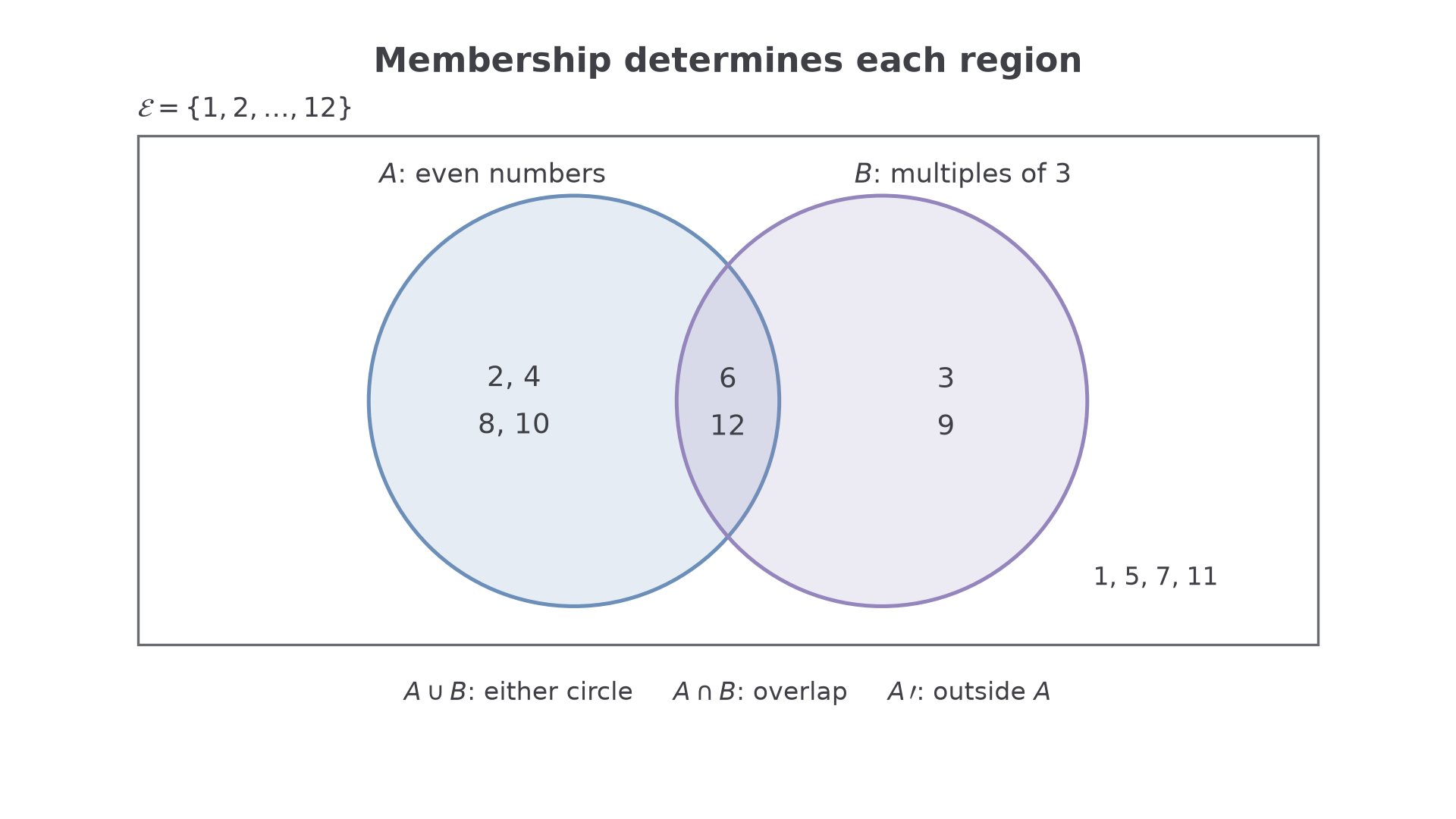
Work with actual elements before trying to count regions. This avoids counting an element twice just because it satisfies two descriptions.
Worked example 1: listing set operations
Question. Let , let be its even numbers and let be its multiples of . Find , and .
Plan. List the elements of each set, then apply “both”, “either” and “not in ” respectively.
Why this step? The word “or” in a union includes elements satisfying both conditions, so and remain in the union.
Answer. The three sets are , and .
Check. The last set contains exactly the odd multiples of in the universal set.
The next example changes only the universal set. This matters because complements depend on the universe, even when the named sets do not change.
Worked example 2: a different universal set
Question. Let and , but now let . Find and its size.
Plan. Remove all elements belonging to either named set from the new universal set.
Why this step? is even, but was explicitly listed and does not contain ; do not silently redefine it when the universe changes.
Answer. , of size .
Check. The union has elements and its complement has , accounting for all elements without overlap.
Sets of elements and individual elements require different notation.
Watch out
For , write and . The statement is false: the elements of are numbers, and none is the set .
For a complement, state or read the universal set before listing anything.
Partitions of a set
A partition divides a set into groups so that every element belongs to exactly one group.
For , the groups and form a partition. The groups and do not, because is used twice. The one-block collection is a partition; so is the collection of three singleton groups.
Partition
A partition of a set is a collection of non-empty, pairwise disjoint subsets whose union is the whole set. The subsets are called its blocks. The blocks have no order: and describe the same partition.
This last point makes counting partitions different from placing people into named teams. A red team and a blue team are labelled; the two blocks of a partition are not. For small sets, organise an exhaustive list by block sizes rather than inventing a formula. No general formula for counting partitions is in the formula booklet.
[DIAGRAM: asset_name: All partitions of a three-element set; asset_slug: h245_7_01_partitions; caption: The five partitions of a three-element set are organised by their block sizes, and reversing the order of the blocks creates no new partition; description: Three horizontal panels show the one partition with a block of size 3, the three partitions with block sizes 2 and 1, and the one partition with three singleton blocks. Elements a, b, c appear once in every displayed partition, enclosed together in pale rounded rectangles exactly when they belong to the same block]
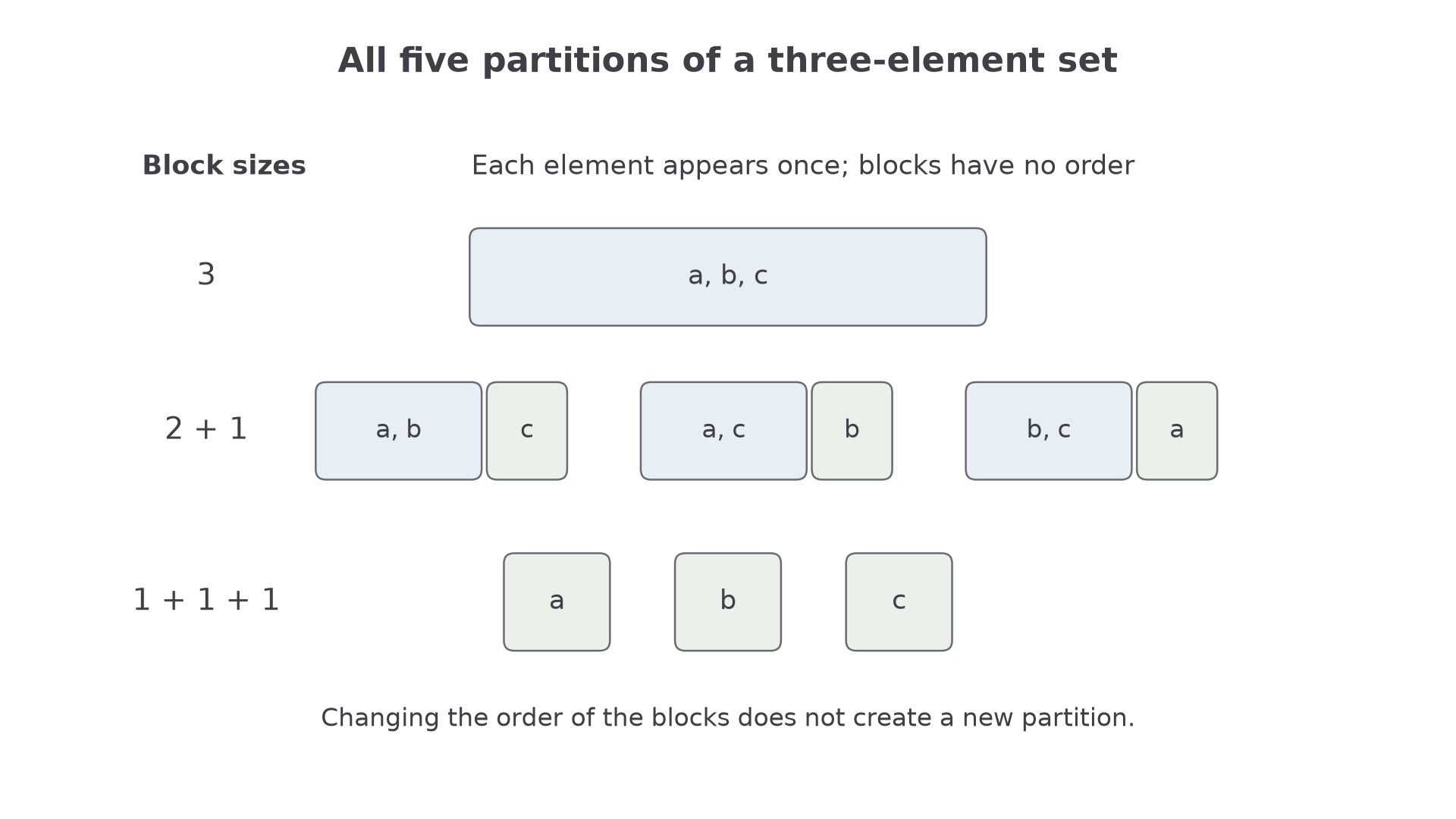
The picture gives a useful surprising count: a set of only three elements already has five partitions. Each element is used once in every row, but the group boundaries change.
Worked example 3: a fixed number of blocks
Question. List all partitions of into exactly two blocks, and state their number.
Plan. Use the only possible block-size patterns: and .
Why this step? Sorting by block sizes makes the list exhaustive. For the unequal sizes, choose the singleton; for equal sizes, list the block containing first to avoid reversing a previously counted pair.
Answer. There are partitions into two blocks, listed above.
Check. Each listed block is non-empty, the blocks within a partition do not overlap, and every partition uses exactly once.
The next example adds only the restriction that the two blocks must have equal size. Their order still creates no extra partitions.
Worked example 4: equal-sized blocks
Question. List the partitions of into two blocks, each of size .
Plan. Fix the block containing , and list its possible partners.
Why this step? Every valid partition has exactly one block containing . Choosing that block identifies each partition once, without naming a first and second block.
Answer. There are such partitions.
Check. There are two-element subsets, but each partition uses two of them; listing a chosen block and its complement would count each partition twice.
A constraint about two named elements can be applied directly to this list.
Watch out
Wrong: the partition becomes a second partition when written as . Right: it is the same collection of blocks. Count a rearrangement only when the groups have distinct labels.
When blocks have different sizes, their sizes can distinguish them; when sizes coincide, fixing one named element is often the cleanest way to avoid duplicates.
Continue this lesson.
You’re previewing NovaLearn without an account. Create a free account to read the rest.
Create free account