4.04d - Angles with planes
Measure the angle between two planes and between a line and a plane using their normals. You will distinguish the angle to a surface from the angle to its normal, choose the required acute angle and recognise parallel and perpendicular cases.
The surface or its normal?
A cable rises 4 metres while travelling 3 metres horizontally across a flat roof. Is its angle to the roof or ? Both are angles in the same right-angled triangle, but they measure different things.
You already know
For non-zero vectors, . A plane has normal . Use a vector product if the plane is given by two spanning directions.
In the cable's vertical cross-section, its direction is , of length 5. The roof's upward normal is . Their scalar product is 4, so the cable makes angle with the normal. The required roof angle is . Equivalently, its sine is .
The distinction changes when both objects are planes. Take a cross-section perpendicular to their line of intersection. Each normal is perpendicular to its own plane trace, so rotating both traces through a right angle preserves the angle between them. The smaller angle between the normals is already the smaller angle between the planes. It needs no complementary-angle correction.
[DIAGRAM: asset_name: Plane angles and normal angles; asset_slug: h245_4_04d_angle_distinction; caption: Two planes use the angle between normals, while a line and a plane use its complement; description: Two exact cross-section panels. Left shows two intersecting plane traces at 35 degrees, with their two normals also at 35 degrees. Right shows a line with direction proportional to (3,4), a horizontal plane trace, its vertical normal, and complementary angles alpha to the plane and beta to the normal.]
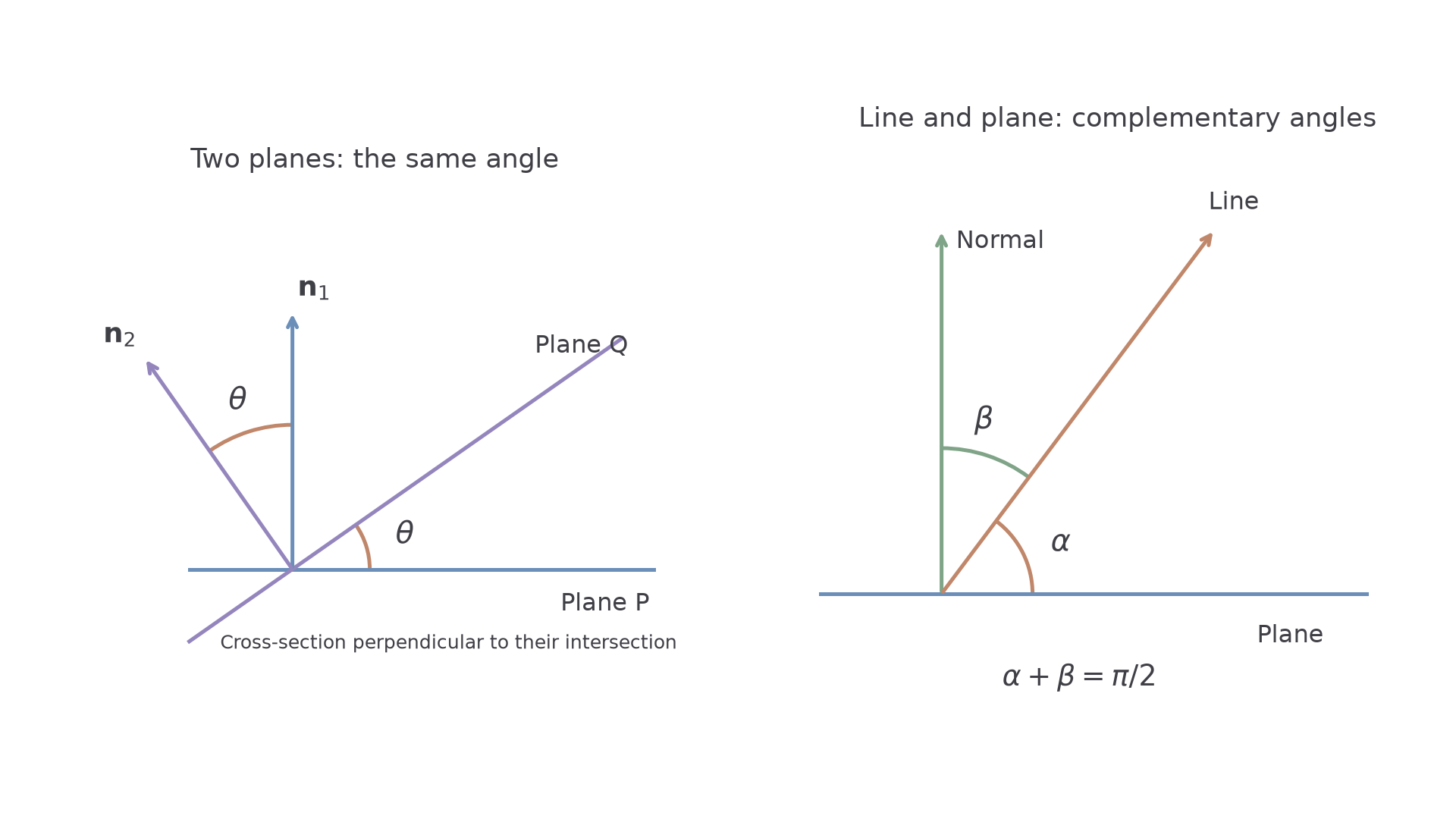
Angle to a plane
The angle between a line and a plane is the smaller angle between the line and its perpendicular projection onto the plane, lying in . A parallel direction gives angle 0; a line normal to the plane gives , where its projection reduces to a point. The smaller angle between two planes is the smaller angle between their normal directions, also in .
One useful surprise follows: moving either plane without rotating it leaves the angle unchanged. The constants in their equations affect position, but none of the angle calculations. Coincident planes and distinct parallel planes both have angle 0.
Key idea
Plane to plane: use the normals' smaller angle. Line to plane: use the complement of the direction-to-normal angle.
Keep that distinction in view when deciding whether a final angle needs adjusting.
Angles between two planes
Read or construct both normals, then take their smaller angle. The modulus in the numerator handles either choice of normal direction.
Smaller angle between planes
For planes with non-zero normals , their smaller angle satisfies
Not in the formula booklet: learn it.
Without the modulus, opposite choices of a normal can produce supplementary answers for exactly the same planes. Perpendicular normals give perpendicular planes. Proportional normals give parallel or coincident planes. These are boundary cases of the same calculation, not separate angle rules.
Worked example 1: cartesian equations
Question. Find the acute angle between and , in radians to 3 significant figures.
Plan. Use the coefficient normals in the scalar-product angle formula.
Why this step? The normals have the same angular separation as the planes; taking a complement would answer a different question.
Answer. radians.
Check. Both planes have non-parallel, non-perpendicular normals, so the angle must lie strictly between 0 and .
Worked example 2 changes one feature: the second plane is given in two-direction form. Its normal must be constructed before the angle calculation.
Worked example 2: a normal is hidden
Question. Find the acute angle between and
Plan. Take the vector product of 's spanning directions, then compare with 's normal.
Why this step? Neither spanning direction is a normal. Using one of them directly would measure the angle between a line in and 's normal.
Answer. radians.
Check. and , so the constructed normal is valid.
The same orientation produces the same angle even though the starting point and equation format have changed.
Watch out
Wrong: subtracting the normals' acute angle from to get the plane-plane angle. Right: use the normals' acute angle itself. The complement is needed for a line and a plane.
For an obtuse angle explicitly requested between intersecting planes, give , where is their acute angle. Read that request before choosing the final angle.
Angles between a line and a plane
The component of a line's direction along the plane's normal measures how steeply the line rises out of the plane.
If is the smaller direction-to-normal angle and , then . You can therefore use the scalar product directly with sine. This also avoids rounding an intermediate angle before subtracting it.
Angle between a line and a plane
For a line with non-zero direction and a plane with non-zero normal ,
Not in the formula booklet: learn it.
A zero scalar product gives a direction parallel to the plane and . This includes a line contained in the plane. A direction proportional to the normal gives . The formula measures orientation, so it cannot distinguish a parallel line outside the plane from a line contained in it.
Worked example 3: an oblique line
Question. Find the angle between and , in radians to 3 significant figures.
Plan. Use the line's direction and the plane's normal in the sine formula.
Why this step? A cosine calculation would find the angle to the normal. Sine gives the required angle to the surface directly.
Answer. radians.
Check. The normal angle is ; adding it to the unrounded plane angle gives .
Worked example 4 changes one feature: the line's direction becomes proportional to the normal. The endpoint of the angle range now gives a useful exact answer.
Worked example 4: a perpendicular line
Question. Find the angle between and .
Plan. Check whether the direction is a multiple of the normal, then confirm with the formula.
Why this step? A line parallel to the normal is perpendicular to the plane, so its angle to the plane is the largest possible value.
Answer. radians.
Check. The direction-to-normal angle is zero; its complement is .
For the other boundary, a direction such as has product with this normal, so its angle to the plane is zero.
Watch out
Wrong: using with the line's starting point . Right: use the direction . Moving the starting point without rotating the line must not change its inclination.
The opening cable has , hence radians. Its angle to the vertical normal is radians. A single triangle explains both answers and tells you which one the roof question needs.
Quick Recap
- Read plane normals from cartesian coefficients, or construct them from two spanning directions.
- Two planes use the cosine of the smaller angle between their normals.
- A line and a plane use the sine of the angle, with the line direction and plane normal.
- Parallel directions give a line-plane angle of 0; a normal line gives .
The cable's roof angle is radians; measures its angle to the roof's normal.