4.09a - Using polar coordinates
Describe a point by its distance and direction from a fixed point. You will convert points and curve equations between polar and cartesian coordinates, keeping the angle range and the convention that distance is never negative.
Distance and direction
Why does the equation describe a circle through the origin, rather than a wave? The cosine gives the distance along a rotating ray, not the height above a horizontal axis. By the end of the lesson you will be able to uncover that circle algebraically.
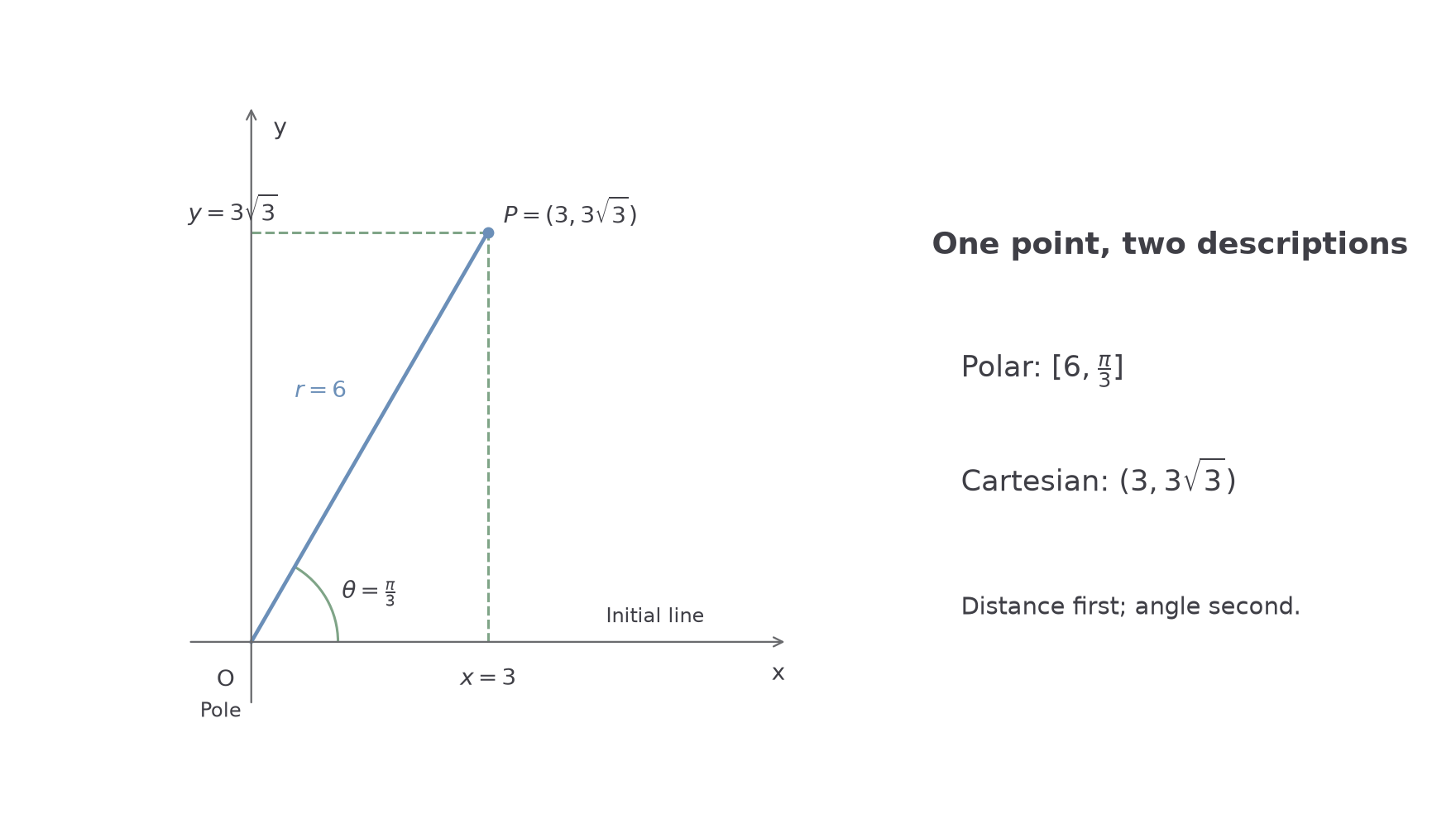
Start with a point reached by turning through anticlockwise from a fixed horizontal ray, then travelling 6 units. This description fixes a point just as precisely as giving its horizontal and vertical coordinates.
[DIAGRAM: asset_name: Distance and direction of a point; asset_slug: h245_polar_point; caption: A point can be located by a distance r and an angle theta, or by its horizontal and vertical coordinates; description: Equal-scale cartesian axes with positive x-axis labelled initial line and origin labelled pole O. A blue ray reaches P at cartesian coordinates (3, 3 root 3), with r = 6 marked alongside. A sage angle arc is labelled theta = pi over 3. Dashed projections label x = 3 and y = 3 root 3. A right panel states polar coordinates [6, pi over 3] and cartesian coordinates (3, 3 root 3)]
You already know
A full turn is radians. Sine and cosine give the vertical and horizontal coordinates of a point on the unit circle, including their signs in every quadrant.
Polar coordinates use the same angles but allow the distance from the centre to vary.
Polar coordinates
The pole is a fixed point , and the initial line is a fixed ray from . The polar coordinates locate a point a distance from , at angle from the initial line. Anticlockwise angles are positive; clockwise angles are negative. We use . For example, is 3 units along the ray opposite the initial line. A pair with is not allowed under this convention.
Unless told otherwise, take the pole as the cartesian origin and the initial line as the positive -axis. Write the radius first: , not .
A point does not have a unique polar description until an angle interval is chosen. The pairs and locate the same point, because their angles differ by a full turn. Typical intervals are or . Follow the interval in the question. A negative angle means a clockwise turn; after turning far enough, you can finish above or below the initial line. At the pole, and every angle locates the same point; there is no unique direction from to itself.
Key idea
The radius is a distance, so . Angles may be negative or exceed one full turn, but equivalent angles differ by an integer multiple of .
A negative cartesian coordinate and a negative polar radius mean different things: a point to the left of still has a positive distance from .
From polar to cartesian coordinates
Project the radius onto the horizontal and vertical axes to turn distance and direction into and .
For , the horizontal projection is , and the vertical projection is . The same projection rule works in every quadrant: sine and cosine supply the signs.
Polar to cartesian conversion
When the pole is the origin and the initial line is the positive -axis,
where .
Not in the formula booklet: learn it.
Calculate the two coordinates separately; this keeps their signs visible.
Worked example 1: a point in the first quadrant
Question. Find the exact cartesian coordinates of .
Plan. Substitute the radius and angle into the horizontal and vertical projection formulae.
Why this step? The radius is the hypotenuse, so multiplying by cosine and sine gives its two components.
Answer.
Check. , and both coordinates are positive, as the angle requires.
Worked example 2 changes only the quadrant, keeping the same radius and reference angle. The horizontal coordinate changes sign because cosine is negative in the second quadrant.
Worked example 2: a point in the second quadrant
Question. Find the exact cartesian coordinates of .
Plan. Use the same projection formulae, with the exact sine and cosine of the given angle.
Why this step? A positive radius does not make both coordinates positive; the angle determines their signs.
Answer.
Check. ; the point is left of and above the pole.
Keeping the angle intact avoids a common sign error.
Watch out
Wrong: . That uses the reference angle without its quadrant. Right: , so .
The next check keeps the second-quadrant angle and changes the radius.
From cartesian to polar coordinates
Find the distance first, then use the quadrant to select an angle in the requested interval.
Pythagoras gives the distance. Dividing the two projection formulae gives when . But tangent repeats after , so a calculator's inverse tangent alone cannot distinguish opposite quadrants.
Cartesian to polar conversion
For a point ,
For a non-zero point with ,
Choose using the quadrant and the required angle interval. If , read the direction from the vertical axis instead.
Not in the formula booklet: learn it.
On the positive -axis use ; on the negative -axis use or , depending on the interval. At , give and recognise that the angle is arbitrary.
Worked example 3: choosing the second quadrant
Question. Find polar coordinates for , with .
Plan. Use Pythagoras for the radius and a reference angle for the direction, then choose the second quadrant.
Why this step? The signs place the point in the second quadrant, so the angle must be between and .
Answer.
Check. and .
Worked example 4 changes only the sign of . The distance and reference angle are unchanged, but the point now lies in the third quadrant.
Continue this lesson.
You’re previewing NovaLearn without an account. Create a free account to read the rest.
Create free account